

Genes, ethics and society
View Sequence overviewStudents will:
- become aware of a range of ethical and social issues associated with genetic testing.
- use their understanding of bioethical principles to make and justify a bioethical decision about genetic testing.
- examine the features of good science communication.
Students will represent their understanding as they:
- role-play a genetics counsellor.
- prepare a poster, brochure or video of background information a genetic counsellor needs to provide to patients.
- share and listen to the views of their peers regarding genetic testing for an ethical dilemma related to cystic fibrosis.
In this lesson, assessment is summative.
Students working at the achievement standard should:
- analyse the key factors that influence interactions between science and society.
- explain how advances in gene sequencing has increased the range of genetic tests for diseases and predispositions that is available to individuals.
- explain the processes that underpin heredity and genetic diversity and describe the evidence.
- select and construct effective representations to organise, process and summarise data and information.
- select and use content, language and text features effectively to achieve their purpose when communicating their ideas, findings and arguments to diverse audiences.
Refer to the Australian Curriculum content links on the Our design decisions tab for further information.
Whole class
Genes, ethics and society Slides
Video: “Difference” vs. “disease”: A question of eugenics? (11:12)
TEACHER NOTE: Ensure that you watch this video prior to the lesson so that you can determine whether it is appropriate for your class. It explores ethical issues regarding prenatal screenings, terminations for medical reasons, and eugenics. See the professional learning Preparing for genetics screening discussion below for more information.
Each group
Genetics counsellor Resource sheet
Bad brochure Resource sheet
Each student
Optional: Cystic fibrosis dilemma Resource sheet
Student notebook
Lesson
The Act phase empowers students to use the Core concepts and key ideas of science they have learned during the Inquire phase. It encourages students to develop a sense of responsibility as members of society—to act rather than be acted upon. It provides students with the opportunity to positively influence their own life and that of the world around them. For this to occur, students need to build foundational skills in an interactive mutually supportive environment with their community.
When designing the Act phase, consider ways that students could use their scientific knowledge and skills. Consider their interests and lifestyles that may intersect with the core concepts and key ideas. What context or problem would provide students with a way to use science to synthesise a design? How (and to whom) will students communicate their understanding?
Read more about using the LIA FrameworkScience education consists of a series of key ideas and core concepts that can explain objects, events and phenomena and link them to the experiences encountered by students in their lives. The purpose of the Anchor routine is to identify and link students’ learning to these ideas and concepts in a way that builds and deepens their understanding.
When designing the Act phase of a teaching sequence, consider the core concepts and key ideas that are relevant. The Anchor routine provides an opportunity to collate and revise the key knowledge and skills students have learned, in a way that emphasises the importance of science as a human endeavour.
Bringing it together
At the start of the lesson, establish ground rules for discussing complicated real-world issues. Read the embedded professional learning Preparing for genetics screening discussion below for more information.
- No one has to share personal experiences or beliefs.
- Discuss ideas and evidence, rather than judging individuals or families.
- Use respectful, non-stigmatising language when discussing disability and genetic conditions.
- Recognise that people can hold different ethical, cultural or religious views.
- Avoid asking classmates questions such as “Would you have an abortion/termination?” because this can become unnecessarily personal.
- It is acceptable to say “I don’t know what I think about that.”
(Slide 72) Revise the relationship between DNA, genes, alleles, and chromosomes.
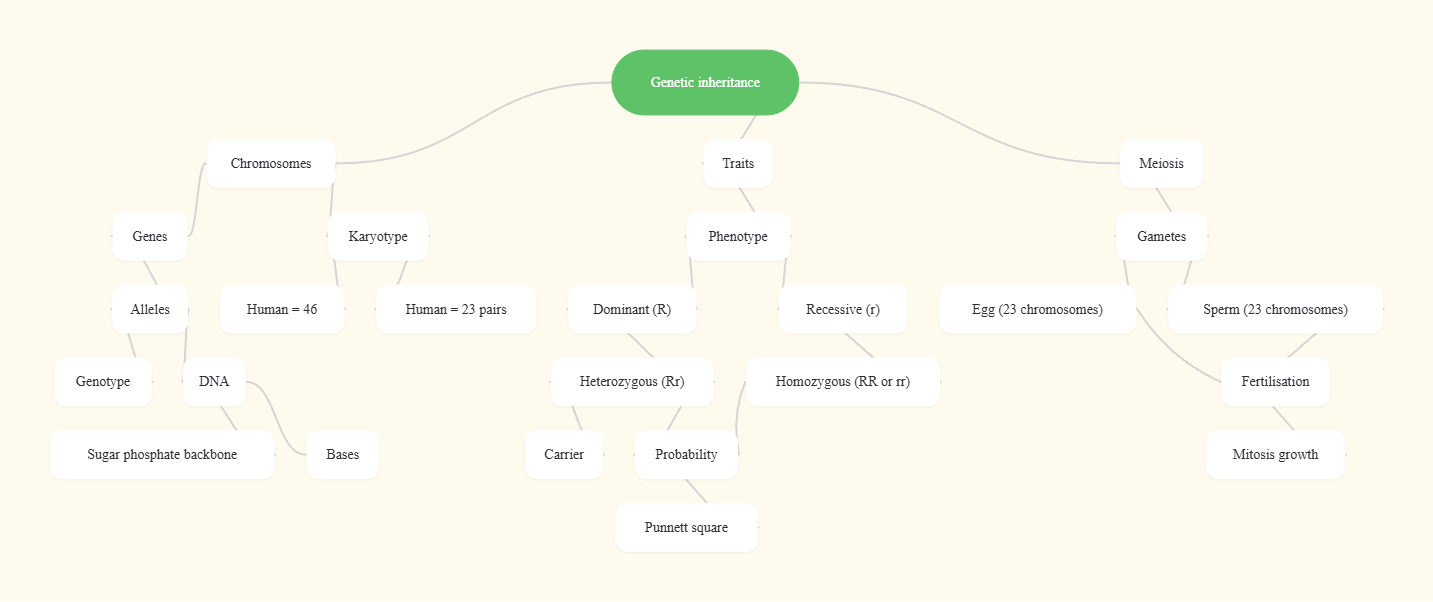
(Slide 73) ✎ STUDENT NOTES: Generate a mind map of the concepts learned during this sequence.
(Slide 74) Discuss how people can be tested for particular versions of genes (such as alleles for sickle cell anaemia and cystic fibrosis).
Pose the question: Why would people take a genetic test?
Students may identify the following reasons:
- Diagnosis: to identify if they have a higher risk of cancer.
- Carrier status: to determine if they are a carrier of a particular condition.
- Prenatal diagnosis: to determine if their unborn child has a particular condition. This helps a parent to prepare their expectations for caring for the child.
- Postnatal diagnosis: to determine if a newborn child has a particular condition (heel prick test) and to allow for early treatment to reduce the development of a disease.
Discuss the risks of having a genetic test, including false positives and negatives, cost, security of information from family and employers, stress (e.g. worrying about future illnesses), informed consent, age of consent, limits of genetic testing for diseases controlled by multiple genes and environment.
- What information can genetic tests tell us, and what can’t they tell us?
- Genetic tests can be used to identify known causes of genetic diseases. They cannot determine if or when the disease will occur, or identify genetic diseases with unknown causes.
- How might a false positive result affect a person’s life and decisions?
- They may make life decisions based on false information.
- Should important medical decisions be based on genetic testing alone?
- Having the allele that increases the risk of a particular disease (e.g. BRCA mutations) does not guarantee the disease will occur. Further tests are always needed.
- Who should have access to a person’s genetic information?
- In Australia, health and life insurance do not have permission to access the results of genetic tests. Organisations need an individual’s permission to access their information.
- Should employers be allowed to request or use genetic test results when hiring staff?
- How might genetic information affect other family members, even if they did not choose to be tested?
- Could the cost of genetic testing create unfair advantages or disadvantages?
- If the tests were expensive, only people who could afford them would be tested and have better health outcomes due to early treatment.
- Is it better to know about a future health risk, or to live without that knowledge?
- At what age should young people be able to decide for themselves whether to have a genetic test?
- Current laws state that a person should be 18 before they can make this decision.
- Should parents be allowed to make genetic testing decisions for their children?
- How do lifestyle and environmental factors influence health alongside genetics?
- Having the allele for a particular disease (e.g. type 2 diabetes) does not always mean a person will show symptoms of the disease. Lifestyle factors such as diet and exercise also affects the likelihood of the disease developing.
- Can knowing your genetic risk lead to healthier choices, or might it create a false sense of security?
- Does a person have a responsibility to share important genetic information with relatives who may also be at risk?
- Some relatives may not want to know.
Pose the question: What information should someone receive before agreeing to a genetic test?
Genetic testing and life insurance
Before October 2026, life insurers could take predictive genetic test results into account when assessing applications.

Genetic testing for particular diseases has been available since the 1950s. Mutations in the BRCA1 and BRCA2 genes are associated with a significantly increased risk of breast cancer and ovarian cancer, as well as some other cancers. Genetic testing for these mutations can help individuals and their healthcare providers make informed decisions about screening programs for early detection, disease prevention, and treatment options. Some individuals are reluctant to undergo genetic testing due to concerns about the use of genetic information by life insurance companies.
Traditionally, life insurers in Australia have assessed applicants according to their level of risk. This process, known as underwriting, allows insurers to consider a range of factors, including age, health status, medical history and family history, when deciding whether to offer cover and how much to charge. Before October 2026, life insurers could also take certain predictive genetic test results into account when assessing applications for products such as life cover, income protection, trauma insurance and total and permanent disability insurance. Depending on the results, insurers could increase premiums, apply exclusions or conditions, or in some cases refuse cover.
Private health insurance operates differently from life insurance in Australia. Private health insurance is community-rated, meaning insurers cannot refuse cover or charge higher premiums because of a person’s genetic test results or family history of a genetic condition. Although waiting periods may apply for pre-existing conditions, health insurers are not permitted to use genetic information to determine eligibility or premium costs. The concerns about genetic discrimination have therefore primarily related to life insurance products that rely on individual risk assessment.
To address these concerns, the Australian Government introduced legislation that prohibits life insurers from using protected genetic information when assessing new life insurance applications. The new law came into effect on 8 October 2026. Under the new legislation, life insurers are no longer allowed to consider predictive genetic test results when making decisions about new life insurance policies. The ban applies to a wide range of genetic information, including tests that predict future disease risk, pharmacogenomic tests, direct-to-consumer genetic tests and genetic tests conducted for research purposes. It also protects information about whether a person has had, plans to have, or has been advised to have a genetic test, as well as information relating to genetic testing of family members.
However, the legislation does not prevent insurers from considering diagnosed medical conditions. If a person has already developed a disease, insurers may continue to use information about that diagnosis when assessing risk, even if the diagnosis was made using genetic testing. The law therefore distinguishes between a person's inherited risk of future disease and diseases that have already been diagnosed.
References
Treasury Laws Amendment (Genetic Testing Protections in Life Insurance and Other Measures) Bill 2025. (2025). Aph.gov.au. https://www.aph.gov.au/Parliamentary_Business/Bills_Legislation/Bills_Search_Results/Result?bId=r7409
Lacaze, P., Tiller, J., Brotchie, A., Nguyen-Dumont, T., Steen, J., Belluoccio, D., Young, M.-A., Willis, A. M., Mitchell, L. A., Terrill, B., Nowak, K. J., Burns, B., Horton, A. E., Nicholls, S. J., Ademi, Z., Green, R. C., Manchanda, R., Thompson, B. A., Thomas, D., & Milne, R. L. (2026). Feasibility and outcomes of the DNA Screen nationwide adult genomic screening pilot. Nature Health, 1(1), 90–98. https://doi.org/10.1038/s44360-025-00020-x
Genetic testing for particular diseases has been available since the 1950s. Mutations in the BRCA1 and BRCA2 genes are associated with a significantly increased risk of breast cancer and ovarian cancer, as well as some other cancers. Genetic testing for these mutations can help individuals and their healthcare providers make informed decisions about screening programs for early detection, disease prevention, and treatment options. Some individuals are reluctant to undergo genetic testing due to concerns about the use of genetic information by life insurance companies.
Traditionally, life insurers in Australia have assessed applicants according to their level of risk. This process, known as underwriting, allows insurers to consider a range of factors, including age, health status, medical history and family history, when deciding whether to offer cover and how much to charge. Before October 2026, life insurers could also take certain predictive genetic test results into account when assessing applications for products such as life cover, income protection, trauma insurance and total and permanent disability insurance. Depending on the results, insurers could increase premiums, apply exclusions or conditions, or in some cases refuse cover.
Private health insurance operates differently from life insurance in Australia. Private health insurance is community-rated, meaning insurers cannot refuse cover or charge higher premiums because of a person’s genetic test results or family history of a genetic condition. Although waiting periods may apply for pre-existing conditions, health insurers are not permitted to use genetic information to determine eligibility or premium costs. The concerns about genetic discrimination have therefore primarily related to life insurance products that rely on individual risk assessment.
To address these concerns, the Australian Government introduced legislation that prohibits life insurers from using protected genetic information when assessing new life insurance applications. The new law came into effect on 8 October 2026. Under the new legislation, life insurers are no longer allowed to consider predictive genetic test results when making decisions about new life insurance policies. The ban applies to a wide range of genetic information, including tests that predict future disease risk, pharmacogenomic tests, direct-to-consumer genetic tests and genetic tests conducted for research purposes. It also protects information about whether a person has had, plans to have, or has been advised to have a genetic test, as well as information relating to genetic testing of family members.
However, the legislation does not prevent insurers from considering diagnosed medical conditions. If a person has already developed a disease, insurers may continue to use information about that diagnosis when assessing risk, even if the diagnosis was made using genetic testing. The law therefore distinguishes between a person's inherited risk of future disease and diseases that have already been diagnosed.
References
Treasury Laws Amendment (Genetic Testing Protections in Life Insurance and Other Measures) Bill 2025. (2025). Aph.gov.au. https://www.aph.gov.au/Parliamentary_Business/Bills_Legislation/Bills_Search_Results/Result?bId=r7409
Lacaze, P., Tiller, J., Brotchie, A., Nguyen-Dumont, T., Steen, J., Belluoccio, D., Young, M.-A., Willis, A. M., Mitchell, L. A., Terrill, B., Nowak, K. J., Burns, B., Horton, A. E., Nicholls, S. J., Ademi, Z., Green, R. C., Manchanda, R., Thompson, B. A., Thomas, D., & Milne, R. L. (2026). Feasibility and outcomes of the DNA Screen nationwide adult genomic screening pilot. Nature Health, 1(1), 90–98. https://doi.org/10.1038/s44360-025-00020-x
Preparing for genetics screening discussion
It is important to establish ground rules when discussing ethical issues related to genetic screening.
One of the key aims of the science curriculum is for students to develop “an ability to solve problems and make informed decisions about current and future uses of science while taking into account ethical, environmental, social and economic implications of decisions”.
The study of genetics is an ideal opportunity to examine the difference between scientific information and social judgement. In the next routine, students will examine genetic screening as a way of identifying biological differences, but it is also important to ask what happens when those differences are described as “normal” or “abnormal”.
Key question: “What can science tell us about a genetic condition, and what questions require values, ethics or personal judgement?”
Encourage students to ask what information a genetic test provides and, equally importantly, what it does not provide. Highlight the difference between genetic influence and genetic determination—remind students that many human characteristics involve complex interactions between genes, environment and individual experience.
When discussing the history of eugenics, help students look beyond the idea that it was simply an error made by scientists in the past. Eugenic thinking developed alongside concerns about immigration, poverty, crime and rapid social change. Encourage students to ask why particular scientific explanations became attractive at that time.
Draw students’ attention to the repeated use of language such as “normal”, “abnormal”, “disease”, “difference”, “fit”, and “unfit”. Using these terms has implied assumptions that difference is less and that some people are more or less worthy.
Key question: “What social problems were people trying to explain, and why might heredity have seemed like a convincing explanation?”
An understanding of the laws of inheritance lead to the development of family trees during a time of poverty and drought. A variety of traits were followed down generations, eventually leading to judgements about intelligence and the identification of people considered “unfit” by those who considered themselves “more fit”.
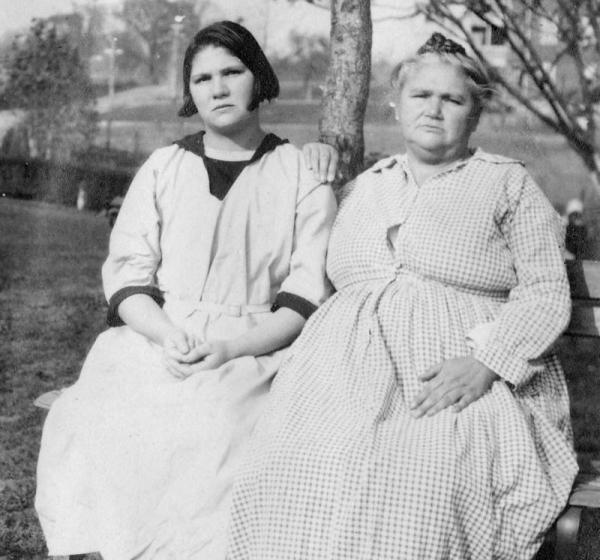
The American example of Buck v. Bell can be used to illustrate the relationship between science, law and authority. This court case involved the American Supreme court making the decision that Carrie Buck (pictured above on the left), a young woman who had been abused as a child and became pregnant, was feeble-minded and immoral and that these conditions were hereditary because her mother had been poor and had children out of wedlock. This “science” was used by the court to justify Carrie’s sterilisation, the first of over 60,000 in America.
This social interpretation of the science was extended by the Nazi regime in Germany, where groups of people were dehumanised, and science was used to validate racism, antisemitism and authoritarian political power.
Asking students to identify both the decision-makers and those affected can help them understand why authority and coercion were a key feature of the eugenics movement.
Social pressure is still an influence in current genetic screening. Contemporary reproductive decision-making requires informed consent. For this to occur, an individual needs accurate information, understanding of alternatives, freedom from coercion and respect for personal values. A decision can be legally voluntary while still being influenced by expectations about what a “healthy” or “normal” child should be.
Encourage students to consider autonomy, dignity, equality, informed consent, disability rights and critical evaluation of scientific claims.
Throughout the lesson, avoid asking students to decide whether particular people with disabilities or genetic conditions should have been born. A formal pro-life vs pro-choice debate may shift attention away from genetics and encourage students to defend personal identities or beliefs.
Instead, this lesson uses an ethical inquiry. For example:
“Imagine a couple receives genetic information during pregnancy. What factors might they need to consider before making a decision?”
Students might identify:
- the nature and severity of the condition.
- uncertainty in the test result.
- available medical treatment.
- disability support.
- quality-of-life considerations.
- the parents’ values and circumstances.
- advice from medical professionals.
- reproductive autonomy.
- possible social pressure.
- legal considerations.
The discussion can then lead to "Which of these questions can genetics answer, and which require ethical or personal judgement?”
This keeps the focus on systems, ideas, evidence, choices and power. The central message is that human biological variation can be studied scientifically, but deciding how society should respond to that variation involves ethical and social questions. The history of eugenics reminds us that scientific authority must be accompanied by critical thinking, humility, respect for human diversity and protection of individual rights.
References
Roberts, W. C. (2020). Facts and ideas from anywhere. Baylor University Medical Center Proceedings, 1–5. https://doi.org/10.1080/08998280.2020.1811835
One of the key aims of the science curriculum is for students to develop “an ability to solve problems and make informed decisions about current and future uses of science while taking into account ethical, environmental, social and economic implications of decisions”.
The study of genetics is an ideal opportunity to examine the difference between scientific information and social judgement. In the next routine, students will examine genetic screening as a way of identifying biological differences, but it is also important to ask what happens when those differences are described as “normal” or “abnormal”.
Key question: “What can science tell us about a genetic condition, and what questions require values, ethics or personal judgement?”
Encourage students to ask what information a genetic test provides and, equally importantly, what it does not provide. Highlight the difference between genetic influence and genetic determination—remind students that many human characteristics involve complex interactions between genes, environment and individual experience.
When discussing the history of eugenics, help students look beyond the idea that it was simply an error made by scientists in the past. Eugenic thinking developed alongside concerns about immigration, poverty, crime and rapid social change. Encourage students to ask why particular scientific explanations became attractive at that time.
Draw students’ attention to the repeated use of language such as “normal”, “abnormal”, “disease”, “difference”, “fit”, and “unfit”. Using these terms has implied assumptions that difference is less and that some people are more or less worthy.
Key question: “What social problems were people trying to explain, and why might heredity have seemed like a convincing explanation?”
An understanding of the laws of inheritance lead to the development of family trees during a time of poverty and drought. A variety of traits were followed down generations, eventually leading to judgements about intelligence and the identification of people considered “unfit” by those who considered themselves “more fit”.
The American example of Buck v. Bell can be used to illustrate the relationship between science, law and authority. This court case involved the American Supreme court making the decision that Carrie Buck (pictured above on the left), a young woman who had been abused as a child and became pregnant, was feeble-minded and immoral and that these conditions were hereditary because her mother had been poor and had children out of wedlock. This “science” was used by the court to justify Carrie’s sterilisation, the first of over 60,000 in America.
This social interpretation of the science was extended by the Nazi regime in Germany, where groups of people were dehumanised, and science was used to validate racism, antisemitism and authoritarian political power.
Asking students to identify both the decision-makers and those affected can help them understand why authority and coercion were a key feature of the eugenics movement.
Social pressure is still an influence in current genetic screening. Contemporary reproductive decision-making requires informed consent. For this to occur, an individual needs accurate information, understanding of alternatives, freedom from coercion and respect for personal values. A decision can be legally voluntary while still being influenced by expectations about what a “healthy” or “normal” child should be.
Encourage students to consider autonomy, dignity, equality, informed consent, disability rights and critical evaluation of scientific claims.
Throughout the lesson, avoid asking students to decide whether particular people with disabilities or genetic conditions should have been born. A formal pro-life vs pro-choice debate may shift attention away from genetics and encourage students to defend personal identities or beliefs.
Instead, this lesson uses an ethical inquiry. For example:
“Imagine a couple receives genetic information during pregnancy. What factors might they need to consider before making a decision?”
Students might identify:
- the nature and severity of the condition.
- uncertainty in the test result.
- available medical treatment.
- disability support.
- quality-of-life considerations.
- the parents’ values and circumstances.
- advice from medical professionals.
- reproductive autonomy.
- possible social pressure.
- legal considerations.
The discussion can then lead to "Which of these questions can genetics answer, and which require ethical or personal judgement?”
This keeps the focus on systems, ideas, evidence, choices and power. The central message is that human biological variation can be studied scientifically, but deciding how society should respond to that variation involves ethical and social questions. The history of eugenics reminds us that scientific authority must be accompanied by critical thinking, humility, respect for human diversity and protection of individual rights.
References
Roberts, W. C. (2020). Facts and ideas from anywhere. Baylor University Medical Center Proceedings, 1–5. https://doi.org/10.1080/08998280.2020.1811835
The Act phase empowers students to use the Core concepts and key ideas of science they have learned during the Inquire phase. It encourages students to develop a sense of responsibility as members of society—to act rather than be acted upon. It provides students with the opportunity to positively influence their own life and that of the world around them. For this to occur, students need to build foundational skills in an interactive mutually supportive environment with their community.
When designing the Act phase, consider ways that students could use their scientific knowledge and skills. Consider their interests and lifestyles that may intersect with the core concepts and key ideas. What context or problem would provide students with a way to use science to synthesise a design? How (and to whom) will students communicate their understanding?
Read more about using the LIA FrameworkEach student comes to the classroom with experiences made up from science-related knowledge, attitudes, experiences and resources in their life. The Connect routine is designed to tap into these experiences, and that of their wider community. It is also an opportunity to yarn with community leaders (where appropriate) to gain an understanding of the student’s lives, languages and interests. In the Act phase, this routine reconnects with the science capital of students so students can appreciate the relevance of their learning and the agency to make decisions and take action.
When designing a teaching sequence, consider the everyday occurrences, phenomena and experiences that might relate to the science that they have learned. How could students show agency in these areas?
Read more about using the LIA FrameworkGenetic counselling
Show the video “Difference” vs. “disease”: A question of eugenics? (11:12).
NOTE: Watch this video prior to the lesson to prepare for the questions and the discussion that will arise.
Discuss how science and society influence the way we understand human difference, disability and reproduction, drawing on lessons from the history of eugenics.
- What is the difference between a medical condition, a disability, and a human difference? Are these categories always clear-cut?
- Why can't genetics alone determine the value or quality of a person's life?
- Can a trait be both a challenge and a strength? Can you think of examples?
- What factors might influence quality of life besides genetics?
- What are the benefits and limitations of prenatal genetic screening? What information can it provide? What can't it tell us about a person's future life?
- Does having access to more genetic information always lead to better decisions? Why or why not?
- How can the history of eugenics help us think critically about modern genetic technologies and society's attitudes towards difference? What has changed? What ethical concerns remain similar?
- How can society support informed reproductive choice while also respecting people with disabilities and genetic differences?
- What responsibilities do governments, scientists, healthcare professionals and the media have when communicating information about genetics?
- They need to ensure that the public understands the evidence, assumptions and limitations of the new knowledge.
Explain that genetic counsellors are healthcare professionals with qualifications in both genetics and psychology. They support people and families with genetic health conditions. For prenatal or childhood testing, they can support parents before, during and after genetic testing. Explain that a genetics counsellor will not tell the parents what to do. Instead, the counsellor will explain the options and consequences available to parents, taking into account the parents’ circumstances.
Explain to students that as a prospective parent, they may ask for or be offered genetic testing.
Pose the question: If you were a prospective parent, what information would you want from a genetics counsellor before undergoing genetic testing?
(Slide 75) ✎ STUDENT NOTES: Brainstorm the information that would be needed by parents deciding whether to undergo genetic testing.
- How accurate is the test?
- 95-100% accuracy for known cystic fibrosis variants.
- Will the test harm the baby?
- Chorionic villus sampling has traditionally been used to collect a sample of the fetal cells. It carries a very small risk (1%) to the fetus. Non-invasive parental tests (NIPT) are now being used to collect samples of the mother’s blood, which can carry fetal cell-free DNA that can be used for testing.
- What are the short- and long-term symptoms of cystic fibrosis?
- Thick, sticky mucus affecting the lungs (persistent coughing, multiple chest infections, wheezing, and poor lung function) and the digestive system (poor nutrient absorption, slow growth and low weight).
- Do the benefits of my decision outweigh the risks?
- What does the doctor say?
- Is the best treatment available?
- Does the decision align with my religious or cultural beliefs?
- How will my decision affect other family members?
Pose the question: Which of these questions can genetics answer, and which require ethical or personal judgement?
Discuss how the role of a genetics counsellor is to answer the genetics questions and to help the parents find their own answers to the ethical or personal questions.
(Slide 76) Explain to students that they will role-play a genetic counsellor who is supporting parents before and after a genetic test for cystic fibrosis on their unborn baby. Discuss the approaches used by people making decisions. They may:
- consider how different individuals are affected.
- compare the risks and benefits for each person.
- identify the short-term and long-term consequences of each decision.
(Slide 77) Discuss the bioethical principles that are used by medical and health care professionals to make ethical decisions, including autonomy (the right to make an informed, independent decision about their own body), beneficence (maximise the benefit), non-maleficence (minimise the harm) and justice (fair sharing of the resources and burdens).
✎ STUDENT NOTES: Describe each of the bioethical principles used by a genetics counsellor.
Making decisions about genetic testing issues
Considering genetic issues helps students develop skills in evidence-based decision-making and enhances critical thinking skills.

The ethical issues used in this teaching sequence were designed to allow students to select particular positions and to consider the evidence and arguments that support those positions.
The initial classroom discussion allows critical thinking to be modelled before students move to the role-play in the Communicate routine.
During classroom discussion, the role of the teacher is to:
- encourage talking and listening.
- encourage students to justify their comments with evidence.
- help students construct arguments to justify or refute decisions.
- model evaluating arguments and evidence.
- encourage reflecting on the argument process (mind change).
Students often have difficulty either making a decision or using evidence to justify their decision. Support can be provided by guiding students to first identify each of the stakeholders involved. This allows the students to identify an individual stakeholder when discussing the short- and long-term risks and benefits, instead of using their own perspective.
Bioethical principles can assist in decision-making about genetic testing. The bioethical principles that can be used in this lesson include:
- autonomy: the personal free will and right to choose or consent.
- beneficence: maximising the benefit for self and others.
- non-maleficence: minimising the harm to all involved.
- justice: fairness and equity of access and choice.
The ethical issues used in this teaching sequence were designed to allow students to select particular positions and to consider the evidence and arguments that support those positions.
The initial classroom discussion allows critical thinking to be modelled before students move to the role-play in the Communicate routine.
During classroom discussion, the role of the teacher is to:
- encourage talking and listening.
- encourage students to justify their comments with evidence.
- help students construct arguments to justify or refute decisions.
- model evaluating arguments and evidence.
- encourage reflecting on the argument process (mind change).
Students often have difficulty either making a decision or using evidence to justify their decision. Support can be provided by guiding students to first identify each of the stakeholders involved. This allows the students to identify an individual stakeholder when discussing the short- and long-term risks and benefits, instead of using their own perspective.
Bioethical principles can assist in decision-making about genetic testing. The bioethical principles that can be used in this lesson include:
- autonomy: the personal free will and right to choose or consent.
- beneficence: maximising the benefit for self and others.
- non-maleficence: minimising the harm to all involved.
- justice: fairness and equity of access and choice.
The Act phase empowers students to use the Core concepts and key ideas of science they have learned during the Inquire phase. It encourages students to develop a sense of responsibility as members of society—to act rather than be acted upon. It provides students with the opportunity to positively influence their own life and that of the world around them. For this to occur, students need to build foundational skills in an interactive mutually supportive environment with their community.
When designing the Act phase, consider ways that students could use their scientific knowledge and skills. Consider their interests and lifestyles that may intersect with the core concepts and key ideas. What context or problem would provide students with a way to use science to synthesise a design? How (and to whom) will students communicate their understanding?
Read more about using the LIA FrameworkA key part of Science Inquiry, the Communicate routine provides students with an opportunity to communicate their ideas effectively to others. It allows students a chance to show their learning to members of their community and provides a sense of belonging. It also encourages students to have a sense of responsibility to share their understanding of science and to use this to provide a positive influence in the community.
When designing a teaching sequence, consider who might be connected to the students that have an interest in science. Who in their lives could share their learning? What forum could be used to build an enthusiasm for science. Are there members of the community (parents, teachers, peers or wider community) who would provide a link to future science careers?
Read more about using the LIA FrameworkGenetics counsellor role play
Invite students to play the role of a genetics counsellor and a parent who is about to undergo prenatal testing for cystic fibrosis. Divide the students into pairs, where one student is the counsellor, and one is the parent-to-be.
(Slide 78) Provide students with a copy of the Genetics counsellor Resource sheet. Allow students time to read the different roles individually.
(Slide 79) Outline the rules of the role play discussion:
- Stay in character throughout the role-play.
- Be respectful of different opinions and values.
- Use evidence and information to support your statements.
- Remember that there may not be one “correct” decision.
- Focus on understanding the issue from another person’s perspective.
Allow students time to complete the role play.
(Slide 80) Following the role play, invite students to use argumentation to outline the reasons why people would make a decision for and against taking a genetic test. Compare students’ answers, emphasising the need to understand the perspectives of others in order to have an informed debate.
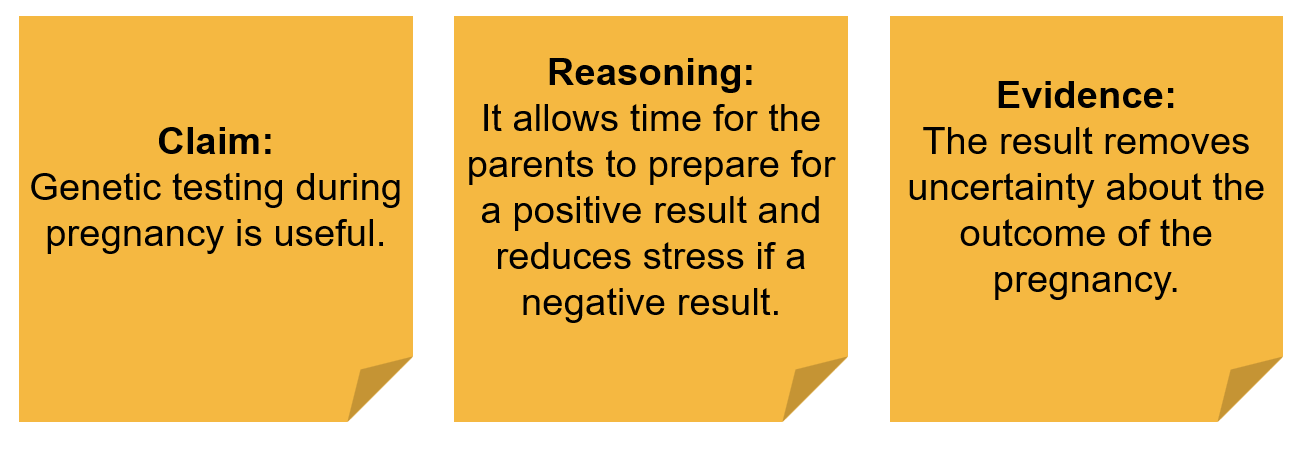

Discuss the information that was needed during the role play for the parent-to-be to understand how cystic fibrosis is inherited and how the genetic testing is done.
Discuss the decision-making process with students as a debrief. Without asking students to provide their decision, ask if students have changed their minds about taking the genetic test. Ask how it felt to role play the genetics counsellor.
- What information was most important in making a decision?
- Was the counsellor able to remain neutral?
- What concerns mattered most to the parent-to-be?
- How did uncertainty affect decision-making?
- Should parents always be offered genetic testing? Why or why not?
- What ethical issues emerged during the conversation?
- How might different cultural, religious, or personal values influence decisions about genetic testing?
(Slide 81) Provide students with a copy of the Cystic fibrosis dilemma Resource sheet. Allow students time to read the information provided.
Divide students into groups of four to share their decisions and reasons. Reinforce the rules of respectful discussions. Allow students time to make their group decision about what Mr C and Mrs C would be told.
Invite students to record their decision at the front of the class.
Eugenics in Australia
Eugenics was a social and scientific movement that emerged in the early 20th century.

In the early 20th century, eugenic ideas were particularly prominent among academics, medical professionals, educators, and government officials in Melbourne, who saw eugenics as a modern scientific approach to addressing social issues.
A key figure in the movement was Richard Berry, Professor of Anatomy at the University of Melbourne from 1906 to 1929. Berry and his supporters promoted the belief that traits such as intelligence, morality, and social behaviour were largely inherited. They argued that people considered “mentally deficient” or socially undesirable should be prevented from reproducing.
Eugenic ideas influenced public policy in Victoria. Between 1926 and 1939, several Mental Deficiency Bills were introduced into the Victorian Parliament. These proposed the institutionalisation and possible sterilisation of people classified as “unfit”, including those with intellectual disabilities, people living in poverty, alcoholics, and other groups who were viewed through the lens of eugenic theory. First Nation peoples were also frequently included in these discriminatory classifications. Although one bill was passed in 1939, it was never enacted, partly due to the outbreak of World War II and growing awareness of the atrocities associated with Nazi racial policies.
Modern eugenics
Although organised eugenics movements declined after World War II, some eugenic practices, including involuntary sterilisation, institutionalisation, and discrimination against people with disabilities, continued in various countries (including America) into the 1970s and, in some cases, beyond. Advances in genetics and reproductive technologies have prompted renewed ethical discussions about what some scholars call “modern eugenics”. Developments such as prenatal genetic screening, embryo testing and reproductive technologies can provide valuable information to prospective parents and help identify serious genetic conditions. However, some ethicists and disability advocates have expressed concern that widespread use of these technologies could create social pressure to avoid the birth of individuals with certain genetic traits or disabilities. New techniques that estimate the likelihood of complex traits and conditions have also raised questions about whether selecting embryos based on genetic characteristics could resemble historical eugenic goals of shaping future populations. While modern genetic counselling emphasises informed choice and individual autonomy rather than state control, debates continue about the ethical implications of using genetic information in reproductive decision-making and how society can balance medical advances with respect for diversity, disability rights, and human dignity.
References
Jones, R. L. (2011, September 20). Eugenics in Australia: The secret of Melbourne’s elite. The Conversation. https://theconversation.com/eugenics-in-australia-the-secret-of-melbournes-elite-3350
In the early 20th century, eugenic ideas were particularly prominent among academics, medical professionals, educators, and government officials in Melbourne, who saw eugenics as a modern scientific approach to addressing social issues.
A key figure in the movement was Richard Berry, Professor of Anatomy at the University of Melbourne from 1906 to 1929. Berry and his supporters promoted the belief that traits such as intelligence, morality, and social behaviour were largely inherited. They argued that people considered “mentally deficient” or socially undesirable should be prevented from reproducing.
Eugenic ideas influenced public policy in Victoria. Between 1926 and 1939, several Mental Deficiency Bills were introduced into the Victorian Parliament. These proposed the institutionalisation and possible sterilisation of people classified as “unfit”, including those with intellectual disabilities, people living in poverty, alcoholics, and other groups who were viewed through the lens of eugenic theory. First Nation peoples were also frequently included in these discriminatory classifications. Although one bill was passed in 1939, it was never enacted, partly due to the outbreak of World War II and growing awareness of the atrocities associated with Nazi racial policies.
Modern eugenics
Although organised eugenics movements declined after World War II, some eugenic practices, including involuntary sterilisation, institutionalisation, and discrimination against people with disabilities, continued in various countries (including America) into the 1970s and, in some cases, beyond. Advances in genetics and reproductive technologies have prompted renewed ethical discussions about what some scholars call “modern eugenics”. Developments such as prenatal genetic screening, embryo testing and reproductive technologies can provide valuable information to prospective parents and help identify serious genetic conditions. However, some ethicists and disability advocates have expressed concern that widespread use of these technologies could create social pressure to avoid the birth of individuals with certain genetic traits or disabilities. New techniques that estimate the likelihood of complex traits and conditions have also raised questions about whether selecting embryos based on genetic characteristics could resemble historical eugenic goals of shaping future populations. While modern genetic counselling emphasises informed choice and individual autonomy rather than state control, debates continue about the ethical implications of using genetic information in reproductive decision-making and how society can balance medical advances with respect for diversity, disability rights, and human dignity.
References
Jones, R. L. (2011, September 20). Eugenics in Australia: The secret of Melbourne’s elite. The Conversation. https://theconversation.com/eugenics-in-australia-the-secret-of-melbournes-elite-3350
Cystic fibrosis dilemma
In the optional cystic fibrosis dilemma, students role-play a scenario where a husband is found not to be the genetic parent of his wife's unborn child.

In the optional cystic fibrosis dilemma, students role-play a genetic counsellor who guides the parents (Mr and Mrs C) through the decision-making process where Mr C is determined not to be the genetic parent of the unborn child.
From previous lessons, students will be aware of the inheritance pattern (autosomal recessive), diagnosis (through predictive carrier screening or genetic testing at birth), symptoms (chronic chest infections, digestive problems, infertility and reduced life span) and treatment (lifelong treatment).
Encourage students to consider the needs, rights and responsibilities of not only the parents (Mr and Mrs C) but also the baby who has cystic fibrosis, the potential genetic father, other family, medical staff, and genetics counsellor.
Constructing an argument encourages students to make the processes visible as they make their decision, justify the decision with their peers, become aware of different views within their group and whole class, and have the option of changing their mind.
The dilemma has been trialled with Year 10 students in many contexts, including Catholic schools where the purpose of testing is to prepare for the birth of the child. Initially, some students may focus on the morality or not of Mrs C, whose paternity is not in doubt. Through questioning, the focus can shift to the needs of the baby.
In reinforcing the autosomal recessive inheritance, some students will propose that perhaps Mr C had a spontaneous mutation in his otherwise normal allele or that there is an error in the testing. Mr C may be aware that he is not the biological father. From the genetic counsellor’s perspective, the parents have attended to see if their baby has cystic fibrosis, and that is the information that would be provided to Mr and Mrs C. The debrief stage at the conclusion is very important as students may hold strong opposing views.
In the optional cystic fibrosis dilemma, students role-play a genetic counsellor who guides the parents (Mr and Mrs C) through the decision-making process where Mr C is determined not to be the genetic parent of the unborn child.
From previous lessons, students will be aware of the inheritance pattern (autosomal recessive), diagnosis (through predictive carrier screening or genetic testing at birth), symptoms (chronic chest infections, digestive problems, infertility and reduced life span) and treatment (lifelong treatment).
Encourage students to consider the needs, rights and responsibilities of not only the parents (Mr and Mrs C) but also the baby who has cystic fibrosis, the potential genetic father, other family, medical staff, and genetics counsellor.
Constructing an argument encourages students to make the processes visible as they make their decision, justify the decision with their peers, become aware of different views within their group and whole class, and have the option of changing their mind.
The dilemma has been trialled with Year 10 students in many contexts, including Catholic schools where the purpose of testing is to prepare for the birth of the child. Initially, some students may focus on the morality or not of Mrs C, whose paternity is not in doubt. Through questioning, the focus can shift to the needs of the baby.
In reinforcing the autosomal recessive inheritance, some students will propose that perhaps Mr C had a spontaneous mutation in his otherwise normal allele or that there is an error in the testing. Mr C may be aware that he is not the biological father. From the genetic counsellor’s perspective, the parents have attended to see if their baby has cystic fibrosis, and that is the information that would be provided to Mr and Mrs C. The debrief stage at the conclusion is very important as students may hold strong opposing views.
The Act phase empowers students to use the Core concepts and key ideas of science they have learned during the Inquire phase. It encourages students to develop a sense of responsibility as members of society—to act rather than be acted upon. It provides students with the opportunity to positively influence their own life and that of the world around them. For this to occur, students need to build foundational skills in an interactive mutually supportive environment with their community.
When designing the Act phase, consider ways that students could use their scientific knowledge and skills. Consider their interests and lifestyles that may intersect with the core concepts and key ideas. What context or problem would provide students with a way to use science to synthesise a design? How (and to whom) will students communicate their understanding?
Read more about using the LIA FrameworkWhen students use their knowledge and skills in new ways, they also have an opportunity to develop and use their creative and critical thinking skills. With scaffolded support, they can become more confident to work in a team and develop a stronger sense of autonomy. This results in stronger student outcomes, attitudes and sense of empowerment.
When designing a teaching sequence, consider what activity would allow students to showcase their knowledge and skills. Consider the current abilities of your students. What are they capable of explaining? What props could they design or build that would support their explanations? How much information would they need in their design brief to support their thinking? How does this connect with their lives and interests?
Design a genetics brochure
Discuss how genetics counsellors often need to provide information that can be taken away by the prospective parents, as there is usually too much information for them to understand in a single session.
Provide students with the Bad brochure Resource sheet that has four examples of badly written brochures. Discuss why the brochures are examples of bad science communication, including;
- ignoring ethical concerns, disability rights and human diversity.
- encouraging eugenics.
- overstating what genetics can predict.
- suggesting that some lives are more valuable than others.
- presenting social issues such as poverty and crime as genetic.
- ignoring education and family circumstances as factors that affect outcomes.
- using value-laden terms such as “undesirable”.
- using language too difficult for non-scientists.
- not providing references to find further information.
✎ STUDENT NOTES: Highlight examples of poor science communication on the Bad brochure Resource sheet. Explain why they are poor science communication.
(Slide 82) Discuss the features of good science communication.
Invite students to design a poster, brochure or video that explains the inheritance of cystic fibrosis.
✎ STUDENT NOTES: Design a poster, brochure or video that explains the inheritance of cystic fibrosis. Include information on:
- background information on the condition.
- the chromosome on which the allele is located.
- the inheritance pattern of the condition (dominant or recessive trait).
- how meiosis can affect how alleles are inherited.
- an example of a Punnett square if two carriers were to have a child.
- the difference between probability and actual outcome of inheritance.
- the importance of genetic counselling before testing.
Reflect on the lesson
You might ask students to:
- read and record their perspective on the article Should Australia DNA test every newborn.
- read and reflect on their perspective of the article Want a tall smart child - how IVF tests are selling a dream.
Using Generative AI tools to write assessment rubrics
Careful use of artificial intelligence tools can support teachers in developing assessment rubrics.

Artificial intelligence tools can provide support in developing assessment rubrics, however, the quality of the output depends heavily on the clarity of the prompt, the inclusion of curriculum standards, and the specificity of the assessment criteria provided. The draft rubric produced will need to be carefully checked for clarity, coherence, and class-appropriate content. AI cannot replace professional judgement; rather, it assists when it is used strategically.
1. Start with the standard, not the tool
Effective rubric design begins with curriculum alignment. Before using a Generative AI tool, identify the following criteria:
- the relevant achievement standard.
- the content descriptors being assessed.
- the cognitive demand (e.g. explain, analyse, evaluate, construct).
Providing the achievement standard directly within the prompt ensures that the Generative AI tool anchors the rubric to expected student performance. For example, including wording such as: “Students explain the processes that underpin heredity and genetic diversity…” directs the Generative AI tool to align descriptors to the required depth of knowledge and skill.
Without this anchor, Generative AI tools may generate generic criteria that lack alignment to reporting requirements.
2. Specify the assessment components clearly
Generative AI tools perform best when the task requirements are explicitly broken down. Instead of asking “Write a rubric for a genetic testing brochure”, a more effective prompt would include:
- the science concepts required.
- the skills students must demonstrate (data analysis, calculation, argument construction).
- the design or application component.
- the communication expectations.
Breaking the assessment into categories (e.g. science understanding, design, communication) produces a rubric that reflects the multidimensional nature of authentic tasks.
3. Define performance levels explicitly
To generate meaningful performance bands (e.g. Well Below Standard to Well Above Standard), the prompt should:
- provide the wording for “At Standard”.
- clarify what progression should look like (increasing complexity, accuracy, independence, evaluation).
Generative AI tools can then scale descriptors logically:
- Below Standard → partial understanding, limited analysis.
- At Standard → accurate application, appropriate analysis.
- Above Standard → detailed reasoning, evaluation, integration.
- Well Above Standard → sophisticated, critical, and reflective reasoning.
Without this structure, descriptors may become repetitive rather than developmental.
4. Use cognitive verbs intentionally
Assessment criteria should reflect increasing cognitive demand. Guide Generative AI tools by incorporating verbs such as define, describe, explain, etc.
This ensures that higher performance levels demonstrate deeper reasoning rather than simply “more detail”.
5. Prompt for evidence-based language
AI-generated rubrics are stronger when prompts require:
- evidence-based reasoning.
- identification of assumptions.
- consideration of conflicting evidence.
- data analysis and anomaly identification.
These elements align with upper-primary and secondary achievement standards and promote higher-order thinking.
6. Maintain professional judgement
AI-generated rubrics should always be reviewed and refined. Consider the accessibility of the language, the appropriateness of the context, and its ability to separate students’ grades appropriately. Generative AI drafts accelerate the process, but professional expertise ensures validity. If the first attempt is not appropriate for the class, readdress the prompt and try again.
Example of a strong generative AI prompt template
Write an Australian Year [year/level] assessment rubric for a task where students will [outline the task e.g. create a brochure that provides the background information on cystic fibrosis required before genetic testing].
Align the rubric to the following achievement standard:
[Paste the full Science Understanding standard]
The task requires students to: [outline all the Science as a Human Endeavour and Science Inquiry criteria required]
Organise the rubric into the following categories: [outline the key elements of the design e.g. DNA chromosomes and genes, random assortment during meiosis, using a Punnett square to demonstrate the inheritance of cystic fibrosis, difference between probability and outcome, why genetic counselling is important, the design, communication for appropriate audience.]
Include five performance levels in columns: Well Below Standard, Below Standard, At Standard, Above Standard, Well Above Standard.
“At Standard” must align directly to the achievement standard.
Ensure progression across levels reflects increasing depth of analysis, use of evidence, and critical thinking.
Include references to assumptions, data analysis, and evidence-based reasoning where appropriate.
References
Commonwealth of Australia. (2023). Australian framework for generative artificial intelligence in schools. Commonwealth of Australia. <https://www.education.gov.au/schooling/resources/australian-framework-generative-artificial-intelligence-ai-schools>
Artificial intelligence tools can provide support in developing assessment rubrics, however, the quality of the output depends heavily on the clarity of the prompt, the inclusion of curriculum standards, and the specificity of the assessment criteria provided. The draft rubric produced will need to be carefully checked for clarity, coherence, and class-appropriate content. AI cannot replace professional judgement; rather, it assists when it is used strategically.
1. Start with the standard, not the tool
Effective rubric design begins with curriculum alignment. Before using a Generative AI tool, identify the following criteria:
- the relevant achievement standard.
- the content descriptors being assessed.
- the cognitive demand (e.g. explain, analyse, evaluate, construct).
Providing the achievement standard directly within the prompt ensures that the Generative AI tool anchors the rubric to expected student performance. For example, including wording such as: “Students explain the processes that underpin heredity and genetic diversity…” directs the Generative AI tool to align descriptors to the required depth of knowledge and skill.
Without this anchor, Generative AI tools may generate generic criteria that lack alignment to reporting requirements.
2. Specify the assessment components clearly
Generative AI tools perform best when the task requirements are explicitly broken down. Instead of asking “Write a rubric for a genetic testing brochure”, a more effective prompt would include:
- the science concepts required.
- the skills students must demonstrate (data analysis, calculation, argument construction).
- the design or application component.
- the communication expectations.
Breaking the assessment into categories (e.g. science understanding, design, communication) produces a rubric that reflects the multidimensional nature of authentic tasks.
3. Define performance levels explicitly
To generate meaningful performance bands (e.g. Well Below Standard to Well Above Standard), the prompt should:
- provide the wording for “At Standard”.
- clarify what progression should look like (increasing complexity, accuracy, independence, evaluation).
Generative AI tools can then scale descriptors logically:
- Below Standard → partial understanding, limited analysis.
- At Standard → accurate application, appropriate analysis.
- Above Standard → detailed reasoning, evaluation, integration.
- Well Above Standard → sophisticated, critical, and reflective reasoning.
Without this structure, descriptors may become repetitive rather than developmental.
4. Use cognitive verbs intentionally
Assessment criteria should reflect increasing cognitive demand. Guide Generative AI tools by incorporating verbs such as define, describe, explain, etc.
This ensures that higher performance levels demonstrate deeper reasoning rather than simply “more detail”.
5. Prompt for evidence-based language
AI-generated rubrics are stronger when prompts require:
- evidence-based reasoning.
- identification of assumptions.
- consideration of conflicting evidence.
- data analysis and anomaly identification.
These elements align with upper-primary and secondary achievement standards and promote higher-order thinking.
6. Maintain professional judgement
AI-generated rubrics should always be reviewed and refined. Consider the accessibility of the language, the appropriateness of the context, and its ability to separate students’ grades appropriately. Generative AI drafts accelerate the process, but professional expertise ensures validity. If the first attempt is not appropriate for the class, readdress the prompt and try again.
Example of a strong generative AI prompt template
Write an Australian Year [year/level] assessment rubric for a task where students will [outline the task e.g. create a brochure that provides the background information on cystic fibrosis required before genetic testing].
Align the rubric to the following achievement standard:
[Paste the full Science Understanding standard]
The task requires students to: [outline all the Science as a Human Endeavour and Science Inquiry criteria required]
Organise the rubric into the following categories: [outline the key elements of the design e.g. DNA chromosomes and genes, random assortment during meiosis, using a Punnett square to demonstrate the inheritance of cystic fibrosis, difference between probability and outcome, why genetic counselling is important, the design, communication for appropriate audience.]
Include five performance levels in columns: Well Below Standard, Below Standard, At Standard, Above Standard, Well Above Standard.
“At Standard” must align directly to the achievement standard.
Ensure progression across levels reflects increasing depth of analysis, use of evidence, and critical thinking.
Include references to assumptions, data analysis, and evidence-based reasoning where appropriate.
References
Commonwealth of Australia. (2023). Australian framework for generative artificial intelligence in schools. Commonwealth of Australia. <https://www.education.gov.au/schooling/resources/australian-framework-generative-artificial-intelligence-ai-schools>