

Genes, ethics and society
View Sequence overviewStudents will:
- identify trustworthy data sets.
- identify how screening can contribute to early diagnosis of bowel cancer.
- compare the financial costs of early detection and late detection of bowel cancer.
Students will represent their understanding as they:
- compare the trustworthiness of secondary data sets.
- calculate the financial benefits of screening for bowel cancer.
- explain the reason screening tests may be funded by the Australian Government.
In this lesson, assessment is formative.
Feedback might focus on students’ ability to:
- identify valid secondary data.
- use spreadsheets to construct tables and compare mathematical relationships.
- use evidence and reasoning to support a claim through argumentation.
Potential summative task
Students working at the achievement standard should:
- explore environmental and other factors that cause mutations and identify changes in DNA or chromosomes.
- explain how scientific knowledge is validated and refined, including the role of publication and peer review.
- investigate how advances in technologies enable advances in science, and how science has contributed to developments in technologies and engineering.
- analyse the key factors that contribute to science knowledge and practices being adopted more broadly by society.
- examine how the values and needs of society influence the focus of scientific research.
- construct mathematical relationships to organise and process data and information.
- explore relationships between variables using spreadsheets, databases, and tables.
- construct arguments based on analysis of a variety of evidence to support conclusions or evaluate claims.
Whole class
Genes, ethics and society Slides
Each student
Cystic fibrosis Resource sheet from Lesson 1
Population screening costs Data resource
Reliable resources Resource sheet
Sticky notes
Student notebook
Lesson
Re-orient
Discuss how everyone inherits one set of genes from their mother and one set of genes from their father. Together, these versions of each gene (the alleles) form the genotype of the person.
(Slide 63) Discuss how each gene is made up of a sequence of DNA with the bases adenine, thymine, cytosine and guanine.
The Inquire phase allows students to cycle progressively and with increasing complexity through the key science ideas related to the core concepts. Each Inquire cycle is divided into three teaching and learning routines that allow students to systematically build their knowledge and skills in science and incorporate this into their current understanding of the world.
When designing a teaching sequence, it is important to consider the knowledge and skills that students will need in the final Act phase. Consider what the students already know and identify the steps that need to be taken to reach the level required. How could you facilitate students’ understanding at each step? What investigations could be designed to build the skills at each step?
Read more about using the LIA FrameworkIdentifying and constructing questions is the creative driver of the inquiry process. It allows students to explore what they know and how they know it. During the Inquire phase of the LIA Framework, the Question routine allows for past activities to be reviewed and to set the scene for the investigation that students will undertake. The use of effective questioning techniques can influence students’ view and interpretation of upcoming content, open them to exploration and link to their current interests and science capital.
When designing a teaching sequence, it is important to spend some time considering the mindset of students at the start of each Inquire phase. What do you want students to be thinking about, what do they already know and what is the best way for them to approach the task? What might tap into their curiosity?
Read more about using the LIA FrameworkTesting everyone
(Slide 63) Discuss how any changes in the order of the DNA bases (called a mutation) can cause a new allele that affects the phenotype of a person.
(Slide 64) Remind students of how the deletion of three DNA bases can cause cystic fibrosis.
Pose the question: What types of things may cause a mutation or change in the sequence of DNA?
If required, suggest that mutations can occasionally cause uncontrolled growth (cancers). Students may identify cigarette smoke, different types of radiation, asbestos, silica fibres, etc.
NOTE: Students will often use the generalisation that chemicals cause cancer. Not all chemicals are mutagens. For example, water is a chemical.
(Slide 65) ✎ STUDENT NOTES: Define “mutation”: a change in the sequence of DNA bases caused by errors when the DNA is copied or exposure to mutagenic chemicals/radiation. List some examples of things that can cause a mutation.
Discuss how scientists can test for some common mutations or disease-causing alleles such as cystic fibrosis. Discuss how early detection means people can receive early treatment. Refer students to the earlier video of Melanie from Lesson 1 and the Cystic fibrosis Resource sheet that they completed.
Optional: Rewatch Rookie Reporter: Melody tells us about Cystic Fibrosis (4:32), the story of Melody, an Australian girl with cystic fibrosis, who describes her diagnosis, symptoms and treatment.
Pose the question: If we can test for the probability of having a disease, why don’t we test everyone?
Discuss how each genetic test can cost between \$350 and \$1000 depending on the disease. Explain that the population of Australia is approximately 27-28 million and that the cost of testing everyone for several genetic diseases is too expensive.
Pose the question: How does the government make decisions about who gets tested and what disease they are tested for?
The Inquire phase allows students to cycle progressively and with increasing complexity through the key science ideas related to the core concepts. Each Inquire cycle is divided into three teaching and learning routines that allow students to systematically build their knowledge and skills in science and incorporate this into their current understanding of the world.
When designing a teaching sequence, it is important to consider the knowledge and skills that students will need in the final Act phase. Consider what the students already know and identify the steps that need to be taken to reach the level required. How could you facilitate students’ understanding at each step? What investigations could be designed to build the skills at each step?
Read more about using the LIA FrameworkThe Investigate routine provides students with an opportunity to explore the key ideas of science, to plan and conduct an investigation, and to gather and record data. The investigations are designed to systematically develop content knowledge and skills through increasingly complex processes of structured inquiry, guided inquiry and open inquiry approaches. Students are encouraged to process data to identify trends and patterns and link them to the real-world context of the teaching sequence.
When designing a teaching sequence, consider the diagnostic assessment (Launch phase) that identified the alternative conceptions that students held. Are there activities that challenge these ideas and provide openings for discussion? What content knowledge and skills do students need to be able to complete the final (Act phase) task? How could you systematically build these through the investigation routines? Are there opportunities to build students’ understanding and skills in the science inquiry processes through the successive investigations?
Read more about using the LIA FrameworkCalculating the cost
(Slide 66) Explain that bowel cancer testing could be used as an example of how these decisions are made. Discuss how bowel cancer is caused by a combination of genetics and the environment. Some people are more likely to have mutations in the cells lining their bowel or large intestine. When enough of these mutations accumulate, the cell can start growing and reproducing through uncontrolled mitosis.
(Slide 67) Explain that free bowel cancer tests are sent to everyone over 50 in Australia.
Pose the question: Why did the Australian government make this decision?
Explain that students will need to gather data from a variety of sources to explore how and why this decision was made.
(Slide 68) Divide groups of students according to their abilities and select the appropriate data tabs from the Population screening costs Data resource. Each set of data was identified in 2026 from the linked websites embedded in each tab of the Data resource.
There are four differentiated sets of data provided as part of this activity. Each dataset is on a different tab in the Data resource.
Bowel cancer A: the tables prepared with no data or formulas added. Students will need to find the data from all the embedded linked websites and determine the formulas that will be needed.
Bowel cancer B: the table with formulas completed. Students will need to find the data from all the embedded linked websites to complete the tables.
Bowel cancer C: the partially completed data tables with all large numbers entered and the formulas completed. Students only need to find and enter the cost of the test and the cost of treatments.
Bowel cancer D: the completed data for those students who may have limited ability to use a computer or spreadsheets.
Explain that students will need to use the internet to identify the data required.
Introduce the TRAAP method for identifying the trustworthiness of data.
Provide students with a copy of the Reliable resources Resource sheet. Discuss the factors that students need to look for to gather data to answer the questions, including:
- Timeliness considers whether the information is up to date, which is especially important in science, where new discoveries can quickly make older data outdated.
- Relevance checks if the information is directly related to a scientific topic or research question. Is this source too basic or advanced for what is being investigated?
- Authority looks at the author’s or publisher’s qualifications—scientific sources should come from experts in the field or reputable institutions. A researcher who works in marine biology will not necessarily have valid knowledge of astrophysics.
- Accuracy involves checking whether the information is supported by scientific evidence, such as data, experiments, or peer-reviewed research. Can the data be cross-checked elsewhere?
- Purpose helps identify why the information was published—whether it aims to inform using objective evidence, or if it has bias, like promoting a product or opinion.
✎ STUDENT NOTES: Complete the Reliable resources Resource sheet and Population screening costs Data resource.
The Inquire phase allows students to cycle progressively and with increasing complexity through the key science ideas related to the core concepts. Each Inquire cycle is divided into three teaching and learning routines that allow students to systematically build their knowledge and skills in science and incorporate this into their current understanding of the world.
When designing a teaching sequence, it is important to consider the knowledge and skills that students will need in the final Act phase. Consider what the students already know and identify the steps that need to be taken to reach the level required. How could you facilitate students’ understanding at each step? What investigations could be designed to build the skills at each step?
Read more about using the LIA FrameworkFollowing an investigation, the Integrate routine provides time and space for data to be evaluated and insights to be synthesized. It reveals new insights, consolidates and refines representations, generalises context and broadens students’ perspectives. It allows student thinking to become visible and opens formative feedback opportunities. It may also lead to further questions being asked, allowing the Inquire phase to start again.
When designing a teaching sequence, consider the diagnostic assessment that was undertaken during the Launch phase. Consider if alternative conceptions could be used as a jumping off point to discussions. How could students represent their learning in a way that would support formative feedback opportunities? Could small summative assessment occur at different stages in the teaching sequence?
Read more about using the LIA FrameworkThe cost of not screening
Discuss whether students found the websites trustworthy. If they identified any concerns with the sites, discuss how they found alternative sources of data. Relate this process to the need to use valid scientific data to make decisions regarding government policies such as screening for disease.
(Slide 69) Compare the cost/person of treating early-stage bowel cancer (\$50,434) to the cost of treating late-stage bowel cancer (\$100,000). Explain that the number of people diagnosed with bowel cancer would not change if it was detected early or late stage—only the timing of the detection changes.
- Why is the cost of treating bowel cancer much higher when it is detected at a late stage (over \$100,000) compared with early detection (\$50,434)?
- What factors might contribute to the increased treatment costs for late-stage bowel cancer?
- Late-stage detection means larger surgeries, longer stay in hospital, and longer-term treatment.
Compare the cost of treatment of late-stage cancer treatment for all people diagnosed to the cost of screening tests and early treatment. Discuss how the screening tests and early treatment saves over $291 million each year.
- What are the advantages and disadvantages of spending money on screening tests for large populations?
- Compare the total cost of treating all bowel cancer patients at a late stage with the combined cost of screening and early treatment. What conclusions can be drawn?
- How could the $291 million saved annually be used elsewhere in the healthcare system?
- Besides financial savings, what other benefits might result from detecting bowel cancer early?
- How might early detection affect patients' quality of life, survival rates, and ability to continue working?
- If early detection saves money and improves outcomes, why do some people still get diagnosed at a late stage?
- What barriers might prevent people from participating in bowel cancer screening programs?
- Why might governments choose to fund screening programs even though screening itself has a cost?
(Slide 70) Invite students to use argumentation to make a claim about screening tests saving money for the Australian Government.
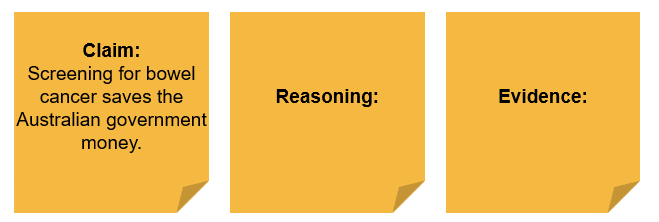
Discuss the evidence and reasoning that students used to support the claim.
✎ STUDENT NOTES: Describe why screening tests can ultimately save money for the government.
Optional: Discuss how these costs could change if the Australian Government decided to offer free tests to everyone over the age of 40. Allow students to use the Population screening costs Data resource to recalculate the cost of this change in screening.
Discuss the conflict between the costs involved in genetic testing every child born in Australia and the impact early treatment will have on the child’s long-term health and lifestyle. Examples may include cystic fibrosis (70-90 babies diagnosed each year in Australia), where early treatment can result in an almost normal lifestyle, and spinal muscular atrophy (20-30 babies diagnosed each year in Australia), where early treatment supports lifestyle but not longevity.
Discuss how, in the next lesson, students will examine the ethical challenges of genetic screening programs.
Reflect on the lesson
You might ask students to:
- add “mutation” to their glossary.
- identify what other screening tests are currently offered in Australia.
- develop an argument for introducing other screening tests in Australia.