

Genes, ethics and society
View Sequence overviewStudents will:
- understand that the environment can affect the expression of a phenotype.
- use the terms “homozygous”, “heterozygous”, “recessive” and “dominant” to explain the outcome of a monogenic cross.
- identify the features and limitations of an educational model.
Students will represent their understanding as they:
- select the appropriate alleles to produce dominant or recessive phenotypes.
- use the genotype to identify if an individual is homozygous or heterozygous for a genetic trait.
- use the known genotype to identify the phenotype of an individual.
In this lesson, assessment is formative.
Feedback might focus on students’ ability to:
- identify recessive and dominant traits.
- identify the key features and limitations of an educational model.
Whole class
Genes, ethics and society Slides
Each student
Breeding pigeons Resource sheet
Student notebook
Access to Pigeonetics website
Lesson
Re-orient
(Slide 41) Discuss how a human cell has 46 chromosomes (23 homologous pairs) and how the process of meiosis produces egg and sperm cells with a single copy of each chromosome (23 chromosomes). Emphasise that the chromosome that is passed on (the left or right of the homologous pair) will vary with each child. This means that the version of each gene (allele) that is passed on will vary.
The Inquire phase allows students to cycle progressively and with increasing complexity through the key science ideas related to the core concepts. Each Inquire cycle is divided into three teaching and learning routines that allow students to systematically build their knowledge and skills in science and incorporate this into their current understanding of the world.
When designing a teaching sequence, it is important to consider the knowledge and skills that students will need in the final Act phase. Consider what the students already know and identify the steps that need to be taken to reach the level required. How could you facilitate students’ understanding at each step? What investigations could be designed to build the skills at each step?
Read more about using the LIA FrameworkIdentifying and constructing questions is the creative driver of the inquiry process. It allows students to explore what they know and how they know it. During the Inquire phase of the LIA Framework, the Question routine allows for past activities to be reviewed and to set the scene for the investigation that students will undertake. The use of effective questioning techniques can influence students’ view and interpretation of upcoming content, open them to exploration and link to their current interests and science capital.
When designing a teaching sequence, it is important to spend some time considering the mindset of students at the start of each Inquire phase. What do you want students to be thinking about, what do they already know and what is the best way for them to approach the task? What might tap into their curiosity?
Read more about using the LIA FrameworkHidden traits
Remind students of the results of the Inherited traits Resource sheet completed in Lesson 4.
Pose the question: Do all inherited traits show in a person’s appearance?
Discuss how traits can be hidden (using makeup to hide freckles, dying hair different colours, using a hair straightener or perm to change hair), not evident (not having learnt to tongue roll) or modified due to environmental influences (tanning).
- What does it mean for a trait to be “hidden” versus “not being present”?
- A hidden trait may be present but not seen. Not being present suggests it was never present.
- Are all genetic traits always easy to observe? Why or why not?
- No. Some people may have the allele for red hair, but the matching allele for hair colour may produce a black pigment that makes the red pigment difficult to see.
- How do examples like makeup, hair dye, or styling change what we see without changing the underlying genes?
- Why might someone choose to change or hide a visible trait?
- Because they do not like that trait.
- How does the environment affect how traits are expressed (e.g. tanning, nutrition, exercise)?
- Can environmental factors sometimes have a bigger impact than genes?
- A genetic predisposition for heart disease can be influenced by a person’s diet and exercise.
- What are some traits that are strongly influenced by both genes and environment?
- Height, weight, cardiovascular health, skin colour, etc.
- What are some traits or abilities that might not show up until later in life or with practice (e.g. skills like tongue rolling)?
- Sporting ability, academic ability, etc.
- Why is it important not to make assumptions about someone’s genetics based only on appearance?
- The environment can change the appearance of a trait.
- How could misunderstanding genetics lead to stereotypes or incorrect conclusions?
- Traits are shaped by a combination of genes, environment, experiences, and opportunities. People might wrongly assume that everyone in a particular family or group will have the same abilities, personality, or health. These kinds of assumptions are called stereotypes and do not account for the randomness of inheritance and the influence of the environment.
Explain that not all traits can be seen on the external surface. Some traits cannot be seen, like metabolism or types of muscles. These are described as biochemical traits (the chemical molecules in the body) and physiological traits (how the body works). These can be affected by what a person eats and how much they exercise.
(Slide 42) Define “phenotype”: the set of observable physical, biochemical and physiological traits of an organism, that is a combination of an individual’s genetic material and their environment.
✎ STUDENT NOTES: Write a definition of “phenotype”.
Pose the question: How do we know which phenotype is passed on?
The Inquire phase allows students to cycle progressively and with increasing complexity through the key science ideas related to the core concepts. Each Inquire cycle is divided into three teaching and learning routines that allow students to systematically build their knowledge and skills in science and incorporate this into their current understanding of the world.
When designing a teaching sequence, it is important to consider the knowledge and skills that students will need in the final Act phase. Consider what the students already know and identify the steps that need to be taken to reach the level required. How could you facilitate students’ understanding at each step? What investigations could be designed to build the skills at each step?
Read more about using the LIA FrameworkThe Investigate routine provides students with an opportunity to explore the key ideas of science, to plan and conduct an investigation, and to gather and record data. The investigations are designed to systematically develop content knowledge and skills through increasingly complex processes of structured inquiry, guided inquiry and open inquiry approaches. Students are encouraged to process data to identify trends and patterns and link them to the real-world context of the teaching sequence.
When designing a teaching sequence, consider the diagnostic assessment (Launch phase) that identified the alternative conceptions that students held. Are there activities that challenge these ideas and provide openings for discussion? What content knowledge and skills do students need to be able to complete the final (Act phase) task? How could you systematically build these through the investigation routines? Are there opportunities to build students’ understanding and skills in the science inquiry processes through the successive investigations?
Read more about using the LIA FrameworkPigeon breeding
Explain that people have been trying to control the traits that appear in each generation for hundreds of years. In the 19th century, Gregor Mendel examined how the traits of pea plants were passed on to the next generation. He found that each parent passed on a separate factor, now called an allele, and that some factors were more likely to appear in the next generation than others. Explain that students are going to explore this during the lesson.
(Slide 43) Discuss some pigeon phenotypes: head crest (extra feathers surrounding the head), grouse (feathers on the legs) and foot slipper (feathers on the foot instead of scales).
(Slide 44) Explain that pigeons have 40 pairs of chromosomes and that their sex chromosomes are different to humans. A male pigeon has a pair of ZZ sex chromosomes, while the female has sex chromosomes ZW.
(Slide 45) Discuss how meiosis separates these chromosomes so that the father passes on the Z chromosome, while the mother can pass on either the W chromosome or the Z chromosome. Remind students that the chromosomes are made up of different genes.
- Why can a male pigeon only produce sperm carrying a Z chromosome?
- Why is the father unable to pass on a W chromosome to his offspring?
- If a father’s sperm always carries a Z chromosome, what determines whether the chick will be ZZ (male) or ZW (female)?
- Why is it accurate to say that the mother determines the sex of the chick in pigeons?
(Slide 46) Introduce the term “genotype” as a way to represent the types of genes (the alleles) that parents can pass on to their offspring (children). Explain that it can also refer to the complete set of genetic material in an organism.
✎ STUDENT NOTES: Define “genotype”.
Remind students that each offspring inherits two copies of each genetic trait, one allele from the mother and one allele from the father.
Pose the question: How do we know which trait will show up in the phenotype?
(Slide 47) Discuss how the pigeon crest phenotype needs “crest alleles” to be inherited from both the mother and the father. The no-crest phenotype only needs a single copy of the no-crest allele in order to appear in the phenotype. Explain that this means the no-crest trait is dominant. When both alleles are present (the second example), the offspring have no crest. The crest trait is recessive as it needs two copies of the allele for it to appear in the phenotype of the offspring.
- What does it mean when a trait is described as “dominant”?
- Why is the trait for the pigeon crest called “recessive”?
- Does an allele for a recessive trait disappear if it is not expressed in the phenotype? Explain.
- The allele for a recessive trait (crest) is still present, it just does not appear in the phenotype.
- If a pigeon has the genotype of crest and no-crest, will it have a crest? Why?
- For a crest to appear in the phenotype, it needs two copies of the crest allele.
- Why does the no-crest allele “mask” the crest allele in an individual with both types of alleles?
- The no-crest trait is dominant and is always most likely to appear.
- Can a pigeon with no crest carry the allele for a crest? Explain your reasoning.
- A pigeon only needs one copy of the no-crest allele for it to appear in the phenotype. They can still carry the crest allele as well.
- Is it accurate to say that the no-crest allele is “stronger” than the crest allele? Why or why not?
- No. Being the dominant trait just means that it is more likely to appear in the phenotype.
(Slide 48) ✎ STUDENT NOTES: Define “dominant” and “recessive” traits.
(Slide 49) Remind students that another feature of breeding pigeons is the ability to develop feathers on the legs instead of scales. The allele for this feature is called the “grouse” allele. Invite students to use the images on the slide to identify if the grouse trait is a dominant or recessive trait.
Discuss how a pigeon that inherits a grouse allele from the father and the no-grouse allele from the mother would result in the no-grouse trait. This means the no-grouse trait is dominant.
(Slide 50) Explain that sometimes a trait (like the foot slipper in pigeons) can be partially dominant (incomplete dominance) when two different alleles are inherited from the parents. This means the pigeon’s foot has some feathers, but not as many as a pigeon with two alleles for the foot slipper trait.
Provide students with a copy of the Breeding pigeons Resource sheet.
(Slide 51) Use the Pigeonetics simulation to model how to select the pigeons for breeding, and which alleles to choose to breed the desired traits in the next generation.
The goal of this activity is to use the Pigeonetics simulation produced by the Stark Science Learning Centre at the University of Utah to breed a selected type of pigeon.
Step through the introduction about pigeon breeding, then follow the steps below.
- Select a pigeon parent. The genotype of the pigeon will appear below the pigeon.
- Select the allele that you want to appear in the offspring.
- Repeat steps 1 and 2 for the second parent and alleles.
- Select “Hatch” to produce the offspring.
- If the offspring correctly matches your desired goal, record the alleles you selected on the Resource sheet.
Allow students time to breed seven different pigeons meeting the goals on their Resource sheet.
Mendel’s genetics
Gregor Mendel is regarded as the father of modern genetics.
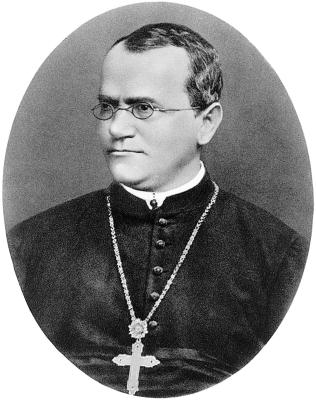
Gregor Mendel is regarded as the father of modern genetics because he was the first scientist to explain how traits are inherited from one generation to the next. In the early 1860s, Mendel conducted thousands of carefully controlled experiments using pea plants (Pisum sativum). Pea plants were an ideal model because they have easily observable traits, reproduce quickly, and can be either self-fertilised or cross-fertilised by hand.
Mendel began by establishing pure-breeding lines of pea plants that consistently produced the same traits over many generations. He studied seven characteristics, including seed colour, seed shape, pod colour, pod shape, flower position, stem height, and seed coat colour. By cross-pollinating plants with contrasting traits, such as round-seeded plants with wrinkled-seeded plants, Mendel observed that the first generation of offspring (F1) displayed only one of the parental traits. He called this the dominant trait, while the “hidden” trait was called recessive.
To investigate further, Mendel allowed the F1 plants to self-fertilise and produce a second generation (F2). In this next generation, the recessive trait reappeared in a predictable ratio of approximately 3:1. These results demonstrated that traits do not blend together, as many scientists of the time believed. Instead, Mendel proposed that hereditary information is passed as discrete units (now known as genes). Different forms of a gene are now called alleles.
From his observations, Mendel developed the principle of segregation, which states that individuals inherit two alleles for each trait (one from each parent). These alleles separate during the formation of gametes, so each gamete carries only one allele. Fertilisation then restores the pair of alleles in the offspring. Mendel’s work also laid the foundation for the principle of independent assortment, which explains how different traits can be inherited independently of one another.
Mendel’s experiments used rigorous methodology, large sample sizes, and quantitative analysis. Although his findings were published in 1866, they were largely ignored until their rediscovery around 1900. Today, Mendel’s principles form the basis of classical genetics and for understanding inheritance, genetic variation and many inherited human disorders.
References
Miko, I. (2008). Gregor Mendel and the Principles of Inheritance. Nature Education; Nature Education. https://www.nature.com/scitable/topicpage/gregor-mendel-and-the-principles-of-inheritance-593/
Gregor Mendel is regarded as the father of modern genetics because he was the first scientist to explain how traits are inherited from one generation to the next. In the early 1860s, Mendel conducted thousands of carefully controlled experiments using pea plants (Pisum sativum). Pea plants were an ideal model because they have easily observable traits, reproduce quickly, and can be either self-fertilised or cross-fertilised by hand.
Mendel began by establishing pure-breeding lines of pea plants that consistently produced the same traits over many generations. He studied seven characteristics, including seed colour, seed shape, pod colour, pod shape, flower position, stem height, and seed coat colour. By cross-pollinating plants with contrasting traits, such as round-seeded plants with wrinkled-seeded plants, Mendel observed that the first generation of offspring (F1) displayed only one of the parental traits. He called this the dominant trait, while the “hidden” trait was called recessive.
To investigate further, Mendel allowed the F1 plants to self-fertilise and produce a second generation (F2). In this next generation, the recessive trait reappeared in a predictable ratio of approximately 3:1. These results demonstrated that traits do not blend together, as many scientists of the time believed. Instead, Mendel proposed that hereditary information is passed as discrete units (now known as genes). Different forms of a gene are now called alleles.
From his observations, Mendel developed the principle of segregation, which states that individuals inherit two alleles for each trait (one from each parent). These alleles separate during the formation of gametes, so each gamete carries only one allele. Fertilisation then restores the pair of alleles in the offspring. Mendel’s work also laid the foundation for the principle of independent assortment, which explains how different traits can be inherited independently of one another.
Mendel’s experiments used rigorous methodology, large sample sizes, and quantitative analysis. Although his findings were published in 1866, they were largely ignored until their rediscovery around 1900. Today, Mendel’s principles form the basis of classical genetics and for understanding inheritance, genetic variation and many inherited human disorders.
References
Miko, I. (2008). Gregor Mendel and the Principles of Inheritance. Nature Education; Nature Education. https://www.nature.com/scitable/topicpage/gregor-mendel-and-the-principles-of-inheritance-593/
The Inquire phase allows students to cycle progressively and with increasing complexity through the key science ideas related to the core concepts. Each Inquire cycle is divided into three teaching and learning routines that allow students to systematically build their knowledge and skills in science and incorporate this into their current understanding of the world.
When designing a teaching sequence, it is important to consider the knowledge and skills that students will need in the final Act phase. Consider what the students already know and identify the steps that need to be taken to reach the level required. How could you facilitate students’ understanding at each step? What investigations could be designed to build the skills at each step?
Read more about using the LIA FrameworkFollowing an investigation, the Integrate routine provides time and space for data to be evaluated and insights to be synthesized. It reveals new insights, consolidates and refines representations, generalises context and broadens students’ perspectives. It allows student thinking to become visible and opens formative feedback opportunities. It may also lead to further questions being asked, allowing the Inquire phase to start again.
When designing a teaching sequence, consider the diagnostic assessment that was undertaken during the Launch phase. Consider if alternative conceptions could be used as a jumping off point to discussions. How could students represent their learning in a way that would support formative feedback opportunities? Could small summative assessment occur at different stages in the teaching sequence?
Read more about using the LIA FrameworkHomozygous and heterozygous
Discuss the genotypes required to breed the desired phenotypes in the activity. Through discussion, reach a consensus that the crests, no-slippers and grouse (recessive traits) phenotypes needed two copies of the alleles. No-crest and no-grouse (dominant traits) only needed one copy of the allele to appear in the phenotype. Identify that the partially dominant trait of slippers has an in-between stage where a partial slipper was possible with a single allele, but a full slipper needs two copies of the desired allele.
(Slide 52) Introduce the terms “homozygous” (two identical alleles) and “heterozygous” (two different alleles). Discuss how recessive traits (crests, no-slippers and grouse) need to be homozygous genotypes to appear in the phenotype. Dominant traits (no-crest and grouse) only need a single copy allele for the phenotype to appear.
✎ STUDENT NOTES: Define the terms “homozygous” (two identical alleles) and “heterozygous” (two different alleles).
Discuss the approaches students used to breed their pigeon. They may have:
- randomly selected the alleles for the desired phenotype with no understanding of dominance.
- deliberately selected the alleles with the desired characteristic to achieve the desired phenotype. While this would have been beneficial in Goals 1-4, this approach would not be possible in Goals 5-7.
- Goals 5-7: Used trial and error across two generations to produce the desired phenotype.
- Goals 5-7: Selected the genotypes for the final offspring (F2 generation) and worked backwards to determine the required genotypes of the parents (F1 generation).
- What strategy did you use to produce your target pigeon phenotype? Why did you choose that approach?
- Did you select alleles randomly, or did you deliberately choose alleles based on your understanding of dominant and recessive traits? How did this affect your success?
- How did your understanding of dominance influence your breeding decisions?
- For Goals 1-4, why was it possible to directly select the alleles needed to achieve the desired phenotype?
- For Goals 5-7, what challenges made direct allele selection difficult?
- If you used trial and error in Goals 5-7, how did your strategy change between the F1 and F2 generations?
- If you worked backwards from the desired F2 offspring, how did you determine the required genotypes of the F1 parents?
- Which approach do you think was the most efficient? What evidence from your results supports your answer?
- If you repeated the activity, would you use the same breeding strategy? Why or why not?
- How does this simulation reflect the way plant and animal breeders make decisions in real-world selective breeding programs?
Pose the question: Does this model of breeding and inheritance reflect what happens in the real world? Why or why not?
Discuss how the effects of the environment do not appear in this model. For example, a disrupted diet, infections and pecking by other birds can alter how well feathers grow.
- What environmental factors could affect feather growth that are not included in the model?
- How might a disrupted or poor diet change the rate or quality of feather growth?
- How could pecking or physical damage from other birds affect the feathers shown in the model?
- What effect might infections or disease have on feather development?
- What assumptions does the model make about the bird’s environment?
- How could you modify the model to account for environmental factors?
- Why is it important to consider both genetic factors and environmental conditions when predicting feather growth?
Discuss how plant and animal breeders cannot select which allele is passed on to the F1 generation. Meiosis involves the random assortment of chromosomes containing the alleles. This means it is difficult to predict which alleles will be passed on to the next (F1) generation.
Invite students to suggest the purpose of this type of scientific model: to educate the user about inheritance. Encourage students to identify the features that support this, including:
- the use of non-scientific language.
- the trial-and-error approach.
- the gradual introduction of scientific language during each task.
- the hints provided for the more complicated goals.
- the explanations that can be selected after achieving each goal.
Invite students to identify the limitations of this model, including that it cannot be used to make predictions of which allele will be passed on and does not represent the random assortment of alleles that occurs during meiosis.
Discuss how students will use a mathematical model that examines this in the next lesson.
Reflect on the lesson
You might ask students to:
- add “offspring”, “dominant trait”, “recessive trait”, “phenotype”, “genotype”, “homozygous” and “heterozygous” to their glossary.
- respond to the below statements.
- Children inherit more characteristics from their mother than their father. True or false?
- False. A common alternative conception is that children inherit more or all of their genes from the mother, as the mother carries the child during pregnancy. Reinforce that children inherit half of their chromosomes (one of each pair) and genes from each parent.
- I breed two pigeons with no crest, and one of their offspring has a crest. Explain this finding.
- The crest trait is recessive. The offspring may have inherited an allele for the recessive crest trait from each parent.
- Children inherit more characteristics from their mother than their father. True or false?