

Genes, ethics and society
View Sequence overviewStudents will:
- identify a series of inherited traits.
- understand that offspring inherit one of each pair of chromosomes from each parent through meiosis and fertilisation.
- model the process of meiosis.
- understand how random assortment can lead to different traits in siblings.
Students will represent their understanding as they:
- explain the key steps of meiosis.
- simulate the process of meiosis.
- use argumentation to make a claim regarding the purpose of meiosis.
In this lesson, assessment is formative.
Feedback might focus on students’ ability to:
- model the process of meiosis.
- identify the number of chromosomes before and after meiosis.
- explain a model of meiosis.
Potential summative task
Students working at the achievement standard should:
- explain how genetic information passed on to offspring from both parents by meiosis and fertilisation increases the variation of a species.
- develop an explanatory model of meiosis.
- construct logical arguments based on evidence to support conclusions and claims.
Whole class
Genes, ethics and society Slides
Each group
8 x pipe cleaners (4 each of 2 different colours)
Masking tape
Scissors
A3/A4 paper
Each student
Inherited traits Resource sheet
Meiosis modelling Resource sheet
Meiosis mix-up Resource sheet
Student notebook
Lesson
Re-orient
Discuss the relationship between chromosomes, genes and DNA.
(Slide 25) Discuss the size differences between cells, genes, chromosomes, nuclei and DNA. Guide students to realise that a chromosome is a shorter, more tightly wound version of DNA. Therefore, the order of size from smallest to largest would be: gene, chromosome/DNA, nucleus, then cell.
The Inquire phase allows students to cycle progressively and with increasing complexity through the key science ideas related to the core concepts. Each Inquire cycle is divided into three teaching and learning routines that allow students to systematically build their knowledge and skills in science and incorporate this into their current understanding of the world.
When designing a teaching sequence, it is important to consider the knowledge and skills that students will need in the final Act phase. Consider what the students already know and identify the steps that need to be taken to reach the level required. How could you facilitate students’ understanding at each step? What investigations could be designed to build the skills at each step?
Read more about using the LIA FrameworkIdentifying and constructing questions is the creative driver of the inquiry process. It allows students to explore what they know and how they know it. During the Inquire phase of the LIA Framework, the Question routine allows for past activities to be reviewed and to set the scene for the investigation that students will undertake. The use of effective questioning techniques can influence students’ view and interpretation of upcoming content, open them to exploration and link to their current interests and science capital.
When designing a teaching sequence, it is important to spend some time considering the mindset of students at the start of each Inquire phase. What do you want students to be thinking about, what do they already know and what is the best way for them to approach the task? What might tap into their curiosity?
Read more about using the LIA FrameworkWhose traits do I have?
Provide students with a copy of the Inherited traits Resource sheet.
(Slide 26) Invite students to identify if they have common traits that they have inherited from their parents (e.g. tongue rolling, hair waviness, attached earlobes).
✎ STUDENT NOTES: Mark each trait that you possess.
(Slide 27) Collate class data on the presence of traits on the whiteboard by asking students to place a sticky note or a tick for each trait they possess.
| Inherited trait | Do you have this trait? | Class result (percentage) |
|---|---|---|
| Tongue rolling | ||
| Attached earlobes | ||
| Widow’s peak | ||
| Dimples | ||
| Cleft chin | ||
| Hitchhiker’s thumb | ||
| Hair on middle finger | ||
| Freckles | ||
| Hand clasping (left thumb on top) | ||
| Hair colour (dark hair) | ||
| Wavy/curly hair |
Discuss how each of these genetic traits is inherited from parents through the passing on of genes and chromosomes.
NOTE: The Inherited traits Resource sheet will be reused in Lesson 6.
Pose the question: How are genetic traits passed from parents to the child?
Discuss how the (genetic) mother provides an egg cell and the (genetic) father provides a sperm cell. These cells are called “gamete cells” and they carry chromosomes (the genetic material) that determine the inherited traits.
Discuss what would happen if sperm and egg cells had 46 chromosomes, like all of the other cells in a body. If a sperm cell with 46 chromosomes combines with an egg cell with 46 chromosomes, the genetic material would combine in the new nucleus with 92 chromosomes.
Invite students to model how the number of chromosomes in each cell would increase if egg and sperm combined all their chromosomes over three generations.
✎ STUDENT NOTES: Calculate the number of chromosomes that would be present in each cell after three generations if egg and sperm cells (gametes) combined all their chromosomes. (46 + 46 = 92; 92 + 92 = 184; 184 + 184 = 368)
- What is the usual number of chromosomes in a human body cell?
- If both gametes had 46 chromosomes, how many chromosomes would the offspring have? Why is that a problem?
- Why is it important that offspring have the same chromosome number as their parents?
- Why is cell division that produces identical daughter cells (with the same number of chromosomes) suitable for growth and repair but not for producing gametes?
Invite students to repeat this calculation if cells halved the number of chromosomes before fertilisation each time.
✎ STUDENT NOTES: Calculate the number of chromosomes that would be present in each cell after three generations if:
- the gametes (egg and sperm) first halved the number of chromosomes to form a gamete (46 ÷ 2 = 23 chromosomes/gamete).
- during fertilisation, the gametes combine (23 + 23 = 46 chromosomes/fertilised cell).
Pose the question: How do the gamete (egg and sperm) cells end up with half the number of chromosomes?
The Inquire phase allows students to cycle progressively and with increasing complexity through the key science ideas related to the core concepts. Each Inquire cycle is divided into three teaching and learning routines that allow students to systematically build their knowledge and skills in science and incorporate this into their current understanding of the world.
When designing a teaching sequence, it is important to consider the knowledge and skills that students will need in the final Act phase. Consider what the students already know and identify the steps that need to be taken to reach the level required. How could you facilitate students’ understanding at each step? What investigations could be designed to build the skills at each step?
Read more about using the LIA FrameworkThe Investigate routine provides students with an opportunity to explore the key ideas of science, to plan and conduct an investigation, and to gather and record data. The investigations are designed to systematically develop content knowledge and skills through increasingly complex processes of structured inquiry, guided inquiry and open inquiry approaches. Students are encouraged to process data to identify trends and patterns and link them to the real-world context of the teaching sequence.
When designing a teaching sequence, consider the diagnostic assessment (Launch phase) that identified the alternative conceptions that students held. Are there activities that challenge these ideas and provide openings for discussion? What content knowledge and skills do students need to be able to complete the final (Act phase) task? How could you systematically build these through the investigation routines? Are there opportunities to build students’ understanding and skills in the science inquiry processes through the successive investigations?
Read more about using the LIA FrameworkModelling meiosis
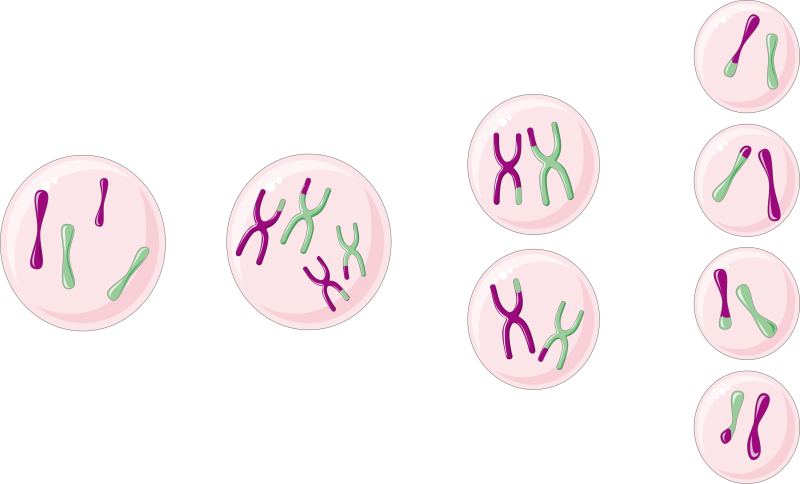
(Slide 28) Introduce the term “meiosis”: the process where gametes (egg and sperm cells) are produced with half the number of chromosomes.
✎ STUDENT NOTES: Define meiosis as a special type of cell division that reduces the number of chromosomes in gamete (egg and sperm) cells.
(Slide 29) Explain that all gamete cells start as a “normal” cell with 46 chromosomes. Explain that it is difficult to model this process with all 46 chromosomes, so students will model it with just two chromosomes.
Provide students with the Meiosis modelling Resource sheet and the materials required to model the process.
(Slide 30) Allow students time to model the process of meiosis I. Discuss how the cells at the end of the process have half the number of (duplicated) chromosomes; they are all wound tightly around the histones and cannot make proteins at this stage.
(Slide 31) Allow students time to model the process of meiosis II. Compare the number of chromosomes in each cell at the end to the number of chromosomes at the start of the meiosis process.
Inheritance of traits
New cells are continuously needed for growth and repair.
New cells are continuously needed for growth and repair. This process of cellular replication is called mitosis. When autosomal (body) cells replicate by mitosis, two identical daughter cells with 46 chromosomes are produced.
Meiosis is another type of cellular replication which produces sperm and ova, also called gametes. Instead of 46 chromosomes, the gametes have 23 chromosomes (22 autosomal chromosomes and one sex chromosome).
The cell that produces gametes is called a germ cell. In males, the primary spermatocytes (male germ cells) produce four sperm cells with 23 chromosomes. This is the process that is modelled in this activity.
In females, the primary oocytes (female germ cells) only produce a single large ovum (egg cell) with 23 chromosomes. The remaining cells produced during meiosis (called polar bodies) are much smaller than the final ova and die during the meiosis process.
During the process of meiosis, the chromosomes are randomly assorted. Random assortment, also known as the law of independent assortment, is a principle of genetics first described by Gregor Mendel. It states that during the formation of gametes, the chromosomes (and therefore the alleles of different genes) are distributed independently of one another. This means that the inheritance of one trait on one chromosome generally does not affect the inheritance of another trait on a different chromosome. Random assortment increases genetic variation within a population by producing many possible combinations of traits in the gametes.
During fertilisation, the sperm and ova combine to produce a single-celled embryo with 46 chromosomes (half from each parent). This means that half of the DNA (one of each chromosome pair) comes from each parent. A fertilised ovum is called a zygote and will replicate by mitosis to become an embryo.
Mitosis is covered in the next lesson of the sequence.
New cells are continuously needed for growth and repair. This process of cellular replication is called mitosis. When autosomal (body) cells replicate by mitosis, two identical daughter cells with 46 chromosomes are produced.
Meiosis is another type of cellular replication which produces sperm and ova, also called gametes. Instead of 46 chromosomes, the gametes have 23 chromosomes (22 autosomal chromosomes and one sex chromosome).
The cell that produces gametes is called a germ cell. In males, the primary spermatocytes (male germ cells) produce four sperm cells with 23 chromosomes. This is the process that is modelled in this activity.
In females, the primary oocytes (female germ cells) only produce a single large ovum (egg cell) with 23 chromosomes. The remaining cells produced during meiosis (called polar bodies) are much smaller than the final ova and die during the meiosis process.
During the process of meiosis, the chromosomes are randomly assorted. Random assortment, also known as the law of independent assortment, is a principle of genetics first described by Gregor Mendel. It states that during the formation of gametes, the chromosomes (and therefore the alleles of different genes) are distributed independently of one another. This means that the inheritance of one trait on one chromosome generally does not affect the inheritance of another trait on a different chromosome. Random assortment increases genetic variation within a population by producing many possible combinations of traits in the gametes.
During fertilisation, the sperm and ova combine to produce a single-celled embryo with 46 chromosomes (half from each parent). This means that half of the DNA (one of each chromosome pair) comes from each parent. A fertilised ovum is called a zygote and will replicate by mitosis to become an embryo.
Mitosis is covered in the next lesson of the sequence.
The Inquire phase allows students to cycle progressively and with increasing complexity through the key science ideas related to the core concepts. Each Inquire cycle is divided into three teaching and learning routines that allow students to systematically build their knowledge and skills in science and incorporate this into their current understanding of the world.
When designing a teaching sequence, it is important to consider the knowledge and skills that students will need in the final Act phase. Consider what the students already know and identify the steps that need to be taken to reach the level required. How could you facilitate students’ understanding at each step? What investigations could be designed to build the skills at each step?
Read more about using the LIA FrameworkFollowing an investigation, the Integrate routine provides time and space for data to be evaluated and insights to be synthesized. It reveals new insights, consolidates and refines representations, generalises context and broadens students’ perspectives. It allows student thinking to become visible and opens formative feedback opportunities. It may also lead to further questions being asked, allowing the Inquire phase to start again.
When designing a teaching sequence, consider the diagnostic assessment that was undertaken during the Launch phase. Consider if alternative conceptions could be used as a jumping off point to discussions. How could students represent their learning in a way that would support formative feedback opportunities? Could small summative assessment occur at different stages in the teaching sequence?
Read more about using the LIA FrameworkMeiosis mix-up
Provide students with a copy of the Meiosis mix-up Resource sheet.
Ask students to cut out each stage of the meiosis diagrams and arrange them to show the order of the process.
✎ STUDENT NOTES: Cut out each stage of the meiosis process and paste them into your student notebook in the correct order. Label each stage and describe the key processes that occur at that stage.
Discuss how individual traits are passed on to each gamete (egg or sperm) cell during meiosis. Compare the final gametes each student has produced by meiosis and discuss how the chromosomes have been randomly sorted.
- How does meiosis ensure that each egg or sperm cell receives only half the genetic information of the parent cell?
- During anaphase 1, each chromosome pair moves to opposite sides of the cell before it divides into two cells.
- What role do chromosomes play in passing traits from parents to offspring?
- Chromosomes contain the genes that produce the proteins that determine hair and skin colour, the shape of facial features, etc.
- How can two siblings inherit different combinations of traits from the same parents?
- There is variation in which combination of chromosomes ends up at each side of a cell before it divides into the final gamete cells.
- Why is fertilisation important after meiosis has reduced chromosome numbers?
- If the chromosome number is not reduced before fertilisation, the number of chromosomes would double in each generation.
- How does the random alignment of chromosomes during meiosis affect inherited characteristics?
- Each sibling could receive different combinations of chromosomes and therefore have different physiological features.
Define “random assortment” as the random organisation of chromosomes in gamete (egg and sperm) cells that increases genetic diversity during fertilisation.
(Slide 32) ✎ STUDENT NOTES: Define random assortment.
Discuss how this model of meiosis could explain why some people might inherit one more or one less chromosome.
- How could we use this model to show what happens when chromosomes do not separate properly?
- By modelling a paired set of chromosomes both moving to the same side of a cell, or by a duplicated “H” chromosome not separating during anaphase 2.
- Why might a baby inherit one extra or one fewer chromosome?
- Because a paired set of chromosomes both moved to the same side of a cell, or if a duplicated “H” chromosome not separating during anaphase 2.
- What could happen if an egg or sperm has the wrong number of chromosomes?
- The fertilised cell would end up with one more or one less chromosome. For example, Down syndrome (3 x chromosome 21), Klinefelter’s syndrome (XXY) or Turner’s syndrome (single X chromosome).
- What do you think happens to the cells that have errors in the chromosomes?
- Many cells with the incorrect number of chromosomes will die and be reabsorbed back into the body.
- What are the strengths and weaknesses of using a model to explain chromosome inheritance?
- All models have limitations in what they can explain or predict. This model does not show what happens when there is a mutation in a single gene. It also does not predict the effect of chromosomal errors.
- How could scientists use this type of model to explain chromosome disorders to patients or families?
- Scientists can use the model to show how the chromosomal error occurred. It does not explain the symptoms or consequences of the disorder.
- If you could improve this model, what would you add or change to make it easier to understand?
(Slide 33) Invite students to use argumentation to provide evidence and reasoning for the claim “Each egg and sperm receive different combinations of traits”.
✎ STUDENT NOTES: Use argumentation to provide evidence and reasoning to support the claim. Identify a limitation for the argument (for example, bacteria use binary fission rather than meiosis).
Reflect on the lesson
You might ask students to:
- add the words “nucleus”, “cell”, “inherited”, “gamete” (egg and sperm cells), “meiosis” and “random assortment” to a glossary.
- create a flip book or stop motion video of the meiosis process.
- identify the number of chromosomes at each stage of meiosis.
- watch the video Meiosis song by Peter Weatherall (2:47).