

Genes, ethics and society
View Sequence overviewStudents will:
- use an analogy of strands of wool to develop their understanding of the relationship between DNA, genes, alleles and chromosomes.
- observe the 46 chromosomes that make up a human karyotype.
- recall that DNA is a double helix molecule present in the nucleus of most living cells and codes for proteins.
Students will represent their understanding as they:
- construct a pair of wool chromosomes and explain the parts that represent chromosomes, genes, DNA and alleles.
- respond to questions about how the strands of wool are like or unlike a chromosome with genes.
- suggest further analogies to understand the structure of chromosomes.
In this lesson, assessment is formative.
Feedback might focus on students’ ability to:
- label and interpret the parts of a chromosome made out of strands of coloured wool.
- compare analogies of chromosomes, DNA, genes and alleles.
Potential summative task
Students working at the achievement standard should:
- select and construct appropriate representations, including models, to organise and process data and information.
- write and create texts to communicate ideas, findings and arguments effectively for identified purposes and audiences, including selection of appropriate content, language and text features.
Whole class
Genes, ethics and society Slides
Video: Genetics 101 (1:18)
Video: Heredity: Who are you? (5:55)
Homologous chromosomes Resource sheet (cut out the 30 individual chromosomes and optionally laminate for future use)
Each group
4 x balls of wool in different colours (two colours should be different shades of the same colour e.g. light blue and dark blue)
Coloured pencils or pens, in the same colours as the wool
Scissors
Each student
Chromosomes genes and analogies Resource sheet
Student notebook
Optional: 2 m of cotton thread
Lesson
The Inquire phase allows students to cycle progressively and with increasing complexity through the key science ideas related to the core concepts. Each Inquire cycle is divided into three teaching and learning routines that allow students to systematically build their knowledge and skills in science and incorporate this into their current understanding of the world.
When designing a teaching sequence, it is important to consider the knowledge and skills that students will need in the final Act phase. Consider what the students already know and identify the steps that need to be taken to reach the level required. How could you facilitate students’ understanding at each step? What investigations could be designed to build the skills at each step?
Read more about using the LIA FrameworkRe-orient
Remind students that diseases can be caused by infectious agents, environmental/lifestyle factors, or inherited from parents.
- “All diseases are caused by germs.” Agree or disagree?
- “Inherited diseases can’t be prevented.” What do you think?
- “Lifestyle choices have no impact on health.” True or false?
The Inquire phase allows students to cycle progressively and with increasing complexity through the key science ideas related to the core concepts. Each Inquire cycle is divided into three teaching and learning routines that allow students to systematically build their knowledge and skills in science and incorporate this into their current understanding of the world.
When designing a teaching sequence, it is important to consider the knowledge and skills that students will need in the final Act phase. Consider what the students already know and identify the steps that need to be taken to reach the level required. How could you facilitate students’ understanding at each step? What investigations could be designed to build the skills at each step?
Read more about using the LIA FrameworkIdentifying and constructing questions is the creative driver of the inquiry process. It allows students to explore what they know and how they know it. During the Inquire phase of the LIA Framework, the Question routine allows for past activities to be reviewed and to set the scene for the investigation that students will undertake. The use of effective questioning techniques can influence students’ view and interpretation of upcoming content, open them to exploration and link to their current interests and science capital.
When designing a teaching sequence, it is important to spend some time considering the mindset of students at the start of each Inquire phase. What do you want students to be thinking about, what do they already know and what is the best way for them to approach the task? What might tap into their curiosity?
Read more about using the LIA FrameworkDNA forms chromosomes
(Slide 9) Recall from Year 7-8 science that genetic/DNA material is found in the nucleus of most cells in the body, and that it is needed for healthy growth and repair of cells and tissues. Invite students to study the slide to identify a single cell and the nucleus within the cell.
- Where have you heard about DNA before?
- Where in a cell is DNA found?
- What is the role of the nucleus?
- Do you think only humans have DNA, or do other living things have it too?
- What might happen if the DNA in a cell is damaged?
- Why is DNA important for growth and repair?
Explain that each cell has approximately 2 metres of deoxyribonucleic acid (DNA) in it.
Optional: Provide students with 2 metres of cotton thread and ask them to gather it together to make it small enough to fit inside a cell (less than 1 mm).
Pose the question: How do cells make sure that the DNA does not become too tangled to be used to make new cells and to repair the body?
(Slide 10) Explain that each cell carefully winds a DNA molecule around small proteins (histones) so that it does not become tangled. This combination of DNA and proteins is called “chromatin”. To make it even smaller, the DNA/protein chromatin winds up in an organised way to be called a “chromosome”. This stops it tangling when a cell divides. Most human cells (except sperm, ova and red blood cells) have 46 chromosomes.
✎ STUDENT NOTES: Define “chromatin” (DNA wound around protein histones) and “chromosome” (organised arrangement of chromatin to prevent tangling during cell replication).
Discuss how the 46 chromosomes can be paired according to their length and banding.
Pose the question: How do scientists identify and pair chromosomes?
The Inquire phase allows students to cycle progressively and with increasing complexity through the key science ideas related to the core concepts. Each Inquire cycle is divided into three teaching and learning routines that allow students to systematically build their knowledge and skills in science and incorporate this into their current understanding of the world.
When designing a teaching sequence, it is important to consider the knowledge and skills that students will need in the final Act phase. Consider what the students already know and identify the steps that need to be taken to reach the level required. How could you facilitate students’ understanding at each step? What investigations could be designed to build the skills at each step?
Read more about using the LIA FrameworkThe Investigate routine provides students with an opportunity to explore the key ideas of science, to plan and conduct an investigation, and to gather and record data. The investigations are designed to systematically develop content knowledge and skills through increasingly complex processes of structured inquiry, guided inquiry and open inquiry approaches. Students are encouraged to process data to identify trends and patterns and link them to the real-world context of the teaching sequence.
When designing a teaching sequence, consider the diagnostic assessment (Launch phase) that identified the alternative conceptions that students held. Are there activities that challenge these ideas and provide openings for discussion? What content knowledge and skills do students need to be able to complete the final (Act phase) task? How could you systematically build these through the investigation routines? Are there opportunities to build students’ understanding and skills in the science inquiry processes through the successive investigations?
Read more about using the LIA FrameworkMatching chromosomes
Provide each student with an individual chromosome cut from the Homologous chromosome Resource sheet.
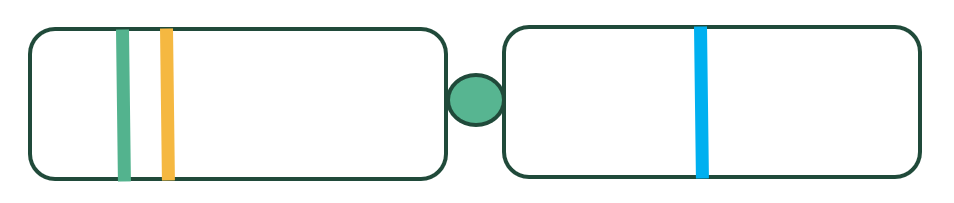
(Slide 11) Invite students to find their matching chromosome by comparing the length and the coloured bands.
Allow students time to find their matching chromosome partner.
The Inquire phase allows students to cycle progressively and with increasing complexity through the key science ideas related to the core concepts. Each Inquire cycle is divided into three teaching and learning routines that allow students to systematically build their knowledge and skills in science and incorporate this into their current understanding of the world.
When designing a teaching sequence, it is important to consider the knowledge and skills that students will need in the final Act phase. Consider what the students already know and identify the steps that need to be taken to reach the level required. How could you facilitate students’ understanding at each step? What investigations could be designed to build the skills at each step?
Read more about using the LIA FrameworkFollowing an investigation, the Integrate routine provides time and space for data to be evaluated and insights to be synthesized. It reveals new insights, consolidates and refines representations, generalises context and broadens students’ perspectives. It allows student thinking to become visible and opens formative feedback opportunities. It may also lead to further questions being asked, allowing the Inquire phase to start again.
When designing a teaching sequence, consider the diagnostic assessment that was undertaken during the Launch phase. Consider if alternative conceptions could be used as a jumping off point to discussions. How could students represent their learning in a way that would support formative feedback opportunities? Could small summative assessment occur at different stages in the teaching sequence?
Read more about using the LIA FrameworkHomologous chromosomes
(Slide 12) Discuss the meaning of homologous chromosomes: matching pairs of chromosomes that are the same size and have the same genes.
✎ STUDENT NOTES: Define homologous chromosomes as a matching pair of chromosomes that are the same size and have the same genes.
Discuss how scientists will use the process of matching pairs of chromosomes to identify if a person is male (XY) or female (XX), or if there are extra or missing chromosomes.
(Slide 13) Guide students to identify the stained 46 chromosomes in a single human cell in the left image. Point out that chromosomes can only be seen when the cell is ready to divide. This is why they are in a “X” shape on the left image. Explain that the 46 chromosomes (23 pairs) spend most of their time as a single “I” shaped (unreplicated) molecule, as represented on the right image.
- What differences do you notice between the chromosomes in this image and the chromatin in the previous drawing?
- Can you count how many chromosomes are visible in this human cell?
- Why might scientists photograph chromosomes when a cell is about to divide?
- Because the chromosomes are wound up into easily seen molecules.
- What do you think each half of the “X” represents?
- The two halves are identical copies of each other.
- If chromosomes are usually “I” shaped, what must have happened before they became “X” shaped?
- Each chromosome has made an identical copy of itself.
- Why would a cell need to copy its chromosomes before division?
- So that when a cell divides into two new cells, each cell has a complete set of chromosomes.
- Why is it useful for DNA to be tightly packed during cell division?
- To prevent tangling.
Explain that a full collection of 46 chromosomes is called a “karyotype”: an individual’s complete set of chromosomes that may be arranged in numerical order.
- How many chromosome pairs could you find in a human karyotype?
- 23 pairs (46 chromosomes).
- What do you notice about the final pair of chromosomes compared with the others?
- The X and Y chromosomes (in males) are different sizes.
- What differences do you see between the X and Y chromosomes?
- The X chromosome is much larger than the Y chromosome.
- Why might scientists arrange chromosomes in numerical order?
- To make it easier to see if there are any extra chromosomes or to identify if one is missing.
- How could a karyotype help doctors identify genetic conditions?
- When there are extra or missing chromosomes, this will affect the growth and development of the individual.
- What might happen if there were an extra chromosome or a missing chromosome?
- Examples include Down syndrome (extra chromosome 23), Klinefelter Syndrome (XXY chromosomes), Edwards syndrome (extra chromosome 18), and Turner syndrome (only 1 X chromosome).
- Why do you think the sex chromosomes are grouped separately from the other chromosome pairs?
- They are only paired (XX) in females. Males have XY.
(Slide 14)✎ STUDENT NOTES: Define “karyotype” (an individual’s complete set of chromosomes that may be arranged in numerical order), “autosomes” (chromosomes that do not determine the sex of an individual) and “sex chromosomes” (chromosomes that determine the sex of an individual).
The Inquire phase allows students to cycle progressively and with increasing complexity through the key science ideas related to the core concepts. Each Inquire cycle is divided into three teaching and learning routines that allow students to systematically build their knowledge and skills in science and incorporate this into their current understanding of the world.
When designing a teaching sequence, it is important to consider the knowledge and skills that students will need in the final Act phase. Consider what the students already know and identify the steps that need to be taken to reach the level required. How could you facilitate students’ understanding at each step? What investigations could be designed to build the skills at each step?
Read more about using the LIA FrameworkIdentifying and constructing questions is the creative driver of the inquiry process. It allows students to explore what they know and how they know it. During the Inquire phase of the LIA Framework, the Question routine allows for past activities to be reviewed and to set the scene for the investigation that students will undertake. The use of effective questioning techniques can influence students’ view and interpretation of upcoming content, open them to exploration and link to their current interests and science capital.
When designing a teaching sequence, it is important to spend some time considering the mindset of students at the start of each Inquire phase. What do you want students to be thinking about, what do they already know and what is the best way for them to approach the task? What might tap into their curiosity?
Read more about using the LIA FrameworkHomozygous genes
Pose the question: What is a gene?
Discuss how the coloured bands on each of the chromosomes represent a gene (a section of DNA that has a function).
Explain that, for example, a single gene can be responsible for a cell producing the right sort of mucus. If that gene does not function, the cell (and all cells in that body) cannot produce the mucus needed to trap infections in the lungs. The best mucus can be easily moved out of the lungs. A defective version of this gene found in cystic fibrosis only makes thick, sticky mucus (like Melody in the video from the previous lesson).
Explain that each chromosome can have between 70 genes (Y chromosome) and 3,100 genes (Chromosome 1). Sometimes these genes work together, but each has a special role or function.
(Slide 15) ✎ STUDENT NOTES: Define “gene” (a section of DNA that has a function).
Pose the question: How can we develop a better understanding of the relationship between DNA, chromosomes and genes?
The Inquire phase allows students to cycle progressively and with increasing complexity through the key science ideas related to the core concepts. Each Inquire cycle is divided into three teaching and learning routines that allow students to systematically build their knowledge and skills in science and incorporate this into their current understanding of the world.
When designing a teaching sequence, it is important to consider the knowledge and skills that students will need in the final Act phase. Consider what the students already know and identify the steps that need to be taken to reach the level required. How could you facilitate students’ understanding at each step? What investigations could be designed to build the skills at each step?
Read more about using the LIA FrameworkThe Investigate routine provides students with an opportunity to explore the key ideas of science, to plan and conduct an investigation, and to gather and record data. The investigations are designed to systematically develop content knowledge and skills through increasingly complex processes of structured inquiry, guided inquiry and open inquiry approaches. Students are encouraged to process data to identify trends and patterns and link them to the real-world context of the teaching sequence.
When designing a teaching sequence, consider the diagnostic assessment (Launch phase) that identified the alternative conceptions that students held. Are there activities that challenge these ideas and provide openings for discussion? What content knowledge and skills do students need to be able to complete the final (Act phase) task? How could you systematically build these through the investigation routines? Are there opportunities to build students’ understanding and skills in the science inquiry processes through the successive investigations?
Read more about using the LIA FrameworkGenetic analogies
Explain to students the difference between a model (a representation of a system which may be used for calculation and prediction) and an analogy—a comparison for discussing similarities and differences and to help understanding.
Provide an example of an analogy where DNA is all the letters and words in the library, a gene is a specific recipe/book/chapter containing instructions for one thing, a chromosome is a single book that contains many chapters (genes), and the genome is the entire library.
Provide students with the Chromosomes, genes and analogies Resource sheet, which uses an analogy to demonstrate the relationship between DNA, genes, and chromosomes. Support students in making their wool model that acts as an analogy of DNA, chromosomes and genes.
NOTE: In this activity students make a pair of homologous chromosomes. Each chromosome has two genes with common alleles and one gene that uses different shades of wool to represent different alleles.
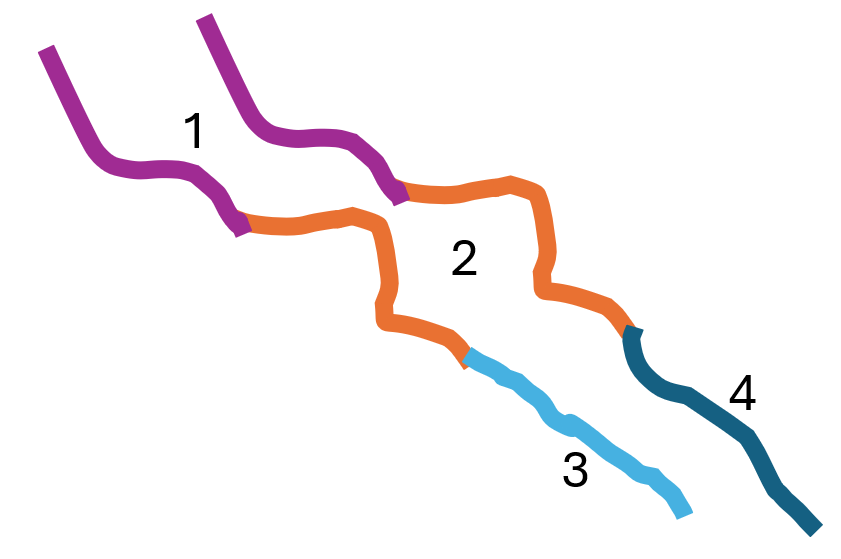
- Cut 2 x 10-15 cm lengths of wool colour 1.
- Cut 2 x 10-15 cm lengths of wool colour 2.
- Cut 1 x 10-15 cm length of wool colour 3 (light shade).
- Cut 1 x 10-15 cm length of wool colour 4 (dark shade).
- Tie a length of colour 1 to a length of colour 2, then tie colour 3 to the other end of colour 2 to make one long strand.
- Create a second strand by tying the other length of colour 1 to the other length of colour 2, then tying colour 4 to the other end of colour 2.
(Slide 16) Discuss how the wool model acts as an analogy for DNA (the wool), chromosomes (the tied-together strands) and genes (the individual-coloured sections in the same location of the strand). Discuss how the wool model analogy is different to DNA, chromosomes and genes.
| Genetic structure | Wool analogy similarities | Wool analogy differences |
|---|---|---|
| DNA | Strands would wrap around each other. | Wool is many-stranded. DNA has two strands wound around each other. |
| Chromosome | A long section made up of many genes next to each other. | Wool analogy has only three genes. Chromosomes have 70-3100 genes. Genes may overlap each other, or may have “unused” sections between them. |
| Gene | Genes with matching colours are found in the same location on the same chromosomes. | Wool genes do not have a function. Genes in DNA have a specific function. |
Discuss how one gene can have slight differences or variations. Compare this to the two pieces of wool that are the same colour but different shades. Both are the same gene in the same location on the chromosome, but they are different types/shades. Explain that different types of the same gene are called “alleles”. An example of this is eye colour, where some alleles produce brown eyes and others produce blue eyes.
(Slide 17) ✎ STUDENT NOTES: Define “alleles”: alternative types of the same gene at the same location on a homologous chromosome.
- Why do organisms have two copies of each gene (one on each chromosome)?
- One from the mother and one from the father. If one version of a gene (allele) is faulty, the other can sometimes compensate. For instance, cystic fibrosis symptoms only appear if there are two copies of cystic fibrosis alleles.
- What might happen if the two alleles for a gene are different?
- One might have more impact on the body than the other (e.g. brown eyes), or both will equally affect the body.
- In your analogy, how can you tell when two genes are the same but have different alleles?
- The same colour wool = same allele. Different colour shades = different alleles.
- What would it mean if a “gene” (piece of wool) was missing?
- If a gene was missing, then the person might not have that function (e.g. the cystic fibrosis gene controlling thickness of mucus).
Using analogies to teach abstract concepts
Models and analogies can be used to help students understand abstract concepts.
Processes occurring at the cellular and molecular levels are too small to see with the naked eye and can be considered abstract. Models and analogies can be used to help students understand these abstract concepts. Models and analogies help make students’ thinking visible, and teachers identify alternative conceptions. Models and analogies can provide scaffolding for students to construct their scientific understanding of particular features of a science concept.
A model is a replica or copy of a concept (e.g. heart model, eye model, model car). An analogy is an object or idea that shares some similarities with the new concept (e.g. a cell is like a city, light waves are like water waves, DNA is like a spiral staircase).
A disadvantage of using analogies is the possible incorrect transfer of features or an unfamiliar analogy that creates confusion.
An effective way of using analogies is the FAR guide (focus, action, reflection).
- Focus (pre-lesson): What is difficult about the concept? What do students know? Are they familiar with the analogy?
- Action (in class): How is the analogy like the new concept? How is it not alike?
- Reflection (post lesson): Was the analogy clear and useful or confusing? What changes are needed for next time?
When using wool as an analogy, six lengths of different coloured wool are knotted together to form a chromosome. The wool represents the DNA strand, each coloured length of wool represents a gene, and different shades of the same colour represent alternative alleles. The single strand is a chromosome, and the two long strands represent a pair of chromosomes.
There are some limitations with using wool as an analogy. The wool analogy differs from a real chromosome, as a chromosome is microscopic and wool can be seen with the eye. The different alleles are presented by different colours, whereas in a chromosome the different alleles have different DNA bases. The lengths of different coloured wool show genes as discrete parts, and genes are not always discrete.
The wool analogy is adapted from Venville G., & Donovan, J. (2010). How pupils use a model for abstract concepts in genetics. Journal of Biological Science. 43(1), 6-14. https://doi.org/10.1080/00219266.2008.9656143
Processes occurring at the cellular and molecular levels are too small to see with the naked eye and can be considered abstract. Models and analogies can be used to help students understand these abstract concepts. Models and analogies help make students’ thinking visible, and teachers identify alternative conceptions. Models and analogies can provide scaffolding for students to construct their scientific understanding of particular features of a science concept.
A model is a replica or copy of a concept (e.g. heart model, eye model, model car). An analogy is an object or idea that shares some similarities with the new concept (e.g. a cell is like a city, light waves are like water waves, DNA is like a spiral staircase).
A disadvantage of using analogies is the possible incorrect transfer of features or an unfamiliar analogy that creates confusion.
An effective way of using analogies is the FAR guide (focus, action, reflection).
- Focus (pre-lesson): What is difficult about the concept? What do students know? Are they familiar with the analogy?
- Action (in class): How is the analogy like the new concept? How is it not alike?
- Reflection (post lesson): Was the analogy clear and useful or confusing? What changes are needed for next time?
When using wool as an analogy, six lengths of different coloured wool are knotted together to form a chromosome. The wool represents the DNA strand, each coloured length of wool represents a gene, and different shades of the same colour represent alternative alleles. The single strand is a chromosome, and the two long strands represent a pair of chromosomes.
There are some limitations with using wool as an analogy. The wool analogy differs from a real chromosome, as a chromosome is microscopic and wool can be seen with the eye. The different alleles are presented by different colours, whereas in a chromosome the different alleles have different DNA bases. The lengths of different coloured wool show genes as discrete parts, and genes are not always discrete.
The wool analogy is adapted from Venville G., & Donovan, J. (2010). How pupils use a model for abstract concepts in genetics. Journal of Biological Science. 43(1), 6-14. https://doi.org/10.1080/00219266.2008.9656143
Eye colour
The commonly taught “brown eyes are dominant to blue eyes” model is a simplification used to help students understand basic genetics.

Eye colour is a useful example for introducing inheritance, alleles, and dominant and recessive traits (ideas that will be explored further in later lessons). However, it is important to be aware that the commonly taught “brown eyes are dominant to blue eyes” model is a simplification used to help students understand basic genetics. Students are taught that a person with genotype Bb will have brown eyes because the allele for the dominant brown trait masks the expression of the allele for the recessive blue trait.
Eye colour inheritance is actually more complex than a single-gene trait. Multiple genes influence eye colour, including genes that affect the amount and distribution of melanin in the iris. This is why eye colours occur along a spectrum, including brown, amber, hazel, green, blue and grey.
For introductory genetics lessons, the simplified B/b model is commonly used because it clearly demonstrates:
- dominant and recessive inheritance.
- genotypes and phenotypes.
- the inheritance of one allele from each parent.
References
The complexity of eye colour. (2024, September 16). University of Queensland Institute for Molecular Bioscience. https://imb.uq.edu.au/complexity-eye-colour
Eye colour is a useful example for introducing inheritance, alleles, and dominant and recessive traits (ideas that will be explored further in later lessons). However, it is important to be aware that the commonly taught “brown eyes are dominant to blue eyes” model is a simplification used to help students understand basic genetics. Students are taught that a person with genotype Bb will have brown eyes because the allele for the dominant brown trait masks the expression of the allele for the recessive blue trait.
Eye colour inheritance is actually more complex than a single-gene trait. Multiple genes influence eye colour, including genes that affect the amount and distribution of melanin in the iris. This is why eye colours occur along a spectrum, including brown, amber, hazel, green, blue and grey.
For introductory genetics lessons, the simplified B/b model is commonly used because it clearly demonstrates:
- dominant and recessive inheritance.
- genotypes and phenotypes.
- the inheritance of one allele from each parent.
References
The complexity of eye colour. (2024, September 16). University of Queensland Institute for Molecular Bioscience. https://imb.uq.edu.au/complexity-eye-colour
The Inquire phase allows students to cycle progressively and with increasing complexity through the key science ideas related to the core concepts. Each Inquire cycle is divided into three teaching and learning routines that allow students to systematically build their knowledge and skills in science and incorporate this into their current understanding of the world.
When designing a teaching sequence, it is important to consider the knowledge and skills that students will need in the final Act phase. Consider what the students already know and identify the steps that need to be taken to reach the level required. How could you facilitate students’ understanding at each step? What investigations could be designed to build the skills at each step?
Read more about using the LIA FrameworkFollowing an investigation, the Integrate routine provides time and space for data to be evaluated and insights to be synthesized. It reveals new insights, consolidates and refines representations, generalises context and broadens students’ perspectives. It allows student thinking to become visible and opens formative feedback opportunities. It may also lead to further questions being asked, allowing the Inquire phase to start again.
When designing a teaching sequence, consider the diagnostic assessment that was undertaken during the Launch phase. Consider if alternative conceptions could be used as a jumping off point to discussions. How could students represent their learning in a way that would support formative feedback opportunities? Could small summative assessment occur at different stages in the teaching sequence?
Read more about using the LIA FrameworkAlternative analogies
Discuss how the wool model was a useful analogy to understand the relationship between a chromosome (the length of wool), DNA (the wool), genes (the matching-coloured lengths) and alleles (the different shades of woollen genes).
- How did the analogy of the wool model help you visualise the difference between a chromosome, DNA, a gene, and an allele?
- Which part of the analogy was the easiest to understand, and why?
- Were there any parts of the analogy that were confusing or inaccurate compared with real genetics?
- Why is the chromosome represented as the whole length of wool rather than just a single-coloured section?
- In what way do different shades of the same colour represent alleles effectively?
- What are the limitations of using coloured wool to explain DNA structure and function?
- How does the analogy demonstrate that many genes can exist along one chromosome?
- Does the analogy suggest that genes are separate from DNA, or part of DNA? Why is that distinction important?
Explain that it is sometimes useful to compare different analogies to help identify important relationships within a scientific concept, while also recognising the strengths and limitations of each.
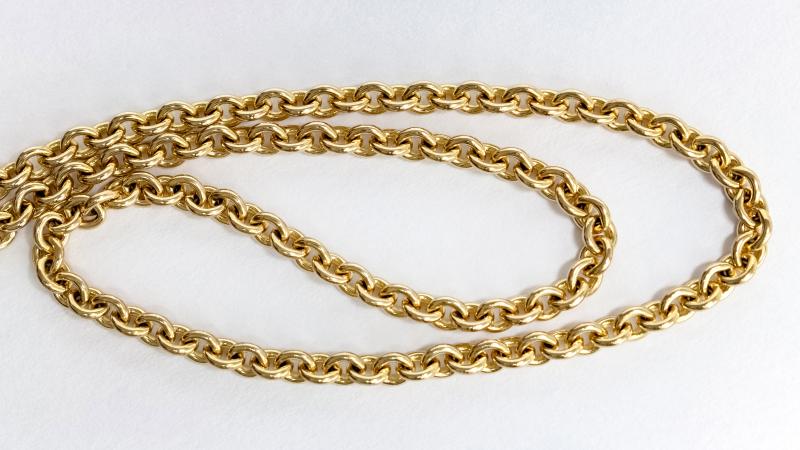
(Slide 18) Pose the question: How is a gold necklace like a DNA chromosome?
Discuss how a gold necklace can be used as an analogy, where the gold metal represents the DNA and the gold chain represents a single chromosome. Each link in the chain represents a gene.
- How is a gold necklace similar to a chromosome? What does each part represent?
- In this analogy, what do the chain and the links help us understand about DNA structure?
- What parts of real DNA are not well represented by a necklace?
- If each link represents a gene, what might different “types” of links represent?
- How could this necklace model show different alleles (variations of a gene)?
- What would it mean if a link was missing, broken, or repeated in the chain?
- Which is more helpful for you—the wool model or the necklace analogy? Why?
Pose the question: What are some other analogies that could be used for DNA, genes and chromosomes?
Brainstorm with students other examples of analogies. Students might propose plaited cord with different colours representing genes, pipe cleaners to show how chromosomes twist around each other, Lego blocks using different colours for different genes, and a spiral staircase to show the double helix structure.
- Why do scientists and teachers use analogies to explain concepts like DNA?
- Can you think of your own analogy for DNA, genes, and chromosomes? What would represent each part?
- From the examples (plaited cord, Lego, recipe book, spiral staircase), which do you think works best? Why?
- How would you improve one of these analogies to make it more accurate?
- Why is it important to remember that these are just analogies, not exact representations?
- How might using different analogies help different people learn?
✎ STUDENT NOTES: Describe an alternative analogy for chromosomes, DNA, genes and alleles.
Reflect on the lesson
You might ask students to:
- add the following words to a glossary: deoxyribonucleic acid (DNA), histones, chromatin, chromosome, autosome, sex chromosome, karyotype, homologous, alleles and analogy.
- use the interactive Make a karyotype tool to match pairs of chromosomes.
- watch the video Genetics 101 (1:18).
- watch the video Heredity: Who are you? (5:55).