

Genes, ethics and society
View Sequence overviewStudents will:
- use Punnett squares to predict the genotype (alleles) and phenotype (inheritance of a trait or a genetic disease) in a monogenic cross.
- understand that the environment can affect the expression of a phenotype.
- use the terms “homozygous”, “heterozygous”, “recessive”, “dominant” and “carrier” to explain the outcome of a monogenic cross.
Students will represent their understanding as they:
- use Punnett squares to predict the genotype and phenotype of single gene (monogenic) crosses.
- predict that there is a 25% chance of a child inheriting an autosomal recessive genetic disease if both parents are carriers.
- predict that there is a 50% chance of a child inheriting an autosomal dominant disease if one parent has the disease.
In this lesson, assessment is formative.
Feedback might focus on students’ ability to:
- understand the need for large sample size to determine probability.
- use Punnett squares to predict the probability of sickle cell anaemia.
- understand the difference between genetic probability and certainty of inheritance of a trait.
Potential summative task
Students working at the achievement standard should:
- explain how genetic information passed on to offspring from both parents by meiosis and fertilisation increases the variation of a species.
- use Mendelian inheritance to predict the ratio of offspring genotypes and phenotypes in monohybrid crosses involving alleles for dominant and recessive traits.
- explore the role of DNA in cancer or genetic disorders such as sickle cell condition and cystic fibrosis.
- consider the use of genetic testing for the identification of carriers of genetic mutations and the use of this information for personal use.
- construct mathematical relationships to organise and process data and information.
Whole class
Genes, ethics and society Slides
Each group
2 x different coloured counters
Permanent markers
Each student
Inheriting genotypes Resource sheet
Punnett squares Resource sheet
Student notebook
Lesson
Re-orient
Remind students of the pigeon breeding activity completed during the previous lesson. Discuss how they were able to select particular alleles that would be passed to the next (F1) generation. The combination of alleles is called the genotype and how they physically appeared is called the phenotype.
The Inquire phase allows students to cycle progressively and with increasing complexity through the key science ideas related to the core concepts. Each Inquire cycle is divided into three teaching and learning routines that allow students to systematically build their knowledge and skills in science and incorporate this into their current understanding of the world.
When designing a teaching sequence, it is important to consider the knowledge and skills that students will need in the final Act phase. Consider what the students already know and identify the steps that need to be taken to reach the level required. How could you facilitate students’ understanding at each step? What investigations could be designed to build the skills at each step?
Read more about using the LIA FrameworkIdentifying and constructing questions is the creative driver of the inquiry process. It allows students to explore what they know and how they know it. During the Inquire phase of the LIA Framework, the Question routine allows for past activities to be reviewed and to set the scene for the investigation that students will undertake. The use of effective questioning techniques can influence students’ view and interpretation of upcoming content, open them to exploration and link to their current interests and science capital.
When designing a teaching sequence, it is important to spend some time considering the mindset of students at the start of each Inquire phase. What do you want students to be thinking about, what do they already know and what is the best way for them to approach the task? What might tap into their curiosity?
Read more about using the LIA FrameworkSex determination
Explain that alphabet letters can be used to show the type of allele from each parent. Remind students of the meiosis modelling activity from a previous lesson, where the different genes and alleles were shown as different letters of the alphabet in upper and lowercase.
(Slide 54) Remind students of the pigeon inheritance for the crest trait: the no-crest trait was dominant and the crest trait was recessive.
(Slide 54 animation 1) Explain that if the no-crest gene was given a letter B or b, the alleles for the dominant no-crest trait would be given a capital letter to show that no-crest “dominates” the phenotype. A pigeon only needs one copy of this allele for the trait to appear in the phenotype.
(Slide 54 animation 2) Explain that because the crest trait is recessive (not dominant), it will be given the same letter (same gene) but a lowercase version b. Explain how inheriting an allele for no-crest from one parent (B) and an allele for a crest from another parent (b) means that the child will have the no-crest phenotype.
(Slide 54 animation 3) Describe how a pigeon needs two copies of the crest allele (bb—one from each parent) for the crest trait to appear in the phenotype.
- What does it mean when a capital B is used for an allele?
- Why is a lowercase b used for the allele for a pigeon crest?
- Does the b allele disappear if it is not expressed in the phenotype? Explain.
- The b allele for a recessive trait is still present. It does not show in the phenotype if a B allele is present.
- If a pigeon has the genotype Bb, would they have a crest? Why?
- Can a pigeon with no-crest carry the allele for a crest (b)? Explain your reasoning.
- A Bb no-crest pigeon has an allele for the recessive crest trait that can be passed on to its offspring.
Pose the question: Can parents select which alleles are passed on to the next generation?
Discuss how meiosis means that the chromosomes (and therefore the alleles) are randomly sorted to form the egg and sperm cells. This means that a random process determines which alleles are inherited.
Pose the question: How can we determine the probability of inheriting a trait from parents?
The Inquire phase allows students to cycle progressively and with increasing complexity through the key science ideas related to the core concepts. Each Inquire cycle is divided into three teaching and learning routines that allow students to systematically build their knowledge and skills in science and incorporate this into their current understanding of the world.
When designing a teaching sequence, it is important to consider the knowledge and skills that students will need in the final Act phase. Consider what the students already know and identify the steps that need to be taken to reach the level required. How could you facilitate students’ understanding at each step? What investigations could be designed to build the skills at each step?
Read more about using the LIA FrameworkThe Investigate routine provides students with an opportunity to explore the key ideas of science, to plan and conduct an investigation, and to gather and record data. The investigations are designed to systematically develop content knowledge and skills through increasingly complex processes of structured inquiry, guided inquiry and open inquiry approaches. Students are encouraged to process data to identify trends and patterns and link them to the real-world context of the teaching sequence.
When designing a teaching sequence, consider the diagnostic assessment (Launch phase) that identified the alternative conceptions that students held. Are there activities that challenge these ideas and provide openings for discussion? What content knowledge and skills do students need to be able to complete the final (Act phase) task? How could you systematically build these through the investigation routines? Are there opportunities to build students’ understanding and skills in the science inquiry processes through the successive investigations?
Read more about using the LIA FrameworkSickle cell condition
(Slide 55) Introduce students to the sickle cell condition. Describe how people with this genetic condition can develop unusually shaped red blood cells, which causes the cells to block blood vessels and leads to pain in the arms and legs. The red blood cells also break down very quickly (causing anaemia), making it difficult for the muscles to receive enough oxygen for energy.
(Slide 56) Provide students with the Inheriting genotypes Resource sheet. Explain that they will work in pairs to investigate the probability of offspring inheriting an autosomal (non-sex chromosome) recessive trait if both parents are carriers.
- Write a capital “H” on one side of each counter and a lowercase “h” on the other side.
- Each counter represents a sperm or ova/egg from the parent. Flip each counter and record the letters facing up in Table 1. This is the genotype of the first child.
- Identify and record the phenotype of the child in Table 1.
- Repeat steps 2 and 3 fifteen more times.
- Calculate the percentage of offspring with each genotype and phenotype for your data and record in Table 2.
Allow students time to complete the investigation.
- If both parents are carriers, what alleles can they pass on?
- What do you predict the most common genotype will be? Why?
- Do you think all outcomes will appear equally often? Explain your reasoning.
- Why is it important that the counters are flipped randomly?
✎ STUDENT NOTES: Record the results of the investigation on the Inheriting genotypes Resource sheet. Do not do Question 6 yet.
Dominant and recessive traits
In genetics, letters are used to represent different versions of a gene (alleles).
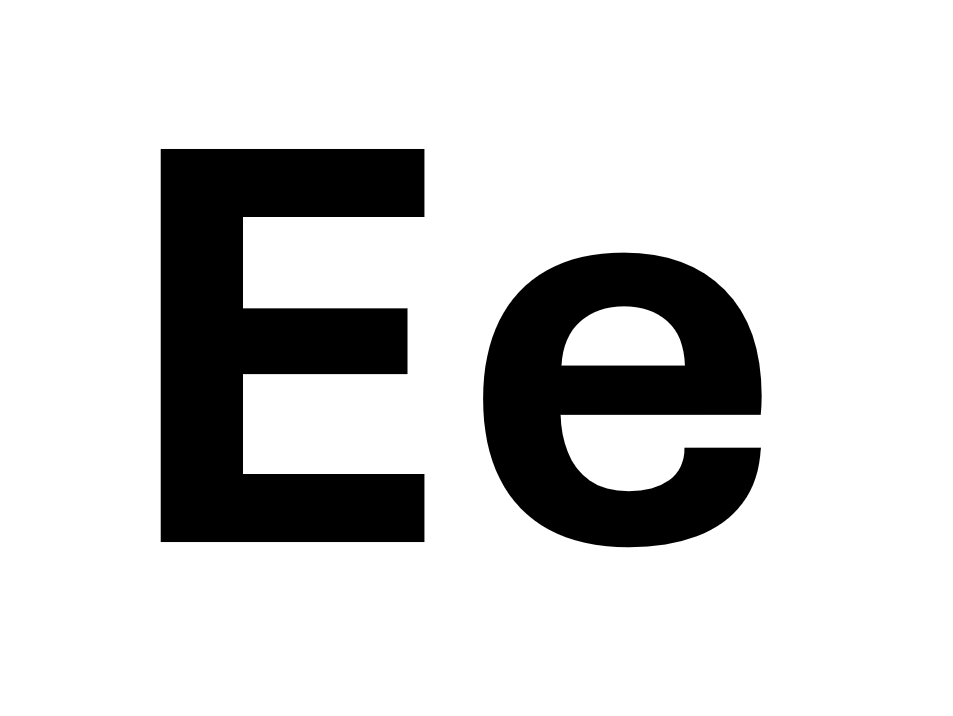
In genetics, letters are used to represent different versions of a gene (alleles). By convention, a capital letter represents the allele for the dominant trait, while the corresponding lowercase letter represents the allele for the recessive trait. For example, if tall plant height is dominant over short plant height, the alleles may be represented as T (dominant trait) and t (recessive trait). An organism with the genotype TT or Tt will display the dominant trait, while only an organism with the genotype tt will display the recessive trait. This notation system was developed from the work of Gregor Mendel and helps students predict patterns of inheritance using tools such as Punnett squares.
When selecting letters for classroom examples, it is best to choose letters where the uppercase and lowercase forms are visually distinct, such as T/t, R/r, P/p, or A/a. Letters such as C/c, K/k, S/s, W/w, X/x, and Z/z can sometimes be difficult for students to distinguish, particularly in handwritten work. If these letters are used, it can be useful to underline the capital letter representing the dominant trait (C vs c).
Common alternative conceptions include:
- Dominant means “stronger” or “better”.
- Dominance only refers to how an allele is expressed in the phenotype. The allele itself is not dominant. Instead, the expression of the allele (and the proteins it does or does not produce) results in a trait being observed in the phenotype. These traits are not always better (for example, the different muscular dystrophy conditions are dominant traits).
- Alleles for the recessive traits disappear when not expressed.
- Recessive alleles can still be passed to future generations.
- Individuals displaying the dominant phenotype cannot carry alleles for the recessive trait.
- A no-crest pigeon may have genotype Bb and pass on an allele for a crest.
In genetics, letters are used to represent different versions of a gene (alleles). By convention, a capital letter represents the allele for the dominant trait, while the corresponding lowercase letter represents the allele for the recessive trait. For example, if tall plant height is dominant over short plant height, the alleles may be represented as T (dominant trait) and t (recessive trait). An organism with the genotype TT or Tt will display the dominant trait, while only an organism with the genotype tt will display the recessive trait. This notation system was developed from the work of Gregor Mendel and helps students predict patterns of inheritance using tools such as Punnett squares.
When selecting letters for classroom examples, it is best to choose letters where the uppercase and lowercase forms are visually distinct, such as T/t, R/r, P/p, or A/a. Letters such as C/c, K/k, S/s, W/w, X/x, and Z/z can sometimes be difficult for students to distinguish, particularly in handwritten work. If these letters are used, it can be useful to underline the capital letter representing the dominant trait (C vs c).
Common alternative conceptions include:
- Dominant means “stronger” or “better”.
- Dominance only refers to how an allele is expressed in the phenotype. The allele itself is not dominant. Instead, the expression of the allele (and the proteins it does or does not produce) results in a trait being observed in the phenotype. These traits are not always better (for example, the different muscular dystrophy conditions are dominant traits).
- Alleles for the recessive traits disappear when not expressed.
- Recessive alleles can still be passed to future generations.
- Individuals displaying the dominant phenotype cannot carry alleles for the recessive trait.
- A no-crest pigeon may have genotype Bb and pass on an allele for a crest.
Sickle cell condition
Sickle cell condition is an autosomal recessive genetic disorder that alters the structure of the haemoglobin molecule found in red blood cells.
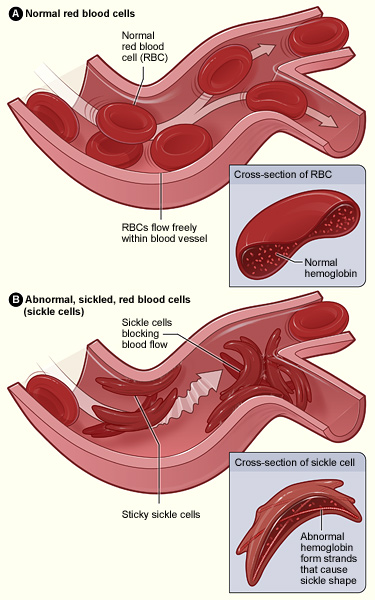
Sickle cell condition is an autosomal (non-sex chromosome) recessive genetic disorder that alters the structure of the oxygen-carrying haemoglobin molecule found in red blood cells (RBCs).
In an individual with a healthy haemoglobin molecule, RBCs are round, flexible, and easily navigate the cardiovascular system to deliver oxygen, maintaining a lifespan of roughly 120 days.
In contrast, individuals with the sickle cell condition have haemoglobin molecules that stick together in a low oxygen environment. This causes the RBC to deform and become rigid, crescents or sickle shapes. These malformed cells break down in 10 to 20 days instead of the usual three months. This premature destruction leads to a chronic shortage of red blood cells, known as anaemia, which severely limits the body’s oxygen supply and results in persistent fatigue.
The sickle shape of the RBCs causes them to easily clog small blood vessels, causing pain and swelling in the hands and feet of sufferers. It can also restrict blood supply to internal organs, causing damage, increased risk of strokes, infections and blindness.
Sickle cell condition is caused by a mutation in the Haemoglobin beta gene (HBB) found on chromosome 11. If an individual inherits only a single copy of the mutated gene alongside one typical gene, they possess the “sickle cell trait”. These individuals act as asymptomatic carriers; they generally lead healthy lives without experiencing symptoms but retain a 50% chance of passing the mutated gene on to their offspring.
While historical treatment has focused exclusively on management such as antibiotics, vaccinations, and pain relief to mitigate symptoms, modern medical advancements include stem cell transplants and gene therapies.
People who carry a single copy of the allele for the sickle cell condition are more resistant to malaria. This is due to malaria-infected red blood cells becoming more deformed, and therefore are more likely to be removed by the spleen before the parasite can complete its lifecycle. This creates a selection advantage for heterozygote individuals from countries with endemic malaria.
References
(2021, August). Sickle cell disease. Centre for Genetics Education; NSW Government Health. https://www.genetics.edu.au/SitePages/Sickle-cell-disease.aspx
Sickle cell condition is an autosomal (non-sex chromosome) recessive genetic disorder that alters the structure of the oxygen-carrying haemoglobin molecule found in red blood cells (RBCs).
In an individual with a healthy haemoglobin molecule, RBCs are round, flexible, and easily navigate the cardiovascular system to deliver oxygen, maintaining a lifespan of roughly 120 days.
In contrast, individuals with the sickle cell condition have haemoglobin molecules that stick together in a low oxygen environment. This causes the RBC to deform and become rigid, crescents or sickle shapes. These malformed cells break down in 10 to 20 days instead of the usual three months. This premature destruction leads to a chronic shortage of red blood cells, known as anaemia, which severely limits the body’s oxygen supply and results in persistent fatigue.
The sickle shape of the RBCs causes them to easily clog small blood vessels, causing pain and swelling in the hands and feet of sufferers. It can also restrict blood supply to internal organs, causing damage, increased risk of strokes, infections and blindness.
Sickle cell condition is caused by a mutation in the Haemoglobin beta gene (HBB) found on chromosome 11. If an individual inherits only a single copy of the mutated gene alongside one typical gene, they possess the “sickle cell trait”. These individuals act as asymptomatic carriers; they generally lead healthy lives without experiencing symptoms but retain a 50% chance of passing the mutated gene on to their offspring.
While historical treatment has focused exclusively on management such as antibiotics, vaccinations, and pain relief to mitigate symptoms, modern medical advancements include stem cell transplants and gene therapies.
People who carry a single copy of the allele for the sickle cell condition are more resistant to malaria. This is due to malaria-infected red blood cells becoming more deformed, and therefore are more likely to be removed by the spleen before the parasite can complete its lifecycle. This creates a selection advantage for heterozygote individuals from countries with endemic malaria.
References
(2021, August). Sickle cell disease. Centre for Genetics Education; NSW Government Health. https://www.genetics.edu.au/SitePages/Sickle-cell-disease.aspx
The Inquire phase allows students to cycle progressively and with increasing complexity through the key science ideas related to the core concepts. Each Inquire cycle is divided into three teaching and learning routines that allow students to systematically build their knowledge and skills in science and incorporate this into their current understanding of the world.
When designing a teaching sequence, it is important to consider the knowledge and skills that students will need in the final Act phase. Consider what the students already know and identify the steps that need to be taken to reach the level required. How could you facilitate students’ understanding at each step? What investigations could be designed to build the skills at each step?
Read more about using the LIA FrameworkFollowing an investigation, the Integrate routine provides time and space for data to be evaluated and insights to be synthesized. It reveals new insights, consolidates and refines representations, generalises context and broadens students’ perspectives. It allows student thinking to become visible and opens formative feedback opportunities. It may also lead to further questions being asked, allowing the Inquire phase to start again.
When designing a teaching sequence, consider the diagnostic assessment that was undertaken during the Launch phase. Consider if alternative conceptions could be used as a jumping off point to discussions. How could students represent their learning in a way that would support formative feedback opportunities? Could small summative assessment occur at different stages in the teaching sequence?
Read more about using the LIA FrameworkSample size is important
Discuss the variation in the data between the different groups and the importance of using large sample sizes.
- How do the results differ between groups?
- Did any groups get results that looked very different from the rest of the class?
- Which results surprised you the most?
- How does randomness affect the outcomes in each group?
- Why might two groups doing the same experiment get different results?
- Does one unusual result mean the model is wrong? Why or why not?
- How many trials did each group complete? Is that a large or small sample size?
(Slide 57) Combine the data from the different student groups into whole class data. Support students to calculate the class percentage of each genotype and phenotype.
- What happens to the results when we combine data from the whole class?
- Why do larger sample sizes tend to be more reliable?
- What patterns do you notice in the class data?
- Which genotype and phenotype were most common? Least common?
- How do the class results compare to your pair’s results?
- If we repeated this experiment, would we get the same percentages? Why or why not?
- What did combining the data help you understand that you didn’t see in your small group?
- What are the limitations of this model, even with class data?
The Inquire phase allows students to cycle progressively and with increasing complexity through the key science ideas related to the core concepts. Each Inquire cycle is divided into three teaching and learning routines that allow students to systematically build their knowledge and skills in science and incorporate this into their current understanding of the world.
When designing a teaching sequence, it is important to consider the knowledge and skills that students will need in the final Act phase. Consider what the students already know and identify the steps that need to be taken to reach the level required. How could you facilitate students’ understanding at each step? What investigations could be designed to build the skills at each step?
Read more about using the LIA FrameworkIdentifying and constructing questions is the creative driver of the inquiry process. It allows students to explore what they know and how they know it. During the Inquire phase of the LIA Framework, the Question routine allows for past activities to be reviewed and to set the scene for the investigation that students will undertake. The use of effective questioning techniques can influence students’ view and interpretation of upcoming content, open them to exploration and link to their current interests and science capital.
When designing a teaching sequence, it is important to spend some time considering the mindset of students at the start of each Inquire phase. What do you want students to be thinking about, what do they already know and what is the best way for them to approach the task? What might tap into their curiosity?
Read more about using the LIA FrameworkPunnett squares
Pose the question: Can we predict the probability of a trait appearing without flipping a counter 100 times?
Explain to students that if we know the alleles (types of genes) in each parent, then we can predict the probability of each offspring showing the trait in the phenotype.
(Slide 58) Remind students how meiosis causes the chromosomes to separate so that a single copy of each gene is passed on to the gametes (egg or sperm cells). If there are different alleles for this gene, then each gamete will have a different allele (type of gene).
NOTE: For simplicity purposes, only two gametes are shown on the slide to reflect all the possible gametes produced.
(Slide 58 animation 1) Explain how scientists can work out the possible genotype combinations that the offspring will have by using a Punnett square. Describe how each possible allele can be placed on the outside of the square.
(Slide 58 animation 2-5) Discuss the possible genotypes that will result from each egg and sperm combining during fertilisation.
(Slide 59 animations 1-8) Discuss how the genotype and phenotypes of the offspring can be determined from the Punnett square.
Draw students’ attention to the term “carrier” to refer to a person who “carries” and can pass on the allele for a particular trait, and who does not show the trait in their phenotype. Discuss how a carrier is always heterozygous (two different alleles for a particular gene).
- Why can a carrier pass on an allele for a trait even if they do not show the trait themselves?
- Because they carry the allele for the recessive trait that does not show in the phenotype.
- If a person is a carrier, what alleles must they have for that gene?
- Heterozygous with one allele for each trait.
- Why is a carrier always described as heterozygous?
- They have one allele for each trait. Only the dominant trait appears in the phenotype.
- Can a person who is homozygous dominant be a carrier? Why or why not?
- No. They do not have an allele for the recessive trait.
- Can a person who is homozygous recessive be a carrier? Why or why not?
- No. The trait appears in the phenotype and is not hidden.
- How can two parents who do not show a genetic disorder have a child who does?
- If both parents are carriers, they can both pass on an allele for the recessive trait.
- Why is it important not to assume that someone is free of a recessive allele simply because they do not show the trait?
- They could be heterozygous and have an allele for the recessive trait.
(Slide 60) ✎ STUDENT NOTES: Define “carrier”.
Pose the question: Can we predict the probability of a trait appearing if a person is a carrier for a recessive trait?
Nature vs nurture
Although some traits are inherited through a single gene, most traits are polygenic and influenced by the environment.
In Year 10, students use a Punnett square to predict the inheritance of a monogenic (single gene) trait. Although some traits are inherited through a single gene (e.g. tongue rolling), most traits (e.g. skin colour, intelligence and height) are polygenic and influenced by the environment (for example, sunlight, education and diet respectively).
The extent to which the environment (nurture) affects the phenotype can vary according to the gene(s) and the level of change in the environment. For example, a person may inherit genes associated with being tall, but if they do not receive enough food during childhood, they will not reach their full height potential.
These changes as a result of the environment during pregnancy and early life (nurture) are a result of changes in the way genes are switched on or off (epigenetics). This changes the amount of protein that is often produced by the gene. This can also be used to explain how cells specialise to become epithelial (skin) cells, neurones (nerve cells), or insulin-producing cells. These cells are specialised because the genes that are not needed are “switched off”.
Prenatal nutrition can not only impact the foetus, but it can also have effects that extend to the next generation. This is illustrated by the people who were conceived in Holland at the end of the Second World War (1944-1945). For approximately eight months, the German army blocked food entering the country. At the same time, the weather conditions meant that little food was able to be grown. Studies of people (particularly men) who were conceived during the resulting famine found that they had long-term health effects. Later studies found that these health effects of higher body mass and associated heart conditions were extended to the next generation (the children of the men originally exposed as foetuses).
References
Learn.genetics. (2013). Epigenetics. Utah.edu. https://learn.genetics.utah.edu/content/epigenetics/
Lobo, I. & Shaw, K. (2008) Phenotypic range of gene expression: Environmental influence. Nature Education 1(1):12
González-Rodríguez, P., Füllgrabe, J., & Joseph, B. (2023). The hunger strikes back: an epigenetic memory for autophagy. Cell Death & Differentiation, 30(6), 1404–1415. https://doi.org/10.1038/s41418-023-01159-4
In Year 10, students use a Punnett square to predict the inheritance of a monogenic (single gene) trait. Although some traits are inherited through a single gene (e.g. tongue rolling), most traits (e.g. skin colour, intelligence and height) are polygenic and influenced by the environment (for example, sunlight, education and diet respectively).
The extent to which the environment (nurture) affects the phenotype can vary according to the gene(s) and the level of change in the environment. For example, a person may inherit genes associated with being tall, but if they do not receive enough food during childhood, they will not reach their full height potential.
These changes as a result of the environment during pregnancy and early life (nurture) are a result of changes in the way genes are switched on or off (epigenetics). This changes the amount of protein that is often produced by the gene. This can also be used to explain how cells specialise to become epithelial (skin) cells, neurones (nerve cells), or insulin-producing cells. These cells are specialised because the genes that are not needed are “switched off”.
Prenatal nutrition can not only impact the foetus, but it can also have effects that extend to the next generation. This is illustrated by the people who were conceived in Holland at the end of the Second World War (1944-1945). For approximately eight months, the German army blocked food entering the country. At the same time, the weather conditions meant that little food was able to be grown. Studies of people (particularly men) who were conceived during the resulting famine found that they had long-term health effects. Later studies found that these health effects of higher body mass and associated heart conditions were extended to the next generation (the children of the men originally exposed as foetuses).
References
Learn.genetics. (2013). Epigenetics. Utah.edu. https://learn.genetics.utah.edu/content/epigenetics/
Lobo, I. & Shaw, K. (2008) Phenotypic range of gene expression: Environmental influence. Nature Education 1(1):12
González-Rodríguez, P., Füllgrabe, J., & Joseph, B. (2023). The hunger strikes back: an epigenetic memory for autophagy. Cell Death & Differentiation, 30(6), 1404–1415. https://doi.org/10.1038/s41418-023-01159-4
The Inquire phase allows students to cycle progressively and with increasing complexity through the key science ideas related to the core concepts. Each Inquire cycle is divided into three teaching and learning routines that allow students to systematically build their knowledge and skills in science and incorporate this into their current understanding of the world.
When designing a teaching sequence, it is important to consider the knowledge and skills that students will need in the final Act phase. Consider what the students already know and identify the steps that need to be taken to reach the level required. How could you facilitate students’ understanding at each step? What investigations could be designed to build the skills at each step?
Read more about using the LIA FrameworkThe Investigate routine provides students with an opportunity to explore the key ideas of science, to plan and conduct an investigation, and to gather and record data. The investigations are designed to systematically develop content knowledge and skills through increasingly complex processes of structured inquiry, guided inquiry and open inquiry approaches. Students are encouraged to process data to identify trends and patterns and link them to the real-world context of the teaching sequence.
When designing a teaching sequence, consider the diagnostic assessment (Launch phase) that identified the alternative conceptions that students held. Are there activities that challenge these ideas and provide openings for discussion? What content knowledge and skills do students need to be able to complete the final (Act phase) task? How could you systematically build these through the investigation routines? Are there opportunities to build students’ understanding and skills in the science inquiry processes through the successive investigations?
Read more about using the LIA FrameworkPredicting sickle cell condition
Discuss the three different genotypes that a carrier for the sickle cell condition could partner with:
- hh—has the sickle cell condition.
- Hh—carrier for the sickle cell condition.
- HH—homozygous for no sickle cell condition.
Pose the question: Can we predict the probability of the children of these individuals inheriting the sickle cell condition?
Provide students with a copy of the Punnett squares Resource sheet.
Invite students to complete the Punnett squares for each of these partnership possibilities.
✎ STUDENT NOTES: Complete the Punnett squares on the Punnett squares Resource sheet.
The Inquire phase allows students to cycle progressively and with increasing complexity through the key science ideas related to the core concepts. Each Inquire cycle is divided into three teaching and learning routines that allow students to systematically build their knowledge and skills in science and incorporate this into their current understanding of the world.
When designing a teaching sequence, it is important to consider the knowledge and skills that students will need in the final Act phase. Consider what the students already know and identify the steps that need to be taken to reach the level required. How could you facilitate students’ understanding at each step? What investigations could be designed to build the skills at each step?
Read more about using the LIA FrameworkFollowing an investigation, the Integrate routine provides time and space for data to be evaluated and insights to be synthesized. It reveals new insights, consolidates and refines representations, generalises context and broadens students’ perspectives. It allows student thinking to become visible and opens formative feedback opportunities. It may also lead to further questions being asked, allowing the Inquire phase to start again.
When designing a teaching sequence, consider the diagnostic assessment that was undertaken during the Launch phase. Consider if alternative conceptions could be used as a jumping off point to discussions. How could students represent their learning in a way that would support formative feedback opportunities? Could small summative assessment occur at different stages in the teaching sequence?
Read more about using the LIA FrameworkGenetic probability
Discuss the probability that a child of each set of parents inherits the sickle cell condition.
- Hh x Hh = 1HH:2Hh:1hh = 3 no sickle cell condition: 1 sickle cell condition (25% probability)
- Hh x hh = 2Hh:2hh = 2 no sickle cell condition: 2 sickle cell condition (50% probability)
- Hh x HH = 2 HH:2Hh = 4 no sickle cell condition (0% probability)
- Which partnership has the highest probability of producing a child with the sickle cell condition?
- Hh x hh
- Which partnership has no chance of producing a child with the sickle cell condition?
- HH x HH
- In the partnership where both parents are carriers, why is there a 75% (three out of four possible outcomes) probability that a child will not have the condition, even though both parents carry the allele?
- The HH and Hh children do not have the trait phenotype. The Hh children are carriers.
- In the example where both parents have the sickle cell condition, explain why there is 0% (no) probability that a child will have the HH genotype.
- Neither parent has the H allele and therefore cannot pass it on to their children.
- In the example with the parent who does not have the sickle cell allele (HH), why will no children in this partnership have the sickle cell condition?
- A child with the sickle cell condition needs to inherit an allele for the recessive trait (h) from both parents. A HH parent cannot pass on the allele for the recessive h trait.
- Why can the sickle cell allele still be passed to future generations even when there is no probability (0%) of a child from these parents having the condition?
- Some of the children may be heterozygous (Hh) and therefore can pass on the allele for the recessive trait (h) even though they do not have the sickle cell condition.
- Why is it important to distinguish between having a condition and being a carrier?
- A carrier has one allele for the trait but does not have the sickle cell condition because they have the allele for the dominant non-sickle cell trait.
Discuss how Punnett squares show the likelihood of inherited alleles rather than a guarantee of what will be inherited.
Optional: Select one of the counters from the previous investigation and flip it 5 times in a row to identify that each flip is independent from the previous result. This means that it is possible to flip 5 $\times$ H, or 5 $\times$ h. The previous result has no impact on the next result.
- How does this activity demonstrate the difference between probability and certainty?
- Probability is an indication of the likelihood of a particular outcome (i.e. the probability of having a child with the sickle cell condition). This does not mean that it is certain to happen.
- Based on our class data, what is the probability of an offspring of two carriers being affected by the recessive condition?
- 1 chance in 4 (25% probability).
- How would you explain these results to someone with no background in genetics?
- Using non-scientific language.
(Slide 61) ✎ STUDENT NOTES: Define “genetic probability” as the expected outcome of inheriting a trait across many offspring, where each fertilisation is independent. Describe an example from this lesson.
Reinforce that many traits (especially health conditions) are more complex than simple dominant/recessive patterns.
Discuss that carrier screening can be used by prospective parents to determine if they are carriers. Carrier screening has only recently become available in Australia.
Explain that in the next lesson, students will learn more about genetic counselling and carrier screening.
Reflect on the lesson
You might ask students to:
- add “Punnett square”, “carrier screening”, "anaemia" and “sickle cell condition” to their glossary.
- research the cost and range of pre-implantation tests available in Australia to prospective parents using IVF.
Probability in genetics
Probability measures the likelihood that a particular event will occur.

Probability measures the likelihood that a particular event will occur and is commonly expressed as a fraction, decimal, percentage, or ratio. In genetics, probability measures the likelihood that offspring will inherit specific alleles, genotypes, or phenotypes from their parents. These predictions are based on Mendel’s principle of segregation, which states that each parent contributes one allele for a gene to their offspring through their gametes.
It is important for students to understand that genetic probabilities describe the expected outcomes across many offspring, not guaranteed outcomes for individual children. Like flipping a coin, each fertilisation event is independent of the previous result. For example, flipping a coin could produce five heads in a row, but it is not guaranteed. Similarly, a family could have five girls in a row, even if the probability of having a girl is 50% for each pregnancy. Because each pregnancy is an independent event, the previous outcome has no bearing on the next.
In this investigation, a couple with a 25% probability of having a child with the sickle cell condition could have no affected children or several affected children, regardless of what the probability predicts. The 25% describes the chance for each individual pregnancy, not a guarantee of how many children in a family will be affected.
Probability measures the likelihood that a particular event will occur and is commonly expressed as a fraction, decimal, percentage, or ratio. In genetics, probability measures the likelihood that offspring will inherit specific alleles, genotypes, or phenotypes from their parents. These predictions are based on Mendel’s principle of segregation, which states that each parent contributes one allele for a gene to their offspring through their gametes.
It is important for students to understand that genetic probabilities describe the expected outcomes across many offspring, not guaranteed outcomes for individual children. Like flipping a coin, each fertilisation event is independent of the previous result. For example, flipping a coin could produce five heads in a row, but it is not guaranteed. Similarly, a family could have five girls in a row, even if the probability of having a girl is 50% for each pregnancy. Because each pregnancy is an independent event, the previous outcome has no bearing on the next.
In this investigation, a couple with a 25% probability of having a child with the sickle cell condition could have no affected children or several affected children, regardless of what the probability predicts. The 25% describes the chance for each individual pregnancy, not a guarantee of how many children in a family will be affected.
First Nations genetics
Aboriginal and Torres Strait Islander peoples have long understood that traits and certain illnesses can be passed through family lines.
Aboriginal and Torres Strait Islander peoples have long understood that traits and certain illnesses can be passed through family lines, demonstrating knowledge of heredity long before the discovery of genes and DNA.
Similar to the observations later made by Gregor Mendel, many Aboriginal and Torres Strait Islander communities recognised that closely related individuals were more likely to pass inherited traits and conditions to their offspring. This understanding is reflected in sophisticated kinship systems, which use moieties, totems, and skin names to identify family relationships, social responsibilities, and appropriate marriage partners.
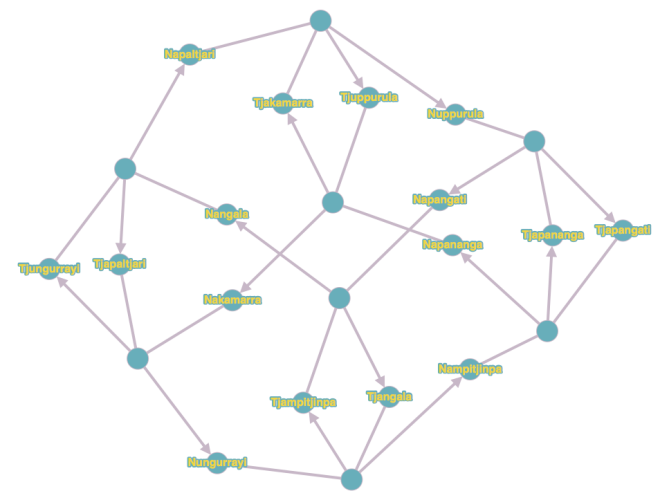
For example, the Warlpiri people from the north and west of Alice Springs have eight kinship groups based on family relationships. The eight groups, or subsections, are connected through both the father’s and mother’s sides of the family. Siblings always belong to the same subsection. Traditionally, a person is encouraged to marry someone from the subsection associated with their maternal grandfather. The diagram above shows the different names used for each relation (male names start with an N, female names with an Tj). Allowed weddings are shown as blue nodes and the children produced are shown with arrows.
These systems remain important in many communities today and help maintain social, cultural, and biological wellbeing.
References
Christine Judith Nicholls. (2016, March 17). Friday Essay: land, kinship and ownership of “Dreamings.” The Conversation. https://theconversation.com/friday-essay-land-kinship-and-ownership-of-dreamings-39637
Aboriginal and Torres Strait Islander peoples have long understood that traits and certain illnesses can be passed through family lines, demonstrating knowledge of heredity long before the discovery of genes and DNA.
Similar to the observations later made by Gregor Mendel, many Aboriginal and Torres Strait Islander communities recognised that closely related individuals were more likely to pass inherited traits and conditions to their offspring. This understanding is reflected in sophisticated kinship systems, which use moieties, totems, and skin names to identify family relationships, social responsibilities, and appropriate marriage partners.
For example, the Warlpiri people from the north and west of Alice Springs have eight kinship groups based on family relationships. The eight groups, or subsections, are connected through both the father’s and mother’s sides of the family. Siblings always belong to the same subsection. Traditionally, a person is encouraged to marry someone from the subsection associated with their maternal grandfather. The diagram above shows the different names used for each relation (male names start with an N, female names with an Tj). Allowed weddings are shown as blue nodes and the children produced are shown with arrows.
These systems remain important in many communities today and help maintain social, cultural, and biological wellbeing.
References
Christine Judith Nicholls. (2016, March 17). Friday Essay: land, kinship and ownership of “Dreamings.” The Conversation. https://theconversation.com/friday-essay-land-kinship-and-ownership-of-dreamings-39637