

Forces and sport
View Sequence overviewStudents will:
- use a simulation to test the effect of mass on an object’s speed.
- describe the effect on the motion of objects of different mass if the magnitude and direction of the applied force is kept constant.
- apply their understanding to analyse motion in a sport or physical activity.
Students will represent their understanding as they:
- conduct a simulation on the impact of mass on an object’s speed.
- construct a model to represent the relationship between mass and speed of an object in a certain time.
- analyse the results and draw valid conclusions.
In this lesson, assessment is formative.
Feedback might focus on students’ ability to:
- describe the relationship between mass and motion (measured as speed).
- complete an investigation and record data.
- analyse data, create and use a model and draw a conclusion.
Potential summative assessment
Students working at the achievement standard should:
- generate and record data with precision.
- process data and information and analyse it to describe patterns, trends and relationships.
- identify evidence to support their conclusions.
Refer to the Australian Curriculum content links on the Our design decisions tab for further information.
Whole class
Forces and sport Slides
Each group
Two different-sized soccer balls or two soft inflatable balls of different mass
Sticky notes
Each student
Individual science notebook
Forces and sport Poster
Access to the PhET Forces and motion: basics computer simulation model
Does mass affect motion Resource sheet
Lesson
The Inquire phase allows students to cycle progressively and with increasing complexity through the key science ideas related to the core concepts. Each Inquire cycle is divided into three teaching and learning routines that allow students to systematically build their knowledge and skills in science and incorporate this into their current understanding of the world.
When designing a teaching sequence, it is important to consider the knowledge and skills that students will need in the final Act phase. Consider what the students already know and identify the steps that need to be taken to reach the level required. How could you facilitate students’ understanding at each step? What investigations could be designed to build the skills at each step?
Read more about using the LIA FrameworkRe-orient
Recall examples of different types of forces. Discuss how forces acting on an object can be balanced or unbalanced, with unbalanced forces leading to changes in motion.
Using the Forces and sport Poster invite students to find three examples of balanced and three examples of unbalanced forces acting on an object (characters or equipment). Examples of balanced forces include the rock climber, the person on the parallel bars, and anyone moving at a constant speed.
Remind students that forces were represented in the last lesson using arrows to show the direction and magnitude of the force. Invite students to draw an example of a pair of balanced forces and an example of a pair of unbalanced forces using arrows on a force diagram. They could use the poster for ideas or draw force arrows for a scenario on the poster.
✎STUDENT NOTES: Draw an example of a pair of balanced forces and an example of a pair of unbalanced forces using arrows on a force diagram.
The Inquire phase allows students to cycle progressively and with increasing complexity through the key science ideas related to the core concepts. Each Inquire cycle is divided into three teaching and learning routines that allow students to systematically build their knowledge and skills in science and incorporate this into their current understanding of the world.
When designing a teaching sequence, it is important to consider the knowledge and skills that students will need in the final Act phase. Consider what the students already know and identify the steps that need to be taken to reach the level required. How could you facilitate students’ understanding at each step? What investigations could be designed to build the skills at each step?
Read more about using the LIA FrameworkIdentifying and constructing questions is the creative driver of the inquiry process. It allows students to explore what they know and how they know it. During the Inquire phase of the LIA Framework, the Question routine allows for past activities to be reviewed and to set the scene for the investigation that students will undertake. The use of effective questioning techniques can influence students’ view and interpretation of upcoming content, open them to exploration and link to their current interests and science capital.
When designing a teaching sequence, it is important to spend some time considering the mindset of students at the start of each Inquire phase. What do you want students to be thinking about, what do they already know and what is the best way for them to approach the task? What might tap into their curiosity?
Read more about using the LIA FrameworkMass and motion
(Slide 24) Pose the question: How does changing the mass of an object affect its motion?
TEACHER NOTE: The term “mass” is used in this question rather than “weight”. The mass of an object in Newtonian physics is related to how much matter it contains or by its ability to resist a given force. In contract, weight is a measure of the gravitational force acting on an object and can vary according to the strength of the gravitational field where the object is located.
Discuss an everyday example of lifting bags filled with, for example, groceries or books. Relate how extra effort or a larger force is required to lift the heavier bag.
Recall the forces on the barbell in each of the pictures as covered at the end of the previous lesson.
Discuss the adjustments the weightlifter would have to make if the mass on the barbell were increased.
- What would happen in the middle picture if double the amount of mass was added to the ends of the barbell?
- Greater weight force downwards with the extra mass added. This means more lift force would be needed to unbalance the forces and cause motion upwards.
- The barbell would not be lifted as fast, if at all, if the weightlifter could not increase the force exerted on the bar.
- The net force would still be upwards if the person is still able to rapidly lift it.
- What would happen in the end picture if half the amount of mass were on the barbell?
- The net force is still zero as the barbell is stationary at the top of the lift.
- To balance the forces, the weightlifter would not need to apply as much force from the arms to the barbell as there would not be as much weight force acting downwards.
(Slide 25) Pose the question: Using your own experience, how does mass affect movement in sport? and discuss.
- Does mass affect throwing?
- Does mass affect hitting with a racket or bat?
- Does mass affect catching?
- Does mass affect kicking?
- Does mass affect pushing?
- What about when you shoot a basketball? Does a heavier basketball require more effort to shoot upwards towards the basket?
- If you were to try to keep the force of your kick the same, what distance would a size 3 vs. size 5 soccer ball travel on a grass field? Would the ball travel with the same speed off the boot?
- The size 5 soccer ball is heavier (has more mass) and it would not travel as far if kicked with the same force.
- Has anyone used a sled-pull at the gym or in training? What happens when you add more weight?
- The sled-pull is much harder to pull when more weight is added to the sled.
(Slide 26) If time allows, play Woggabaliri (“wog-gab-a-lir-i”) with two balls of different mass (for example, a size 4 and 5 soccer ball).
Explain that children from the Bogan and Lachlan rivers area of New South Wales played a kind of football with a ball made of possum fur. The fur was spun by the women and made into a ball about 5 centimetres in diameter. In Wiradyuri language, woggabaliri means “play”. Many Aboriginal groups in central and southern New South Wales understood or spoke this language.
This traditional game has been adapted here into a kicking volley game.
- Form teams of 4-6 players. Players stand in a circle about 2 metres apart.
- One player kicks the ball into the air and other players in the circle try to keep the ball in the air by kicking it. No player should kick the ball twice in a row. All “kicks” are made with either the hands or feet. Players must have one foot on the ground when kicking the ball.
- Each group attempts to volley the ball (consecutive kicks) in the air as many times as they can within a set time. The group with the greatest number of volleys in the time wins. If the ball touches the ground, the count is restarted.
Watch this game being explained in the video Traditional Indigenous Games: Woggabaliri (0:51 min) or read about the game at Yulunga Traditional Indigenous Games | ASC.
Afterwards, discuss how the movements of the game changed when a heavier ball was used.
(Slide 27) Pose the question: What happens to the speed of an object if its mass is increased?
Mass, force and speed
Unbalanced forces change an object’s speed, and mass influences how much the object’s motion changes when a force is applied.

Mass and speed
Newton’s second law of motion
The Year 7 Australian Curriculum Physical Sciences content which describes the effect of unbalanced forces on the motion of objects, and how mass affects that motion, is essentially developing student conceptual understanding of Newton’s second law, without the use of formal equations or explicit naming of the law.
According to Newton’s second law ($F=ma$), acceleration depends on both the net force applied and the mass of an object. For a constant force, increasing mass results in a smaller acceleration, while decreasing mass produces a larger acceleration. Ensuring students understand this relationship is important but can be challenging, as it often conflicts with some students’ everyday experiences, where heavier objects are assumed to move faster because they feel stronger forces acting on them.
Teaching motion in Year 7
In the PhET simulation used in this lesson, speed is used as the dependent variable. This removes the need to introduce acceleration in Year 7 as speed is a measure of motion from students' everyday experiences. Acceleration is measured indirectly by determining the change in speed after a set time. Teachers can build students’ understanding of mass and motion by using qualitative language to describe this relationship between mass and speed without naming Newton’s second law or using the term “acceleration”. Focusing on how the motion of heavier objects changes differently to lighter objects when the same force is applied is a beneficial approach and can be seen in statements such as “If two objects are pushed the same way, but one is moving faster after a set time, it means its motion has changed more”.
Force and speed
A constant net force acting on an object causes the object to accelerate at a constant rate. Acceleration describes how an object’s speed changes over a certain time. This means that when an object is accelerating, its speed is increasing or decreasing rather than staying the same. Therefore, a constant acceleration means that the object will change its speed at a constant rate over time.
For example:
- Scenario A: A 4 N force acting on a 2 kg object produces an acceleration of 2 m.s⁻², so the object’s speed increases by 2 m.s⁻¹ every second.
- Scenario B: A 4 N force acting on a 4 kg object produces only 1 m.s⁻², so its speed increases more slowly; only 1 m.s⁻¹ for every second.
Making these distinctions explicit helps students move beyond everyday intuitions toward more scientifically accurate models of motion.
Mass and speed
Newton’s second law of motion
The Year 7 Australian Curriculum Physical Sciences content which describes the effect of unbalanced forces on the motion of objects, and how mass affects that motion, is essentially developing student conceptual understanding of Newton’s second law, without the use of formal equations or explicit naming of the law.
According to Newton’s second law ($F=ma$), acceleration depends on both the net force applied and the mass of an object. For a constant force, increasing mass results in a smaller acceleration, while decreasing mass produces a larger acceleration. Ensuring students understand this relationship is important but can be challenging, as it often conflicts with some students’ everyday experiences, where heavier objects are assumed to move faster because they feel stronger forces acting on them.
Teaching motion in Year 7
In the PhET simulation used in this lesson, speed is used as the dependent variable. This removes the need to introduce acceleration in Year 7 as speed is a measure of motion from students' everyday experiences. Acceleration is measured indirectly by determining the change in speed after a set time. Teachers can build students’ understanding of mass and motion by using qualitative language to describe this relationship between mass and speed without naming Newton’s second law or using the term “acceleration”. Focusing on how the motion of heavier objects changes differently to lighter objects when the same force is applied is a beneficial approach and can be seen in statements such as “If two objects are pushed the same way, but one is moving faster after a set time, it means its motion has changed more”.
Force and speed
A constant net force acting on an object causes the object to accelerate at a constant rate. Acceleration describes how an object’s speed changes over a certain time. This means that when an object is accelerating, its speed is increasing or decreasing rather than staying the same. Therefore, a constant acceleration means that the object will change its speed at a constant rate over time.
For example:
- Scenario A: A 4 N force acting on a 2 kg object produces an acceleration of 2 m.s⁻², so the object’s speed increases by 2 m.s⁻¹ every second.
- Scenario B: A 4 N force acting on a 4 kg object produces only 1 m.s⁻², so its speed increases more slowly; only 1 m.s⁻¹ for every second.
Making these distinctions explicit helps students move beyond everyday intuitions toward more scientifically accurate models of motion.
The Inquire phase allows students to cycle progressively and with increasing complexity through the key science ideas related to the core concepts. Each Inquire cycle is divided into three teaching and learning routines that allow students to systematically build their knowledge and skills in science and incorporate this into their current understanding of the world.
When designing a teaching sequence, it is important to consider the knowledge and skills that students will need in the final Act phase. Consider what the students already know and identify the steps that need to be taken to reach the level required. How could you facilitate students’ understanding at each step? What investigations could be designed to build the skills at each step?
Read more about using the LIA FrameworkThe Investigate routine provides students with an opportunity to explore the key ideas of science, to plan and conduct an investigation, and to gather and record data. The investigations are designed to systematically develop content knowledge and skills through increasingly complex processes of structured inquiry, guided inquiry and open inquiry approaches. Students are encouraged to process data to identify trends and patterns and link them to the real-world context of the teaching sequence.
When designing a teaching sequence, consider the diagnostic assessment (Launch phase) that identified the alternative conceptions that students held. Are there activities that challenge these ideas and provide openings for discussion? What content knowledge and skills do students need to be able to complete the final (Act phase) task? How could you systematically build these through the investigation routines? Are there opportunities to build students’ understanding and skills in the science inquiry processes through the successive investigations?
Read more about using the LIA FrameworkWhat happens to the speed?
(Slide 28 and 29) Explain that students will investigate the effect of mass on motion using an online simulation model. Using the simulation, they will place different weights on a skateboard, push the skateboard with a constant force, and then record the speed of the skateboard after 10 seconds.
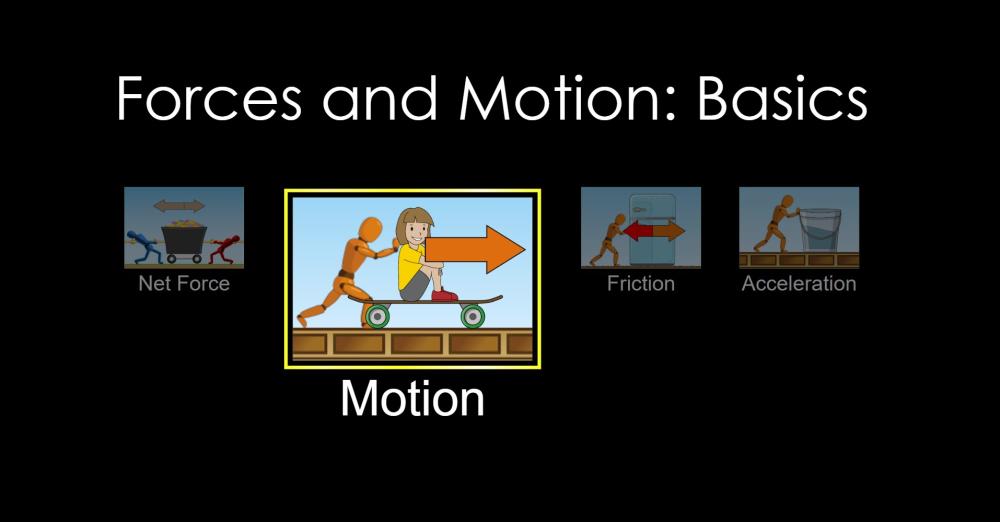
Demonstrate how to use the PhET Forces and motion: basics computer simulation model.
- Open the simulation and select Motion.
- Check all boxes at the top right-hand corner of the screen.
- Point out the features to take note of in the simulation, including:
- the skateboard and 50 kg mass on the board that will be pushed by a force (kept constant).
- the timer (that will be used to measure 10 seconds)
- a dial that will show the speed of the skateboard after 10 seconds (essentially a measurement of the motion of the acceleration of different masses).
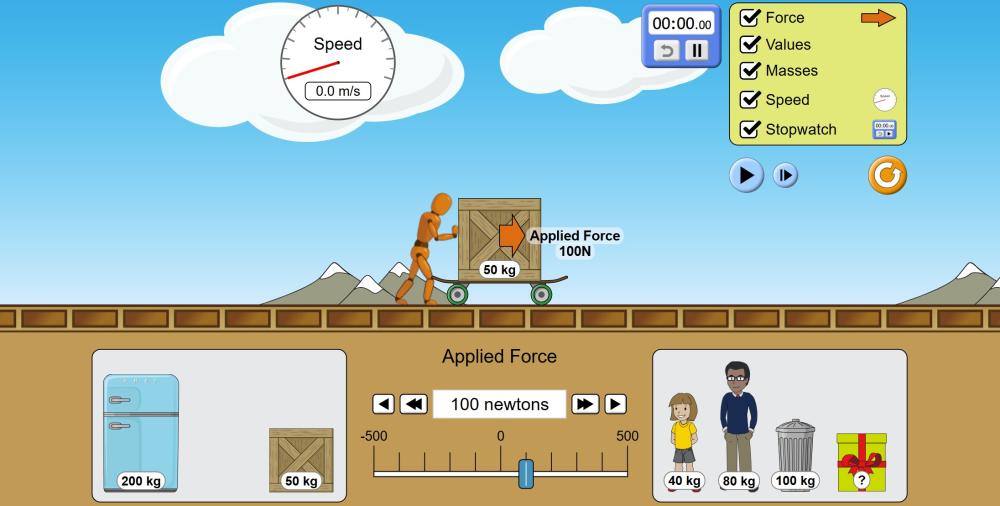
- Pause the simulation.
- Press the start button on the timer.
- Add 100 N of applied force by selecting the double arrow twice.
- Start the simulation and then pause it after 10 seconds have passed.
- Record the speed of the skateboard.
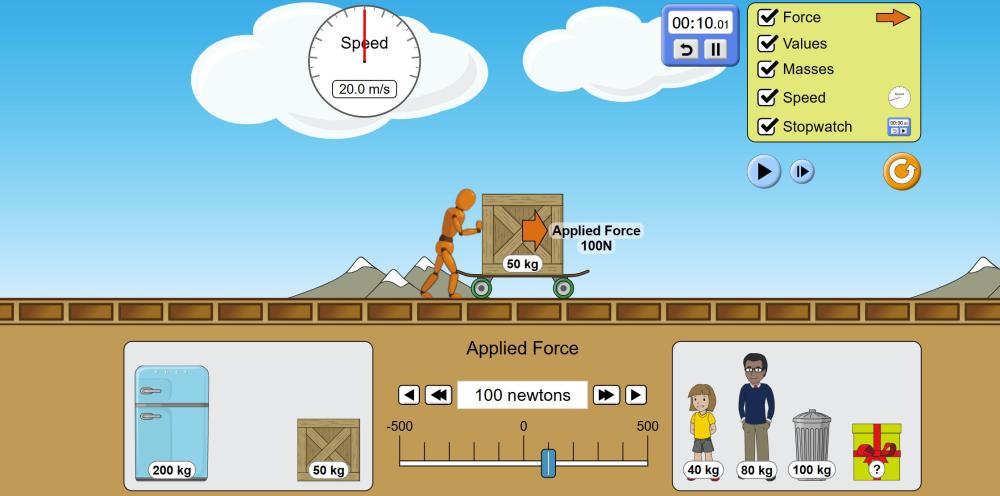
- Show how extra mass can be added to the skateboard by dragging objects from the bottom of the screen.
After showing students the features of the simulation, explain that even though there are a lot of different objects to choose from and test, students are going to test only one factor at a time. Inform students that this is to ensure the test is fair, and encourage discussion of fair testing.
Model designing a fair test by showing that students are:
- changing the mass by adding 50 kg each trial.
- measuring the speed of the skateboard after 10 seconds.
- keeping all the other factors that could impact the outcome the same in each trial.
Explain that if students changed the mass and the push force at the same time, the effect of mass could not be able to be determined.
Discuss why regular amounts of mass are going to be added to the skateboard each time. Guide the discussion so students understand that the regular increase in the independent variable allows for:
- patterns and trends to be detected more clearly.
- more reliable graphs.
- errors and anomalies to be detected.
- more accurate predictions to be made.
- If we added random amounts of mass each time, what might our results look like?
- How does using equal steps help you see what’s happening to the motion of the skateboard?
- Would it be harder or easier to see a pattern if the mass increases weren’t equal? Why?
- How would our graph look if the masses weren’t evenly spaced?
- How does even spacing of data points help with drawing a line of best fit?
- Would uneven points affect how confident we feel about the trend?
- Would irregular steps make mistakes or errors harder or easier to spot?
- How can regular increments help us decide if a result is unusual?
- How does regular spacing help with predictions?
Provide students with the PhET simulation: Mass & motion Resource sheet. Students complete Experiment 1.
✎STUDENT NOTES: Record results and write a conclusion.
Chunking and sequencing learning
When planning lessons, it is important to build on students’ prior knowledge while managing cognitive load.

Chunking content into manageable steps and gradually increasing the complexity of a sequence is essential to avoid overloading working memory.
While Lesson 2 focused on horizontal balanced and unbalanced forces, Lesson 3 builds on this understanding by exploring how mass affects an object’s motion when a horizontal force is applied.
While the additional concepts of weight force, tension force and/or normal force along with new force arrows representations could have been added, this simulation activity was selected to isolate the effect of mass on motion. This allows students to consolidate prior knowledge without unnecessary complexity.
More complex investigations, such as those involving multiple forces, can be reserved for later sequences, such as the Year 10 Newton meets AI lessons.
Chunking content into manageable steps and gradually increasing the complexity of a sequence is essential to avoid overloading working memory.
While Lesson 2 focused on horizontal balanced and unbalanced forces, Lesson 3 builds on this understanding by exploring how mass affects an object’s motion when a horizontal force is applied.
While the additional concepts of weight force, tension force and/or normal force along with new force arrows representations could have been added, this simulation activity was selected to isolate the effect of mass on motion. This allows students to consolidate prior knowledge without unnecessary complexity.
More complex investigations, such as those involving multiple forces, can be reserved for later sequences, such as the Year 10 Newton meets AI lessons.
The Inquire phase allows students to cycle progressively and with increasing complexity through the key science ideas related to the core concepts. Each Inquire cycle is divided into three teaching and learning routines that allow students to systematically build their knowledge and skills in science and incorporate this into their current understanding of the world.
When designing a teaching sequence, it is important to consider the knowledge and skills that students will need in the final Act phase. Consider what the students already know and identify the steps that need to be taken to reach the level required. How could you facilitate students’ understanding at each step? What investigations could be designed to build the skills at each step?
Read more about using the LIA FrameworkFollowing an investigation, the Integrate routine provides time and space for data to be evaluated and insights to be synthesized. It reveals new insights, consolidates and refines representations, generalises context and broadens students’ perspectives. It allows student thinking to become visible and opens formative feedback opportunities. It may also lead to further questions being asked, allowing the Inquire phase to start again.
When designing a teaching sequence, consider the diagnostic assessment that was undertaken during the Launch phase. Consider if alternative conceptions could be used as a jumping off point to discussions. How could students represent their learning in a way that would support formative feedback opportunities? Could small summative assessment occur at different stages in the teaching sequence?
Read more about using the LIA FrameworkConnecting mass and speed
(Slide 30) Invite students to look at their data and to consider the trend or patterns shown. Discuss how they could best display that data when making a scientific model.
Discuss ways that the relationship between mass and speed could be expressed with words. Students could express this relationship:
- pictorially, using arrows to show up or down.
- For example, recording Mass ↑⇒ Speed ↓ to show an inverse relationship.
- by writing a description. For example:
- “As one thing goes up, the other goes down.”
- “One gets bigger while the other gets smaller.”
- “Mass and speed balance each other out: if mass increases, speed decreases.”
Discuss the graph of the data collected from the simulation, shown on Slide 30 and on the Resource sheet.
To make student learning visible, probe student learning by asking:
- What are some things you notice?
- Where do you see that?
- What else?
Direct students’ attention to the axis labels. Model how to interpret the relationship between the variables on each axis by first going to the x-axis and then the y-axis and asking, for example, What happens to the speed for a lower mass? What happens to the speed of the skateboard for a higher mass?
(Slide 31) Read the example student’s claim: The speed of the skateboard has an inverse relationship to the mass on the skateboard. Invite students to provide feedback on the claim by asking: Is the student’s claim supported? Use evidence to support your decision.
(Slide 32) Examine the student’s diagram showing the relationship between mass and speed. Invite students to discuss whether it is an effective model of an inverse relationship, identifying its strengths and limitations. Extend the discussion by asking students how it could be improved.
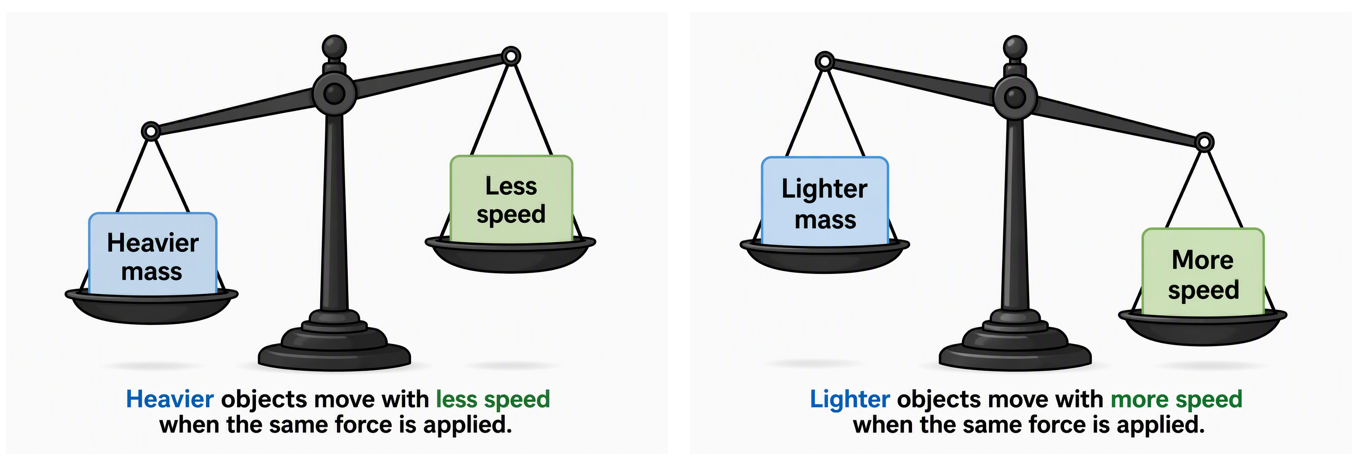
Develop a class consensus response by students writing responses to the claim and the diagram on sticky notes and posting them on a surface in the classroom. Discuss the commonalities of the responses and positively identify examples where evidence has been used in the response.
✎STUDENT NOTES: Complete the questions on page 2 of the PhET simulation: Mass & motion Resource sheet.
(Slide 33) Pose the question: Can the speed of an object be predicted if we know the mass?
Invite students to predict the speed of the 40 kg person and the 80 kg person when placed on the skateboard and 100 N of force is applied, using the data from Experiment 1, and then test predictions using the simulation.
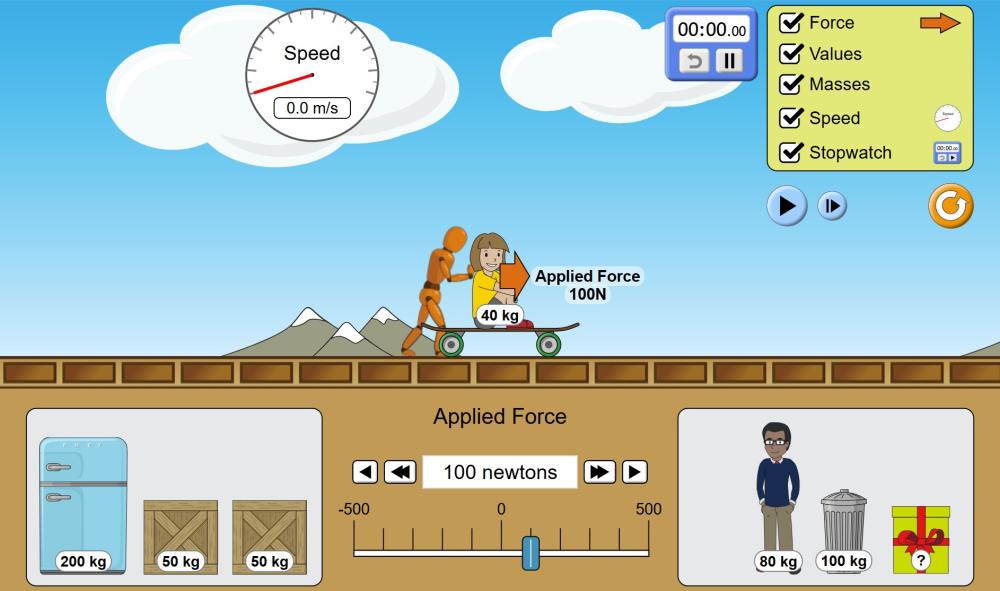
✎STUDENT NOTES: Record the results of Experiment 2 on the PhET simulation: Mass & motion Resource sheet.
(Slide 34) Pose the question: Can the mass of an object be predicted if we know the speed?
Invite students to measure the speed of the unknown object in the wrapped box when 100 N of force is applied (Experiment 3) and use this speed and the previous data to determine the mass of the object.
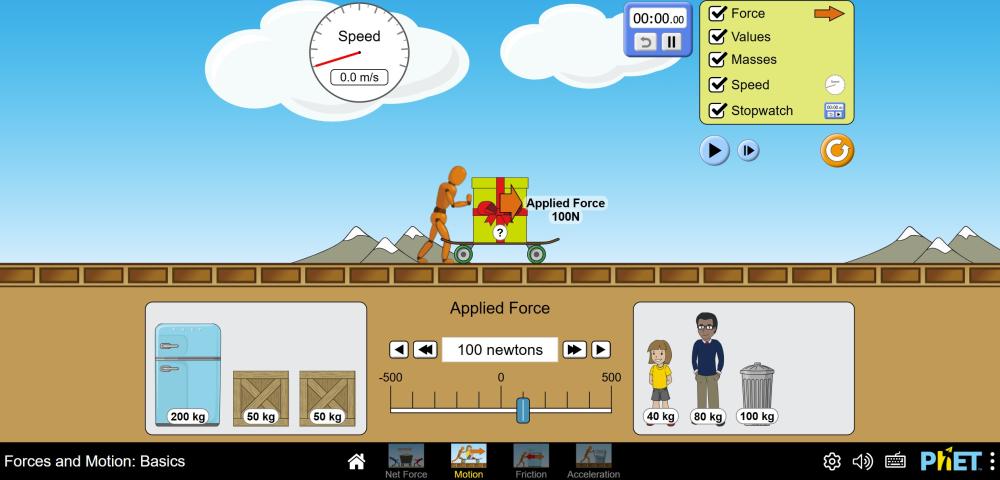
✎STUDENT NOTES: Record the results of Experiment 3 of the PhET simulation: Mass & motion Resource sheet.
(Slide 35) Pose the question: How will you show the impact of mass on motion in your sport or physical activity infographic?
Draw attention to the sports shown on the slide, highlighting how mass impacts motion in each. Discuss how:
- the weight of the backpack affects the motion up and down hills of bushwalkers and the distance covered each day.
- the mass loaded onto a sled pull in a gym makes it harder to pull or push.
- heavier boxing gloves lead to slower arm acceleration during a punch.
In small groups, brainstorm examples of mass (equipment or person) affecting motion in other sports and physical activities, including training. Students could discuss the sport or activity they have chosen for their infographic or discuss a range of other sports.
✎ STUDENT NOTES: Select a single sport and describe how different masses would change the outcome. Identify one way this could be communicated to new participants.
Reflect on the lesson
You might invite students to:
- review the learning goals for the lesson and check for understanding.
- choose a piece of equipment and the movements that occur when using this equipment in a sport or physical activity. Write a paragraph for the “What if mass is changed?” scenario such as:
- What would happen if the equipment was twice as heavy?
- What would happen if the equipment was half as heavy?
Inverse, indirect and causal relationships
In science, inverse relationships describe how two variables change together at the same time, with one increasing while the other decreases.
Students often misunderstand the word inverse, thinking it means two factors are unrelated, have no connection, reversing order or moving backward. Inverse relationships are connected, but the connection is in an opposite pattern (when one factor increases, the other decreases).
True inverse relationships are usually causal, not random. For example, when it starts raining, the school canteen may sell fewer ice creams. These events happen in opposite directions, but rain does not directly determine ice cream sales, so this is not an inverse causal relationship.
Misunderstandings can arise when students assume inverse relationships always follow simple rules, such as “if one increases by 5, the other must decrease by 5”. Graphs of inverse relationships are not always straight lines. On the Resource sheet for this lesson, the inverse relationship between mass and speed is shown with a curved trendline.
It is also important to distinguish between inverse and indirect relationships. In an inverse relationship, two variables are directly linked and change in opposite ways. In an indirect relationship, the variables affect each other through a third factor. For example, hot chocolate sales increase at the same time that shark attacks decrease. Here, hot chocolate sales and shark attacks display an inverse relationship but are indirectly related through the daily temperature.
A special type of inverse relationship is inversely proportional, where the factors are related in a mathematical and predictable way, allowing values to be calculated. For example, “if one doubles, the other halves”. In contrast, an inverse relationship is a general description of two factors changing oppositely, without necessarily being mathematically predictable.
Students often misunderstand the word inverse, thinking it means two factors are unrelated, have no connection, reversing order or moving backward. Inverse relationships are connected, but the connection is in an opposite pattern (when one factor increases, the other decreases).
True inverse relationships are usually causal, not random. For example, when it starts raining, the school canteen may sell fewer ice creams. These events happen in opposite directions, but rain does not directly determine ice cream sales, so this is not an inverse causal relationship.
Misunderstandings can arise when students assume inverse relationships always follow simple rules, such as “if one increases by 5, the other must decrease by 5”. Graphs of inverse relationships are not always straight lines. On the Resource sheet for this lesson, the inverse relationship between mass and speed is shown with a curved trendline.
It is also important to distinguish between inverse and indirect relationships. In an inverse relationship, two variables are directly linked and change in opposite ways. In an indirect relationship, the variables affect each other through a third factor. For example, hot chocolate sales increase at the same time that shark attacks decrease. Here, hot chocolate sales and shark attacks display an inverse relationship but are indirectly related through the daily temperature.
A special type of inverse relationship is inversely proportional, where the factors are related in a mathematical and predictable way, allowing values to be calculated. For example, “if one doubles, the other halves”. In contrast, an inverse relationship is a general description of two factors changing oppositely, without necessarily being mathematically predictable.