

Forces and sport
View Sequence overviewStudents will:
- demonstrate how gravitational force, acting as a net force, increases an object’s speed as it rolls down a ramp.
- develop the skills of collecting, transforming and analysing data from an investigation with a large sample size.
- explain the trajectory of different passes, shots and kicks in sports and physical activities.
Students will represent their understanding as they:
- plan and conduct an investigation to determine that gravitational force acting on an object as it rolls down a ramp causes its speed to increase over time.
- collect, present, transform and analyse data from a large sample size.
- use investigation findings to make inferences and draw conclusions about the action of gravitational force.
- assess and explain the paths of different passes, shots and kicks.
In this lesson, assessment is formative.
Feedback might focus on students’ ability to:
- complete an investigation with a large sample size and collate and present data clearly.
- transform data by calculating averages.
- analyse data to describe patterns.
- assess the precision of data and methods to collect and present data from an investigation with a large sample size.
- explain how the trajectory of a pass, shot or kick is controlled by gravitational force acting on the ball.
Potential summative assessment
Students working at the Achievement Standard should:
- represent and explain the effects of forces acting on objects.
- conduct safe, reproducible investigations to test relationships.
- use equipment to generate and record data with precision.
- select and construct appropriate representations to organise and process data and information.
- process data and information and analyse it to describe patterns, trends and relationships.
- analyse methods and use evidence-based arguments to support claims.
Refer to the Australian Curriculum content links on the Our design decisions tab for further information.
Whole class
Forces and sport Slides
Each group
Optional: Balls such as netballs, basketballs, footballs, tennis balls
A wooden ramp or a long cardboard tube cut in half to use as a ramp
A book to raise the ramp
Metre ruler/tape measure
Marble or ball bearing
Marker/pencil
Timer
Each student
Individual science notebook
Gravitational force investigation planner Resource sheet
Forces and sport Poster
Lesson
The Inquire phase allows students to cycle progressively and with increasing complexity through the key science ideas related to the core concepts. Each Inquire cycle is divided into three teaching and learning routines that allow students to systematically build their knowledge and skills in science and incorporate this into their current understanding of the world.
When designing a teaching sequence, it is important to consider the knowledge and skills that students will need in the final Act phase. Consider what the students already know and identify the steps that need to be taken to reach the level required. How could you facilitate students’ understanding at each step? What investigations could be designed to build the skills at each step?
Read more about using the LIA FrameworkRe-orient
Recall the previous lesson that focused on friction, where students investigated the effect of different surfaces on motion.
(Slide 61) Refer to the table on the slide to recall how surfaces can reduce or increase the friction experienced, and the resulting changes in motion. Invite students to provide examples to complete each row of the table.
Invite students to use the Forces and sport Poster to:
- identify two examples of different surfaces or equipment decreasing the frictional force between two objects (the ice skater at bottom right, the smooth surface used for bowling at the centre of the poster). Explain what happens to motion in each example.
- identify two examples of frictional force decreasing motion (the rhinoceros blocking the rabbit at bottom left, the boulder being climbed at top middle). Explain how and why motion is impacted.
The Inquire phase allows students to cycle progressively and with increasing complexity through the key science ideas related to the core concepts. Each Inquire cycle is divided into three teaching and learning routines that allow students to systematically build their knowledge and skills in science and incorporate this into their current understanding of the world.
When designing a teaching sequence, it is important to consider the knowledge and skills that students will need in the final Act phase. Consider what the students already know and identify the steps that need to be taken to reach the level required. How could you facilitate students’ understanding at each step? What investigations could be designed to build the skills at each step?
Read more about using the LIA FrameworkIdentifying and constructing questions is the creative driver of the inquiry process. It allows students to explore what they know and how they know it. During the Inquire phase of the LIA Framework, the Question routine allows for past activities to be reviewed and to set the scene for the investigation that students will undertake. The use of effective questioning techniques can influence students’ view and interpretation of upcoming content, open them to exploration and link to their current interests and science capital.
When designing a teaching sequence, it is important to spend some time considering the mindset of students at the start of each Inquire phase. What do you want students to be thinking about, what do they already know and what is the best way for them to approach the task? What might tap into their curiosity?
Read more about using the LIA FrameworkGravitational force
(Slide 62) Using the images and student experiences, discuss how gravitational force affects motion. Invite students to describe how a ball moves after a kick, shot, or pass in a sport or physical activity, focusing on its motion through the air when it is acted on only by gravity (air resistance will not be considered in this lesson).
If time permits, take students to an outdoor area and ask them, in small groups, to observe how the path and speed of a ball change when it is passed, kicked or thrown.
Guide students to recognise that:
- because the ball’s motion changes while it is in the air, a force must be acting on it.
- the force acts continuously for the entire time the ball is in the air.
- when a ball is thrown upwards (e.g. in a tennis serve), it rises, reaches a highest point, and then falls back down.
- the ball follows a curved path if projected forward.
- When a ball is kicked or thrown, what is it doing while it is in the air?
- Moving forward, upward, sideways, slowing down, changing direction.
- What is the direction at the start of motion?
- How does the speed change as the ball moves?
- How does the height of the ball change over time?
- In netball, how can a player use gravity to help the ball fall into the netball ring?
- In AFL, when a player kicks the ball long, what shape does the path usually look like?
- In a tennis serve, even before the ball starts coming down, how do players know it will come back down?
- How could a steady downward force explain those changes?
- Is the ball being pushed by the player while it is in the air?
- So, if nothing is touching the ball, what is still affecting its motion?
(Slide 63) Explain that in this lesson students are going to understand more about gravitational force and apply it to sports and physical activities to include on their infographic.
Pose the question: How does gravitational force affect motion?
Alternative conceptions about forces on an object in flight
Students often assume that motion requires an ongoing force in the direction of travel.
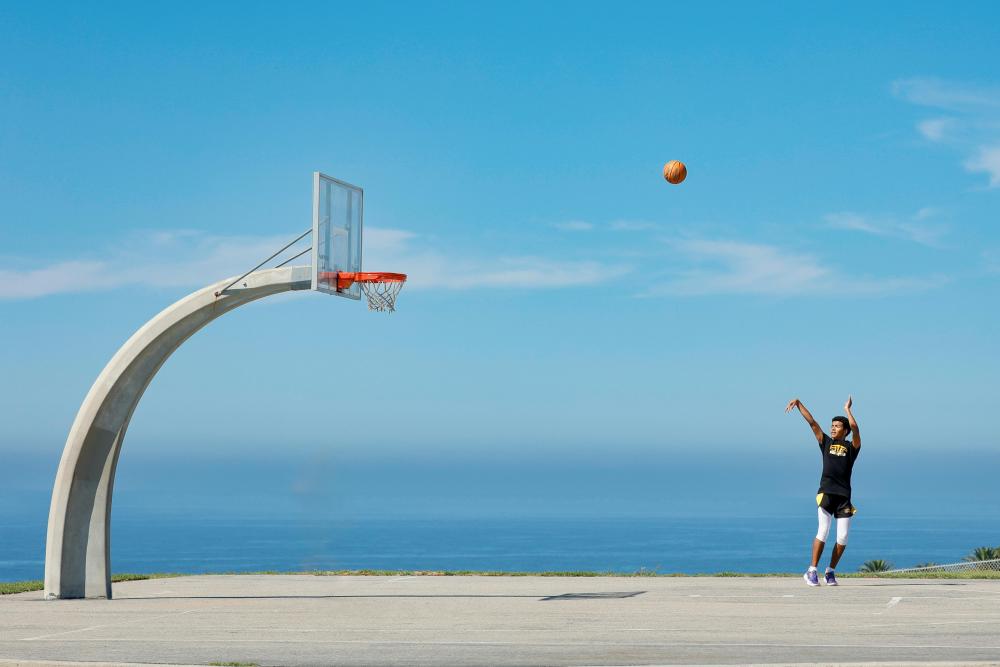
A common alternative conception students believe is that because a ball is moving upward, there must be an upward force that keeps pushing it. This could be addressed during classroom discussions.
Once a ball leaves the player’s hand, the applied force from the shot no longer acts on the ball. Even though the ball continues to move upward for a short time, the net force on the ball is downward due to gravity. The upward motion occurs because of the ball’s initial velocity, not because of an ongoing upward force. Gravitational force continuously acts downward, causing the ball’s upward speed to decrease each moment until it reaches its highest point, after which it accelerates downward. Explicitly distinguishing between the direction of motion and the direction of net force helps students understand that acceleration depends on the net force (gravitational force), not on the direction an object is currently moving.
A common alternative conception students believe is that because a ball is moving upward, there must be an upward force that keeps pushing it. This could be addressed during classroom discussions.
Once a ball leaves the player’s hand, the applied force from the shot no longer acts on the ball. Even though the ball continues to move upward for a short time, the net force on the ball is downward due to gravity. The upward motion occurs because of the ball’s initial velocity, not because of an ongoing upward force. Gravitational force continuously acts downward, causing the ball’s upward speed to decrease each moment until it reaches its highest point, after which it accelerates downward. Explicitly distinguishing between the direction of motion and the direction of net force helps students understand that acceleration depends on the net force (gravitational force), not on the direction an object is currently moving.
A simplified model of gravity
A simplified model of gravity is used to aid students' understanding and for consistency.
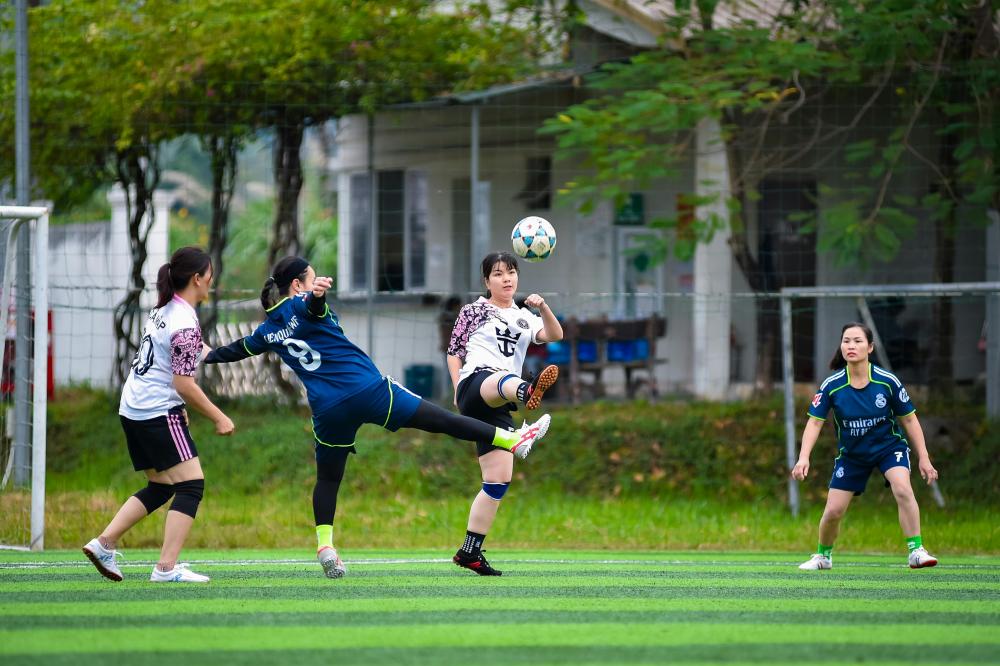
In everyday language and in science lessons, the word gravity is often used as a broad description of why objects fall, why planets orbit, and why we stay on the ground. It refers to the overall phenomenon that objects with mass influence each other’s motion.
The term “gravitational force” comes from a simplified model of gravity, in which gravity is treated as a force that pulls objects toward the centre of the Earth. This model is commonly used in primary and junior secondary science to explain and predict motion. The classification of gravity as one of the four fundamental forces (or interactions) is covered in senior secondary physics, while a deeper and precise understanding of gravity, as described in Einstein’s general theory of relativity, is studied in post-school courses.
Using the term “gravitational force” also helps keep language consistent with the Australian Curriculum, where forces are introduced as interactions that can change motion. It aligns with how students encounter other forces in Year 7, such as pushes, pulls and friction. Using this shared language supports students to compare how different forces affect motion using familiar ideas and helps build a coherent understanding of forces at this stage of learning.
If time allows, it can be helpful to point out that this is a model—a simplified way of explaining something complex. Making this explicit helps students understand that scientific models are useful tools that can be improved and refined as their learning develops.
In everyday language and in science lessons, the word gravity is often used as a broad description of why objects fall, why planets orbit, and why we stay on the ground. It refers to the overall phenomenon that objects with mass influence each other’s motion.
The term “gravitational force” comes from a simplified model of gravity, in which gravity is treated as a force that pulls objects toward the centre of the Earth. This model is commonly used in primary and junior secondary science to explain and predict motion. The classification of gravity as one of the four fundamental forces (or interactions) is covered in senior secondary physics, while a deeper and precise understanding of gravity, as described in Einstein’s general theory of relativity, is studied in post-school courses.
Using the term “gravitational force” also helps keep language consistent with the Australian Curriculum, where forces are introduced as interactions that can change motion. It aligns with how students encounter other forces in Year 7, such as pushes, pulls and friction. Using this shared language supports students to compare how different forces affect motion using familiar ideas and helps build a coherent understanding of forces at this stage of learning.
If time allows, it can be helpful to point out that this is a model—a simplified way of explaining something complex. Making this explicit helps students understand that scientific models are useful tools that can be improved and refined as their learning develops.
The Inquire phase allows students to cycle progressively and with increasing complexity through the key science ideas related to the core concepts. Each Inquire cycle is divided into three teaching and learning routines that allow students to systematically build their knowledge and skills in science and incorporate this into their current understanding of the world.
When designing a teaching sequence, it is important to consider the knowledge and skills that students will need in the final Act phase. Consider what the students already know and identify the steps that need to be taken to reach the level required. How could you facilitate students’ understanding at each step? What investigations could be designed to build the skills at each step?
Read more about using the LIA FrameworkThe Investigate routine provides students with an opportunity to explore the key ideas of science, to plan and conduct an investigation, and to gather and record data. The investigations are designed to systematically develop content knowledge and skills through increasingly complex processes of structured inquiry, guided inquiry and open inquiry approaches. Students are encouraged to process data to identify trends and patterns and link them to the real-world context of the teaching sequence.
When designing a teaching sequence, consider the diagnostic assessment (Launch phase) that identified the alternative conceptions that students held. Are there activities that challenge these ideas and provide openings for discussion? What content knowledge and skills do students need to be able to complete the final (Act phase) task? How could you systematically build these through the investigation routines? Are there opportunities to build students’ understanding and skills in the science inquiry processes through the successive investigations?
Read more about using the LIA FrameworkGravitational force and motion
(Slide 64) Introduce students to a description of gravitational force, focusing on magnitude, direction and possible representations:
- Magnitude: At Earth’s surface, gravity exerts 9.8 N of force on every kilogram of mass.
- Direction: Gravitational force near Earth’s surface always acts downward, pulling objects toward the centre of the Earth.
- Representations:
- Draw arrows pointing to the centre of the Earth, showing that the force acts vertically downwards at all locations.
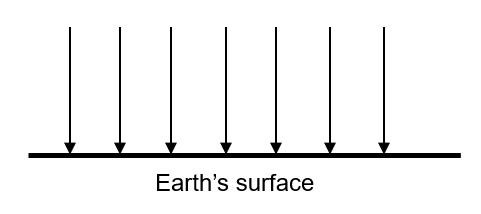
- Draw a single arrow pointing downwards to show gravitational force acting on an object.
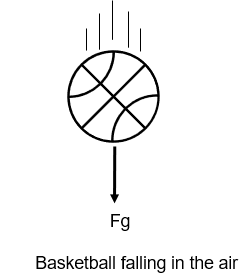
- Draw arrows pointing to the centre of the Earth, showing that the force acts vertically downwards at all locations.
✎STUDENT NOTES: Write a description of gravitational force.
Introduce that the action of gravitational force on objects in sports and physical activities can be investigated using a simple model of a marble moving down a ramp. Explain that as the marble is acted upon only by gravitational force, we can find out more about this force if the motion or speed of the marble is measured.
(Slide 65) Show how the investigation is to be completed by demonstrating the following steps:
- Prop one end of the ramp/tube on a book to create a slope of approximately 10-20 degrees. This investigation will work better if the slope is not too steep.
- Mark a starting point on the higher end of the ramp, to be used in all trials.
- Place the marble on the starting point (but do not let it go yet).
- Simultaneously start the timer and let the marble roll down the ramp for one second.
- Mark the location of the marble on the ramp at one second.
- Measure the distance between the marked starting point and the location of the marble after one second (the distance the marble travelled in one second). Record this distance.
Demonstrate three runs of the test, drawing a line on the ramp each time to mark the distance travelled by the marble after one second.
(Slide 66) Draw students’ attention to the difficulty of determining the marble’s exact position after one second. With reference to the slide, define “variation” and “outliers”:
- Variation refers to how spread out the data points in an investigation are from each other.
- An outlier is a data point that is significantly different from the other points in the data set.
Discuss sources of measurement uncertainty that could have led to the variation observed, such as the differences in the release of the marble and the reaction time involved in starting the timer and judging the marble’s position on the ramp after one second.
✎STUDENT NOTES: Define data variation and outlier.
(Slide 67) Define “reliable data”: reliable data is achieved when the data points consistently show low variation. Invite students to suggest how the variation in the measurement data could be improved. Guide students to suggest:
- repeating the experiment multiple times (a large sample size).
- identifying and potentially excluding outliers or trials where an error is known to have occurred.
✎STUDENT NOTES: Explain the importance of a large sample size in identifying outliers and errors.
Provide students with a copy of the Gravitational force investigation planner Resource sheet.
Allow students time to develop a procedure to improve reliability by repeating the release of the marble and measuring the distance travelled multiple times to determine the best way to control variables and take consistent measurements.
✎STUDENT NOTES: Write a procedure to collect reliable data, account for any risks, and describe how to control variables.
Allow students time to use their new procedure to conduct the experiment and record the distance the marble rolls down the ramp after one second (the opportunity to complete up to ten trials is given in Table 1).
✎STUDENT NOTES: Record the measured distances in Table 1. Calculate the average distance travelled.
(Slide 68) Pose the question: Will the distance travelled by the marble double if the time doubles (to two seconds)?
(Slide 69) Discuss the possible outcomes of this experiment, including:
- the distance travelled will double (suggesting the marble’s speed does not change over time).
- the distance travelled will be less than double (suggesting the marble slows down).
- the distance travelled will be more than double (suggesting the marble speed is increasing/accelerating).
✎STUDENT NOTES: Write a hypothesis for the experiment.
Allow students time to complete the experiment. The number of repeat trials required may vary based on the precision of their collected data.
✎STUDENT NOTES: Record the measured distances in Table 2. Calculate the average distance travelled.
(Slide 70) Guide students to calculate the distance travelled in the interval between second 1 and second 2 by subtracting the average distance travelled in one second from the average distance travelled in two seconds.
✎STUDENT NOTES: Calculate the average distance travelled in the interval between second 1 and second 2 (Table 3).
Common alternative conceptions about gravity
Anticipating common alternative conceptions about gravity allows opportunities for them to be addressed during classroom activities and discussions.
- Heavier objects fall faster than lighter objects.
- Many students believe mass determines how fast an object falls, rather than understanding that (ignoring air resistance) all objects near Earth fall at the same rate.
- Gravity only acts on falling objects.
- Students often think gravity only acts when an object is moving downward, not recognising that gravity also acts on stationary objects and objects moving upward or sideways.
- There is no gravity in space.
- A common belief is that gravity stops beyond Earth’s atmosphere, leading to confusion about why astronauts orbit the Earth or appear “weightless”.
- Gravity needs air to work.
- Some students think gravity depends on air or atmosphere, explaining the misconception that the Moon has little or no gravity because it lacks air.
- Objects fall because it is their natural behaviour.
- Students may describe falling as something objects “naturally do”, rather than linking the motion to a force acting on them.
- Gravity is stronger on taller buildings or mountains.
- Some students believe being higher up significantly changes gravity’s strength, rather than understanding that the change is extremely small near Earth’s surface.
- Gravity acts more strongly on moving objects.
- There is a belief that motion itself affects gravity’s strength, confusing gravity with friction or air resistance.
- Gravity is the same as magnetism.
- Some students conflate gravity with magnetic forces, assuming gravity acts only on certain materials or behaves like a magnetic pull.
Further reading
Syuhendri S (2019) J. Phys.: Conf. Ser. 1185 012047 Student teachers’ misconceptions about gravity https://iopscience.iop.org/article/10.1088/1742-6596/1185/1/012047/pdf
Science Learning Hub (2013) Alternative conceptions about gravity https://www.sciencelearn.org.nz/resources/294-alternative-conceptions-about-gravity
Institute of Physics (IOP) (2026) Misconceptions – Force and motion https://spark.iop.org/misconceptionsrk
Mitchell I (2024) Children’s alternative conceptions in Science.Science Education Research Group (SERG) within Monash University https://www.monash.edu/__data/assets/pdf_file/0007/3399514/alternconcepts.pdf Retrieved April 22, 2026
Khandagale, V. S.; Chavan, Rajendra (2017) Identification of Misconceptions for Gravity, Motion and Inertia among Secondary School Students Aayushi International Interdisciplinary Research Journal v4 n11 p197-205 https://eric.ed.gov/?id=ED593127
Palmer, D. (2001, July 1). Students' alternative conceptions and scientifically acceptable conceptions about gravity. Int. J. Sci. Educ., 23(7), 691-706. Retrieved April 22, 2026, from https://doi.org/10.1080/09500690010006527
- Heavier objects fall faster than lighter objects.
- Many students believe mass determines how fast an object falls, rather than understanding that (ignoring air resistance) all objects near Earth fall at the same rate.
- Gravity only acts on falling objects.
- Students often think gravity only acts when an object is moving downward, not recognising that gravity also acts on stationary objects and objects moving upward or sideways.
- There is no gravity in space.
- A common belief is that gravity stops beyond Earth’s atmosphere, leading to confusion about why astronauts orbit the Earth or appear “weightless”.
- Gravity needs air to work.
- Some students think gravity depends on air or atmosphere, explaining the misconception that the Moon has little or no gravity because it lacks air.
- Objects fall because it is their natural behaviour.
- Students may describe falling as something objects “naturally do”, rather than linking the motion to a force acting on them.
- Gravity is stronger on taller buildings or mountains.
- Some students believe being higher up significantly changes gravity’s strength, rather than understanding that the change is extremely small near Earth’s surface.
- Gravity acts more strongly on moving objects.
- There is a belief that motion itself affects gravity’s strength, confusing gravity with friction or air resistance.
- Gravity is the same as magnetism.
- Some students conflate gravity with magnetic forces, assuming gravity acts only on certain materials or behaves like a magnetic pull.
Further reading
Syuhendri S (2019) J. Phys.: Conf. Ser. 1185 012047 Student teachers’ misconceptions about gravity https://iopscience.iop.org/article/10.1088/1742-6596/1185/1/012047/pdf
Science Learning Hub (2013) Alternative conceptions about gravity https://www.sciencelearn.org.nz/resources/294-alternative-conceptions-about-gravity
Institute of Physics (IOP) (2026) Misconceptions – Force and motion https://spark.iop.org/misconceptionsrk
Mitchell I (2024) Children’s alternative conceptions in Science.Science Education Research Group (SERG) within Monash University https://www.monash.edu/__data/assets/pdf_file/0007/3399514/alternconcepts.pdf Retrieved April 22, 2026
Khandagale, V. S.; Chavan, Rajendra (2017) Identification of Misconceptions for Gravity, Motion and Inertia among Secondary School Students Aayushi International Interdisciplinary Research Journal v4 n11 p197-205 https://eric.ed.gov/?id=ED593127
Palmer, D. (2001, July 1). Students' alternative conceptions and scientifically acceptable conceptions about gravity. Int. J. Sci. Educ., 23(7), 691-706. Retrieved April 22, 2026, from https://doi.org/10.1080/09500690010006527
Measuring speed
This investigation helps students make a clear link between gravitational force and changes in motion.

As a marble rolls down a slope, students can observe that it speeds up, showing that its motion is changing. This change in speed is called acceleration, and it occurs because gravitational force is the net force acting on the marble. According to Newton’s second law, a net force causes an object to accelerate, so the increasing speed is direct evidence of gravity’s effect.
To determine how the speed is changing, students can keep the time interval constant (for example, measuring how far the marble travels in each second). If the marble travels a greater distance between 1-2 seconds than in 0-1 seconds, this shows that its speed has increased. This increasing distance over equal time intervals indicates acceleration, reinforcing the idea that the marble’s motion is changing due to the gravitational force acting on it.
Speed can also be determined using technology such as a photogate, which measures the time it takes for the marble to pass through a known distance. By dividing the length of the marble (or the distance between two photogates) by the measured time, students can calculate the marble’s speed and compare how it changes as the marble moves down the slope.
As a marble rolls down a slope, students can observe that it speeds up, showing that its motion is changing. This change in speed is called acceleration, and it occurs because gravitational force is the net force acting on the marble. According to Newton’s second law, a net force causes an object to accelerate, so the increasing speed is direct evidence of gravity’s effect.
To determine how the speed is changing, students can keep the time interval constant (for example, measuring how far the marble travels in each second). If the marble travels a greater distance between 1-2 seconds than in 0-1 seconds, this shows that its speed has increased. This increasing distance over equal time intervals indicates acceleration, reinforcing the idea that the marble’s motion is changing due to the gravitational force acting on it.
Speed can also be determined using technology such as a photogate, which measures the time it takes for the marble to pass through a known distance. By dividing the length of the marble (or the distance between two photogates) by the measured time, students can calculate the marble’s speed and compare how it changes as the marble moves down the slope.
The Inquire phase allows students to cycle progressively and with increasing complexity through the key science ideas related to the core concepts. Each Inquire cycle is divided into three teaching and learning routines that allow students to systematically build their knowledge and skills in science and incorporate this into their current understanding of the world.
When designing a teaching sequence, it is important to consider the knowledge and skills that students will need in the final Act phase. Consider what the students already know and identify the steps that need to be taken to reach the level required. How could you facilitate students’ understanding at each step? What investigations could be designed to build the skills at each step?
Read more about using the LIA FrameworkFollowing an investigation, the Integrate routine provides time and space for data to be evaluated and insights to be synthesized. It reveals new insights, consolidates and refines representations, generalises context and broadens students’ perspectives. It allows student thinking to become visible and opens formative feedback opportunities. It may also lead to further questions being asked, allowing the Inquire phase to start again.
When designing a teaching sequence, consider the diagnostic assessment that was undertaken during the Launch phase. Consider if alternative conceptions could be used as a jumping off point to discussions. How could students represent their learning in a way that would support formative feedback opportunities? Could small summative assessment occur at different stages in the teaching sequence?
Read more about using the LIA FrameworkConnecting to sport & physical activities
Use the results to reach a class consensus that the distance the marble travelled was more than doubled when the time was doubled.
(Slide 71) Introduce the idea of “inference”: the logical process of reaching a conclusion, opinion, or educated guess based on available evidence, observations, and prior knowledge. Discuss the inferences that can be made from the results of the marble’s motion:
- Observation: Although the time intervals were the same, the marble travelled a larger distance in second 1 than second 2.
- Inference: This means that the marble must have been speeding up over time.
Discuss how a net force is needed to cause a change in speed. In this case, gravitational force was the net force.
- Inference: The marble’s motion was changing due to the gravitational force acting on it.
- Inference: Gravitational force causes the motion to change (speed up) as it is an accelerating force (causing falling objects to increase their speed by about 10 metres per second every second).
✎STUDENT NOTES: Complete the analysis of results and the discussion questions on the Gravitational force investigation planner Resource sheet.
Optional: Play Parndo (“parn-do”). Playing this game allows students to experience the effects of gravity on a ball’s motion.
Explain that this ball game was played by Aboriginal people near Adelaide (Kaurna language) in South Australia. Possum skin was stuffed with dry grasses and charcoal to make the tennis ball-sized parndo (ball). A parndo is a “ball to play with” in the Kaurna language spoken in the southern parts of South Australia.
(A) Larger team version: 12 players on a soccer or rugby field or 15 players on an Australian football field
- The players stand together in a circle or next to each other in a line. One of the players drops the parndo to their foot and kicks it as high and straight up into the air as possible.
- The players attempt to catch the parndo, minimising any physical contact between players.
- Once the parndo is caught, the player is free to kick it without interference.
(B) Alternative team version: Four to eight players in a 20 to 30-metre square area.
- One of the players drops the parndo to their foot and kicks it as high and straight up into the air as possible.
- The players attempt to catch the parndo, minimising any physical contact between players.
- Once the parndo is caught, it may be thrown/passed between players of the same team until the player holding the ball is touched or they can kick it into the air again.
- When a player catching a ball pass is touched by an opponent, they lose possession of the parndo.
- If the parndo falls to the ground, players attempt to retrieve the ball without diving on the ball or physical contact.
See this game being played at Parndo is a traditional game of the Kaurna People - Behind the News (3:35).
(Slide 72) Discuss the effect of gravitational force on balls in flight (from kicks, passes, and shots). Link the findings from the investigation to the information about the direction of the force (Slide 64) in the discussion. Guide students to recognise that:
- gravitational force constantly accelerates a ball in flight downward, causing its speed to change throughout the flight (slowest at the top of the curve).
- kicks, passes, and shots follow curved paths as they rise and fall due to the action of gravitational force.
- a kick, pass or shot's path, timing and likely landing point can be predicted using this understanding.
Predicting the path
- Think about a sport you play or watch (e.g. soccer, AFL, netball, basketball). Where do you see players kicking or throwing a ball along a curved path?
- What clues do players use to judge how far and how fast the ball will travel?
- How does the height of a kick or throw help a player predict how long the ball will stay in the air?
- When a ball is kicked high in a game, when is it moving slowest? How do players use that moment to position themselves?
- How might knowing that the ball speeds up as it falls help a player prepare to catch or receive it?
Controlling the curve
- How can a player change the curve of the ball’s path when kicking or throwing?
- Why might a player choose a low, flatter pass instead of a high, curved one in a game?
- How does gravity affect every kick or throw in a game, no matter how skilled the player is?
- Even though players can’t control gravity, what can they control to make the ball go where they want?
- How does understanding how balls move help players make better decisions during a game?
✎STUDENT NOTES: Draw a diagram of a ball in flight. Add gravitational force arrows to the diagram at different points during the flight such as:
- when the ball first kicked, hit or passed.
- when the ball is at the top of its flight.
- when the ball is returning.
✎STUDENT NOTES: Explain how players use an understanding of gravitational force to predict the ball’s path, timing, and likely landing point during a game using examples.
Reflect on the lesson
You might invite students to:
- review the learning goals for the lesson and check for understanding.
- add to a glossary.
- complete a CER writing activity where they write a structured scientific explanation with the instructions: Write a short Claim–Evidence–Reasoning response:
- Claim: What does gravity do to the ball?
- Evidence: What was observed in the activity or diagram?
- Reasoning: Why does gravity cause this change?
- create their own crossword, including clues, using force and motion terminology used in this unit.