

Forces and sport
View Sequence overviewStudents will:
- define forces as an interaction that can change or maintain an object’s motion (speed or direction) or its shape.
- identify that there are many types of forces, but they are generally classified as acting as contact or non-contact forces.
- identify and describe the types and effects of forces in a chosen sport.
Students will represent their understanding as they:
- describe forces in a sport or physical activity.
In the Launch phase, assessment is diagnostic.
Take note of:
- students’ ability to describe a range of forces.
- students’ understanding of force as an interaction that can change an object’s motion.
- students’ ability to relate movement in a sport or physical activity to the action of forces.
Whole class
Forces and sport Slides
Access to an open area with a smooth surface e.g. a basketball court
Tennis balls or Kanga cricket balls – one per player
Cones or markers to mark out the playing area for Koolchee
10 x plastic skittles or 1.25 L water/soft drink bottles, partially filled with sand or water to add weight
Video: Traditional indigenous games – Koolchee (2:07 min)
Each group
Optional: A3 colour printout of Forces and sport Poster
Each student
Individual science notebook
Forces and sport Poster (A4)
Lesson
The Launch phase is designed to increase the science capital in a classroom by asking questions that elicit and explore students’ experiences. It uses local and global contexts and real-world phenomena that inspire students to recognise and explore the science behind objects, events and phenomena that occur in the material world. It encourages students to ask questions, investigate concepts, and engage with the Core Concepts that anchor each unit.
The Launch phase is divided into four routines that:
- ensure students experience the science for themselves and empathise with people who experience the problems science seeks to solve (Experience and empathise)
- anchor the teaching sequence with the key ideas and core science concepts (Anchor)
- elicit students’ prior understanding (Elicit)
- and connect with the students’ lives, languages and interests (Connect).
Students arrive in the classroom with a variety of scientific experiences. This routine provides an opportunity to plan for a common shared experience for all students. The Experience may involve games, role-play, local excursions or yarning with people in the local community. This routine can involve a chance to Empathise with the people who experience the problems science seeks to solve.
When designing a teaching sequence, consider what experiences will be relevant to your students. Is there a location for an excursion, or people to talk to as part of an incursion? Are there local people in the community who might be able to talk about what they are doing? How could you set up your classroom to broaden the students’ thinking about the core science ideas? How could you provide a common experience that will provide a talking point throughout the sequence?
Read more about using the LIA FrameworkPlaying a new game
(Slide 3) Discuss a variety of sports (including adventure sports) and physical activities students have played or are familiar with.
Pose the question: Think back to the first time you played a new sport or physical activity. What was that experience like?
Invite students to share their experiences.
(Slide 4) Explain that as a class you are going to play a new game, Koolchee (“kool-chee”).
Explain that Koolchee is a traditional Aboriginal bowling game of the Diyari people from the Kati Thanda (Lake Eyre) region in South Australia. Koolchee refers to the specially made balls, usually 8–10 cm in diameter, crafted from materials such as gypsum, sandstone, or mud.
Have students play Koolchee.
- Go to an open area, such as a basketball court, that has a smooth surface. Mark out a playing area.
- Divide players into two teams. Each team lines up along opposite ends of the basketball court or playing area and faces each other. Provide each player with a ball (the koolchee).
- Place five skittles in a line 2-3 m in front of the teams at each end.
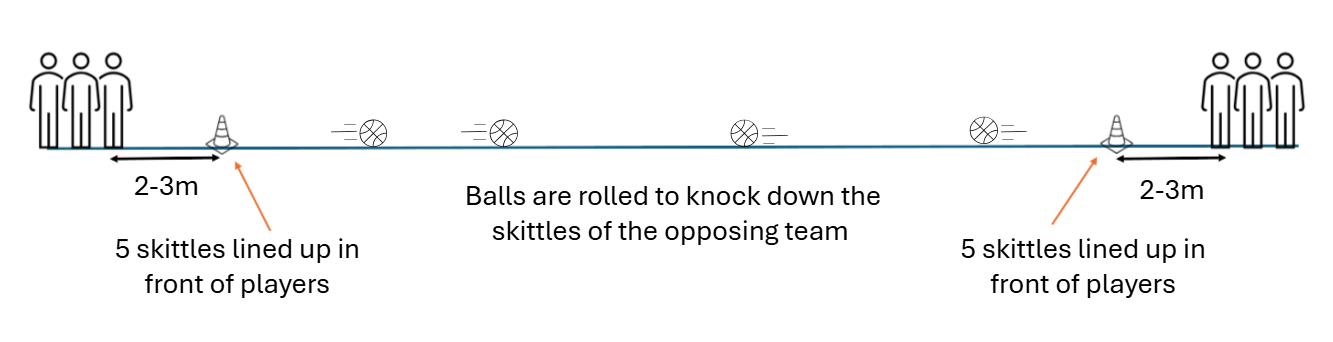
- Players roll their koolchee and attempt to knock down the other team’s skittles lined up on the far end of the play area. Teams must avoid hitting their own skittles directly in front of them, but may defend their skittles by using their ball to hit away any opposition koolchees.
- Koolchees may be recovered from the playing area after everyone has stopped rolling and the playing area is safe.
- The winning team is the one who knocks down all of the opponent’s skittles.
Show students the video Traditional Indigenous games – Koolchee (2:07) to see a game in action.
After the game, discuss:
- Was the game easy to play? What made it harder or easier?
- What was it like learning a new game?
- What would be the most important information to communicate to a new player?
Traditional Indigenous game Koolchee
Students are unlikely to be familiar with a game such as Koolchee, which means they can all learn together.

There are many forces involved in sport that are not always immediately obvious to an experienced player. Learning a new game, such as Koolchee, allows students to experience being a new player and to consider forces behind the movements of the game.
Koolchee is a traditional Aboriginal bowling game played by the Diyari people in the Kati Thanda (Lake Eyre) region in South Australia. Koolchee refers to the special balls that were used in this game. The balls used were as round as possible and were usually about 8-10 centimetres in diameter. Gypsum, sandstone, mud, or almost any material that was easy to work was used to make the balls. To play the game, players were in two teams and lined up on each side of a dry claypan. Each team then rolled the balls along the ground to the other side with the aim being to break up an opponent’s ball by hitting it while it was moving. When balls cannoned out of play to the sides they were left until the stock of balls was nearly used up. These were often retrieved by the small boys and put into play again.
There are many forces involved in sport that are not always immediately obvious to an experienced player. Learning a new game, such as Koolchee, allows students to experience being a new player and to consider forces behind the movements of the game.
Koolchee is a traditional Aboriginal bowling game played by the Diyari people in the Kati Thanda (Lake Eyre) region in South Australia. Koolchee refers to the special balls that were used in this game. The balls used were as round as possible and were usually about 8-10 centimetres in diameter. Gypsum, sandstone, mud, or almost any material that was easy to work was used to make the balls. To play the game, players were in two teams and lined up on each side of a dry claypan. Each team then rolled the balls along the ground to the other side with the aim being to break up an opponent’s ball by hitting it while it was moving. When balls cannoned out of play to the sides they were left until the stock of balls was nearly used up. These were often retrieved by the small boys and put into play again.
The Launch phase is designed to increase the science capital in a classroom by asking questions that elicit and explore students’ experiences. It uses local and global contexts and real-world phenomena that inspire students to recognise and explore the science behind objects, events and phenomena that occur in the material world. It encourages students to ask questions, investigate concepts, and engage with the Core Concepts that anchor each unit.
The Launch phase is divided into four routines that:
- ensure students experience the science for themselves and empathise with people who experience the problems science seeks to solve (Experience and empathise)
- anchor the teaching sequence with the key ideas and core science concepts (Anchor)
- elicit students’ prior understanding (Elicit)
- and connect with the students’ lives, languages and interests (Connect).
The Elicit routine provides opportunities to identify students’ prior experiences, existing science capital and potential alternative conceptions related to the Core concepts. The diagnostic assessment allows teachers to support their students to build connections between what they already know and the teaching and learning that occurs during the Inquire cycle.
When designing a teaching sequence, consider when and where students may have been exposed to the core concepts and key ideas in the past. Imagine how a situation would have looked without any prior knowledge. What ideas and thoughts might students have used to explain the situation or phenomenon? What alternative conceptions might your students hold? How will you identify these?
The Deep connected learning in the ‘Pedagogical Toolbox: Deep connected learning’ provides a set of tools to identify common alternative conceptions to aid teachers during this routine.
Read more about using the LIA FrameworkEach student comes to the classroom with experiences made up from science-related knowledge, attitudes, experiences and resources in their life. The Connect routine is designed to tap into these experiences and that of their wider community. It is also an opportunity to yarn with community leaders (where appropriate) to gain an understanding of the student’s lives, languages and interests. In the Launch phase, this routine identifies and uses the science capital of students as the foundation of the teaching sequence so students can appreciate the relevance of their learning and its potential impact on future decisions. In short, this routine moves beyond scientific literacy and increases the science capital in the classroom and science identity of the students.
When planning a teaching sequence, take an interest in the lives of your students. What are their hobbies, how do they travel to and from school? What might have happened in the lives of your students (i.e. blackouts) that might be relevant to your next teaching sequence? What context might be of interest to your students?
Read more about using the LIA FrameworkWhat's important?
(Slide 5) Student groups choose a sport or physical activity they have played.
Invite students in their groups to share how people or equipment move in their chosen sport or physical activity.
Brainstorm the key information a new participant would need to understand about the chosen sport or physical activity to help them learn it quickly, and in particular, what causes movement to change in the activity.
- How do people move in this sport or physical activity?
- How does the equipment (for example, a ball, puck, bat, racquet, or surfboard) move during the activity?
- What actions make the movement change?
- When does something start moving, stop moving, speed up, slow down, or change direction?
- What do players do to control where they move or where equipment moves?
- What skills help players change movement successfully?
- What changes happen when a player kicks, throws, hits, catches, pushes, or paddles?
Introduce infographics as a visual way to communicate key information about movement in sport and physical activity. Explain that students will create an infographic about a chosen sport or physical activity at the end of the lesson sequence.
✎STUDENT NOTES: Write the ideas from the brainstorm about a chosen sport or physical activity. Include any forces (pushes or pulls) that are mentioned.
Core concepts and key ideas
When planning for teaching in your classroom, it can be useful to see where a sequence fits into the larger picture of science.

When planning for teaching in your classroom, it can be useful to see where a sequence fits into the larger picture of science. This unit is anchored to the Science Understanding core concepts for Physical sciences.
- Forces affect the motion and behaviour of objects.
By Year 7, students have already described pushes and pulls in terms of strength and direction and predicted the effect of these forces on objects’ motion and shape (Year 1). They have identified how forces can be exerted by one object on another and investigated the effect of frictional, gravitational and magnetic forces on the motion of objects (Year 4).
In Year 7, students investigate and represent balanced and unbalanced forces, including gravitational force, acting on objects, and relate changes in an object’s motion to its mass and the magnitude and direction of forces acting on it.
This core concept is linked to the key science ideas:
- Understanding forces and motion relies on observing the motion of objects, deriving relationships and making generalisations (Patterns, order and organisation).
- The action of forces on an object can be analysed to determine the impact on an object’s motion (Form and function).
- The change of motion of objects can be explained by considering relationships between mass, the magnitude and direction of forces and balanced and unbalanced forces (Stability and change).
- Measurement of mass, amount and direction of force (using appropriate units) as well as balanced and unbalanced forces to determine relationships and effects provide information about the motion of objects (Scale and measurement).
- Models can be used to make predictions about how systems behave and the impact of change on the motion of objects (Systems)
When your students next progress through this core concept, they will learn about Newton’s laws of motion (Year 10). However, the ideas developed in this lesson sequence will be built upon in later learning, including future geoscience and energy lesson sequences.
When planning for teaching in your classroom, it can be useful to see where a sequence fits into the larger picture of science. This unit is anchored to the Science Understanding core concepts for Physical sciences.
- Forces affect the motion and behaviour of objects.
By Year 7, students have already described pushes and pulls in terms of strength and direction and predicted the effect of these forces on objects’ motion and shape (Year 1). They have identified how forces can be exerted by one object on another and investigated the effect of frictional, gravitational and magnetic forces on the motion of objects (Year 4).
In Year 7, students investigate and represent balanced and unbalanced forces, including gravitational force, acting on objects, and relate changes in an object’s motion to its mass and the magnitude and direction of forces acting on it.
This core concept is linked to the key science ideas:
- Understanding forces and motion relies on observing the motion of objects, deriving relationships and making generalisations (Patterns, order and organisation).
- The action of forces on an object can be analysed to determine the impact on an object’s motion (Form and function).
- The change of motion of objects can be explained by considering relationships between mass, the magnitude and direction of forces and balanced and unbalanced forces (Stability and change).
- Measurement of mass, amount and direction of force (using appropriate units) as well as balanced and unbalanced forces to determine relationships and effects provide information about the motion of objects (Scale and measurement).
- Models can be used to make predictions about how systems behave and the impact of change on the motion of objects (Systems)
When your students next progress through this core concept, they will learn about Newton’s laws of motion (Year 10). However, the ideas developed in this lesson sequence will be built upon in later learning, including future geoscience and energy lesson sequences.
The Launch phase is designed to increase the science capital in a classroom by asking questions that elicit and explore students’ experiences. It uses local and global contexts and real-world phenomena that inspire students to recognise and explore the science behind objects, events and phenomena that occur in the material world. It encourages students to ask questions, investigate concepts, and engage with the Core Concepts that anchor each unit.
The Launch phase is divided into four routines that:
- ensure students experience the science for themselves and empathise with people who experience the problems science seeks to solve (Experience and empathise)
- anchor the teaching sequence with the key ideas and core science concepts (Anchor)
- elicit students’ prior understanding (Elicit)
- and connect with the students’ lives, languages and interests (Connect).
Science education consists of a series of key ideas and core concepts that can explain objects, events and phenomena, and link them to the experiences encountered by students in their lives. The purpose of the Anchor routine is to identify the key ideas and concepts in a way that builds and deepens students’ understanding. During the Launch phase, the Anchor routine provides a lens through which to view the classroom context, and a way to frame the key knowledge and skills students will be learning.
When designing a teaching sequence, consider the core concepts and key ideas that are relevant. Break these into small bite-sized pieces that are relevant to the age and stage of your students. Consider possible alternative concepts that students might hold. How could you provide activities or ask questions that will allow students to consider what they know?
Motion and forces
Explain that movement and motion in sport or physical activity is linked to forces.
Discuss the forces and movement students experienced while playing Koolchee.
- What forces did you apply to the koolchee?
- What other forces acted on the koolchee as it moved?
- What contact forces were important in the game?
(Slide 6) Introduce the definition and descriptions of forces: A force is a push or pull that acts on an object when it interacts with another object.
(Slide 7) Introduce or recall examples of forces.
Teacher note: The Newtonian definition of gravity is used in this sequence. Read more in the embedded professional learning Gravity below.
(Slide 8) Using the pictures on the slide, invite students to identify:
- the different types of forces involved.
- forces that are acting when objects or people are moving.
- forces that lead to motion that is wanted (like throwing a ball).
- forces that lead to motion that is unwanted (like suddenly stopping due to an incorrect tackle).
Encourage students to identify and describe the forces, or use terms such as “starting motion”, “stopping motion”, or “changing direction”. This provides an opportunity to identify alternative conceptions about force.
- What forces are acting on each player in the tackle? What are the pushes?
- The basketballer has made a shot. What forces allowed this to occur?
- The basketballer applied a pushing force on the ball, gravity acting on the ball so it follows an arc path as it moves, friction between soles of shoes and court to grip so can jump up with shot.
- What forces are involved in the water polo player going for a shot at goal?
- Buoyancy lifting the player up, kicking to push the player upwards, friction on the ball and the player’s hand so they can hold and then throw the ball.
✎STUDENT NOTES: Record the definitions and examples of force. List and describe three examples of forces in sport.
(Slide 9) Distribute the Forces and sport Poster around the class for students to stick into their book or keep in a science display folder. Explain that this resource will be used throughout the lesson sequence.
✎STUDENT NOTES: Identify and record the force/s shown in five sports or physical activities on the poster. Use three terms from the force word bank around the poster’s edge to write a sentence or two about sport and forces.
Reflect on the lesson
You might invite students to:
- start a glossary of key terms about forces.
- write down two questions about forces in sport and physical activity. These will be discussed at the start of the next lesson.
- watch a video of a favourite sport or physical activity (e.g. soccer highlights, gymnastics routine, skateboarding trick) and write down three moments where a force is seen to be clearly acting. For each moment:
- name the force e.g. push, pull, friction, gravity, air resistance.
- describe how the force affects the motion of the athlete or equipment.
- at home, choose one simple action related to sport e.g. kicking a ball, rolling a basketball, swinging a bat or racquet. Write a short explanation of the forces involved (and optionally include a sketch).
- Consider: What force starts the movement? Which forces slow it down? How does the strength of the force change the motion?
Gravity
In this sequence, we use the simplified Newtonian model of gravity.

In the Forces and sport Slides, gravitational force is defined as a force of attraction acting at a distance. This is considered the classic definition of gravity, as formulated by Newton in the 17th century: gravity is a universal, attractive force that acts instantly between any two objects with mass at a distance apart. Another common definition of gravity given to Year 7 students is “Gravity is a pulling force that attracts objects towards the Earth”. This simple model of gravity is used with junior science students because it provides an accessible framework for understanding forces and motion.
More sophisticated models of gravity are introduced and developed later in high school as students’ mathematical skills and conceptual understanding deepen.
In senior physics, students may be introduced to the idea that gravity is the curvature of spacetime caused by the presence of mass and energy—it is not a force acting through space but a geometric property of space and time. Gravity is not a force that pulls from inside a planet. Instead, very large objects such as stars and planets bend the space around them, creating a curved shape. When another object moves near a planet, it is not being “pulled” in the usual sense; it continues moving forward through curved space. Because space itself is bent, the straightest possible path becomes a curve, causing the object to move towards the planet.
In the Forces and sport Slides, gravitational force is defined as a force of attraction acting at a distance. This is considered the classic definition of gravity, as formulated by Newton in the 17th century: gravity is a universal, attractive force that acts instantly between any two objects with mass at a distance apart. Another common definition of gravity given to Year 7 students is “Gravity is a pulling force that attracts objects towards the Earth”. This simple model of gravity is used with junior science students because it provides an accessible framework for understanding forces and motion.
More sophisticated models of gravity are introduced and developed later in high school as students’ mathematical skills and conceptual understanding deepen.
In senior physics, students may be introduced to the idea that gravity is the curvature of spacetime caused by the presence of mass and energy—it is not a force acting through space but a geometric property of space and time. Gravity is not a force that pulls from inside a planet. Instead, very large objects such as stars and planets bend the space around them, creating a curved shape. When another object moves near a planet, it is not being “pulled” in the usual sense; it continues moving forward through curved space. Because space itself is bent, the straightest possible path becomes a curve, causing the object to move towards the planet.