

Forces and sport
View Sequence overviewStudents will:
- analyse data and describe patterns to determine that more applied force on an object leads to an increased travel distance (if mass is kept the same).
- assess the reliability of data, identify errors and suggest improvements.
- describe uses or impacts of increased and/or decreased force in a sport or physical activity.
Students will represent their understanding as they:
- read a scale on the Newton meter and record measurements in a results table.
- construct a hypothesis.
- plot averages on a set of axes, draw a line-of-best-fit and interpret the relationship between the variables.
- draw conclusions on the effect of increased force on the distance a block travelled.
- analyse the data and experimental design and suggest an improvement.
In this lesson, assessment is formative.
Feedback might focus on students’ ability to:
- describe the relationship between force and motion (distance travelled).
- complete an investigation and record data.
- transform data by calculating averages.
- present data on an appropriate graph.
- interpret the relationship between force and distance and draw a conclusion.
Potential summative assessment
Students working at the Achievement Standard should:
- represent and explain the effects of forces acting on objects.
- conduct safe, reproducible investigations to test relationships.
- use equipment to generate and record data with precision.
- process data and information and analyse it to describe patterns, trends and relationships.
- identify evidence to support their conclusions.
- analyse methods and data for possible sources of error after considering the spread of repeated measurements.
- describe how the method could be improved to remove sources of error.
Refer to the Australian Curriculum content links on the Our design decisions tab for further information.
Whole class
Forces and sport Slides
10 x marker cones to designate playing area
A large ball (a soccer ball up to an exercise ball size)
5 N Newton meter
20 N Newton meter
Length of sewing elastic or three large elastic bands tied together
Lab stool or table legs
Each group
5 N Newton meter
Length of sewing elastic or three large elastic bands tied together
Lab stool or table legs
Chalk (or something to mark an erasable line between the chair legs)
A4 paper
1 metre ruler or tape measure
Wooden block
Each student
1-2 x tennis balls
Force and motion investigation Resource sheet
Individual science notebook
Forces and sport Poster
Lesson
The Inquire phase allows students to cycle progressively and with increasing complexity through the key science ideas related to the core concepts. Each Inquire cycle is divided into three teaching and learning routines that allow students to systematically build their knowledge and skills in science and incorporate this into their current understanding of the world.
When designing a teaching sequence, it is important to consider the knowledge and skills that students will need in the final Act phase. Consider what the students already know and identify the steps that need to be taken to reach the level required. How could you facilitate students’ understanding at each step? What investigations could be designed to build the skills at each step?
Read more about using the LIA FrameworkRe-orient
Recall the previous lesson, focusing on the effect of mass on the motion of an object.
Recall the model developed in the simulation: as the mass of an object increases, the speed (or motion) of the object decreases (with a constant force).
Examine the Forces and sport Poster and invite students to identify three examples of sports where mass can affect motion. Examples might include the sled pull (shown on the middle left), weightlifting (by the pool), or any ball sport.
The Inquire phase allows students to cycle progressively and with increasing complexity through the key science ideas related to the core concepts. Each Inquire cycle is divided into three teaching and learning routines that allow students to systematically build their knowledge and skills in science and incorporate this into their current understanding of the world.
When designing a teaching sequence, it is important to consider the knowledge and skills that students will need in the final Act phase. Consider what the students already know and identify the steps that need to be taken to reach the level required. How could you facilitate students’ understanding at each step? What investigations could be designed to build the skills at each step?
Read more about using the LIA FrameworkIdentifying and constructing questions is the creative driver of the inquiry process. It allows students to explore what they know and how they know it. During the Inquire phase of the LIA Framework, the Question routine allows for past activities to be reviewed and to set the scene for the investigation that students will undertake. The use of effective questioning techniques can influence students’ view and interpretation of upcoming content, open them to exploration and link to their current interests and science capital.
When designing a teaching sequence, it is important to spend some time considering the mindset of students at the start of each Inquire phase. What do you want students to be thinking about, what do they already know and what is the best way for them to approach the task? What might tap into their curiosity?
Read more about using the LIA FrameworkForce in sport and physical activities
Pose the question: How does increasing the applied force affect motion in sport and physical activity?
(Slide 37) Discuss how increased force applied on objects like the tennis ball, soccer ball and bow affect the motion of the balls or arrow.
- What happens to the arrow and the balls if more force is applied?
- The arrow and the balls will leave with more speed, and they will go farther.
- How would the archer increase force?
- By pulling the bowstring back towards themselves more.
- What would happen if the archer pulled the bowstring back farther?
- The extra force would transfer to the arrow, and it would leave the bow with extra speed or a high acceleration. It would reach the target more quickly.
- What is the effect of softly hitting the tennis ball versus slogging the ball?
- Sam Kerr has drawn back her leg to deliver a large force to the ball. What distance would we expect the ball to travel with this large force?
- What happens to the paddler’s motion on the water if they push the paddle through the water with more force?
- More force pushing on the water means the paddle would be propelled faster forward, leading to a greater acceleration on the water.
Optional: (Slide 38) Play Gorri (“gor-ri”) - a moving target game.
Explain that many Aboriginal men and boys from all parts of Australia played games that used rolling balls or discs. For example, in the disc-rolling game common throughout Western Australia, a piece of rounded bark (disc) was rolled by one of the players for the other boys to aim at. The boy who set the disc rolling was about 15 metres away from the throwers and would call out gool-gool (going-going) as they started the disc rolling. The boy or young man who succeeded in piercing the disc took the place of the roller. Accuracy of eye and speed in casting the spear were easily learned from the disc game.
- Set up a playing area about 15-20 metres long and about 20 metres wide.
- Allocate two students to be “rollers”, while the rest of the class or teams are “throwers” who line up along two lines facing each other 10-20 metres apart. The target ball will be rolled across the playing area, parallel to the lines of throwers.
- Rollers stand near a marker at the middle of the side of the playing area. Throwers can only throw their tennis balls when the target ball is rolled between these markers.
- The throwers call out for the ball to be rolled when they are all ready. The roller calls out “gool-gool” and starts the ball rolling toward the second roller at the other end of the area.
- As the target ball rolls towards the marker, the players either throw or roll their tennis balls at the target in an attempt to hit it.
- The ball is then rolled from the other end to continue the game. Change around the throwers and rollers after a number of turns.
Safety: Remind players not to go out to retrieve the balls until all the balls have been thrown. Give a signal to allow them to retrieve their balls and re-form their lines.
See how this game is played:
- Video: Traditional Indigenous Games - Gorri (2:18 min) by the NSW Office of sport
- Game card: Yulunga Traditional Indigenous Games – Gorri by the Australian Sports Commission
- A two-team version: Gorri - Playing for Life Activity Cards by the Australian Sports Commission
Invite students to reflect on their experience playing Gorri and consider whether throwing with more force made a difference.
(Slide 39) Pose the question: How does increasing force affect motion?
The Inquire phase allows students to cycle progressively and with increasing complexity through the key science ideas related to the core concepts. Each Inquire cycle is divided into three teaching and learning routines that allow students to systematically build their knowledge and skills in science and incorporate this into their current understanding of the world.
When designing a teaching sequence, it is important to consider the knowledge and skills that students will need in the final Act phase. Consider what the students already know and identify the steps that need to be taken to reach the level required. How could you facilitate students’ understanding at each step? What investigations could be designed to build the skills at each step?
Read more about using the LIA FrameworkThe Investigate routine provides students with an opportunity to explore the key ideas of science, to plan and conduct an investigation, and to gather and record data. The investigations are designed to systematically develop content knowledge and skills through increasingly complex processes of structured inquiry, guided inquiry and open inquiry approaches. Students are encouraged to process data to identify trends and patterns and link them to the real-world context of the teaching sequence.
When designing a teaching sequence, consider the diagnostic assessment (Launch phase) that identified the alternative conceptions that students held. Are there activities that challenge these ideas and provide openings for discussion? What content knowledge and skills do students need to be able to complete the final (Act phase) task? How could you systematically build these through the investigation routines? Are there opportunities to build students’ understanding and skills in the science inquiry processes through the successive investigations?
Read more about using the LIA FrameworkForce and motion
(Slide 40) Explain to students they will be conducting an investigation to determine the effect of force on the motion of an object. First, they need to understand the skill of using a Newton meter so they can measure forces.
Demonstrate the use of the Newton meter to the class.
- Show students the Newton meter (also called a spring balance or force meter). Explain that inside the device is a spring that will extend when something is pulled or lifted/suspended. Show different Newton meters (e.g. 5 N and 20 N) and explain that they all measure force but have different scales of measurement.
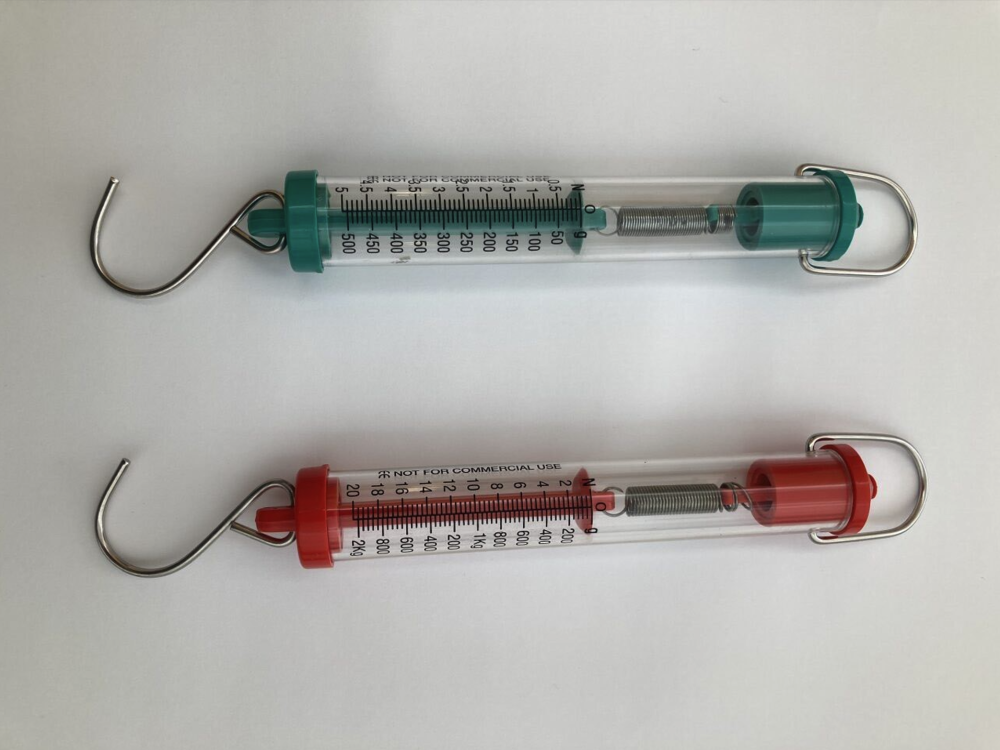
- Explain that in this experiment, students will use one of the Newton meters to measure force. The amount of extension of the spring inside represents the amount of force being exerted. Point out that for this reason, students need to be careful not to affect the accuracy of the device by extending the spring too much during their experiment.
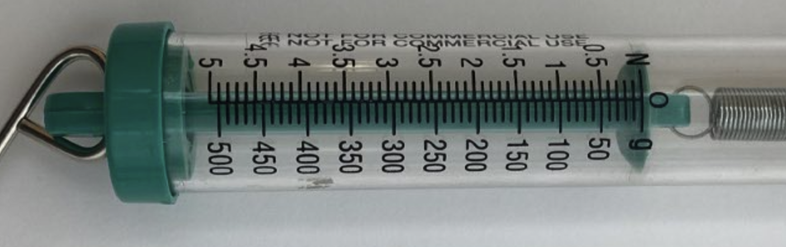
- Draw attention to the scales on the side of the meter—one scale gives a measurement in grams and the other gives a measurement in Newtons. Explain that the measurements for this lesson will need to be read from the Newton scale.
- Check that both Newton meters are working (the spring will extend if the hook is gently pulled) and that it reads 0 N before starting.
- Discuss with students which Newton meter (5 N or 20 N) would be appropriate to use in this experiment, noting that the maximum force required is 5 N.
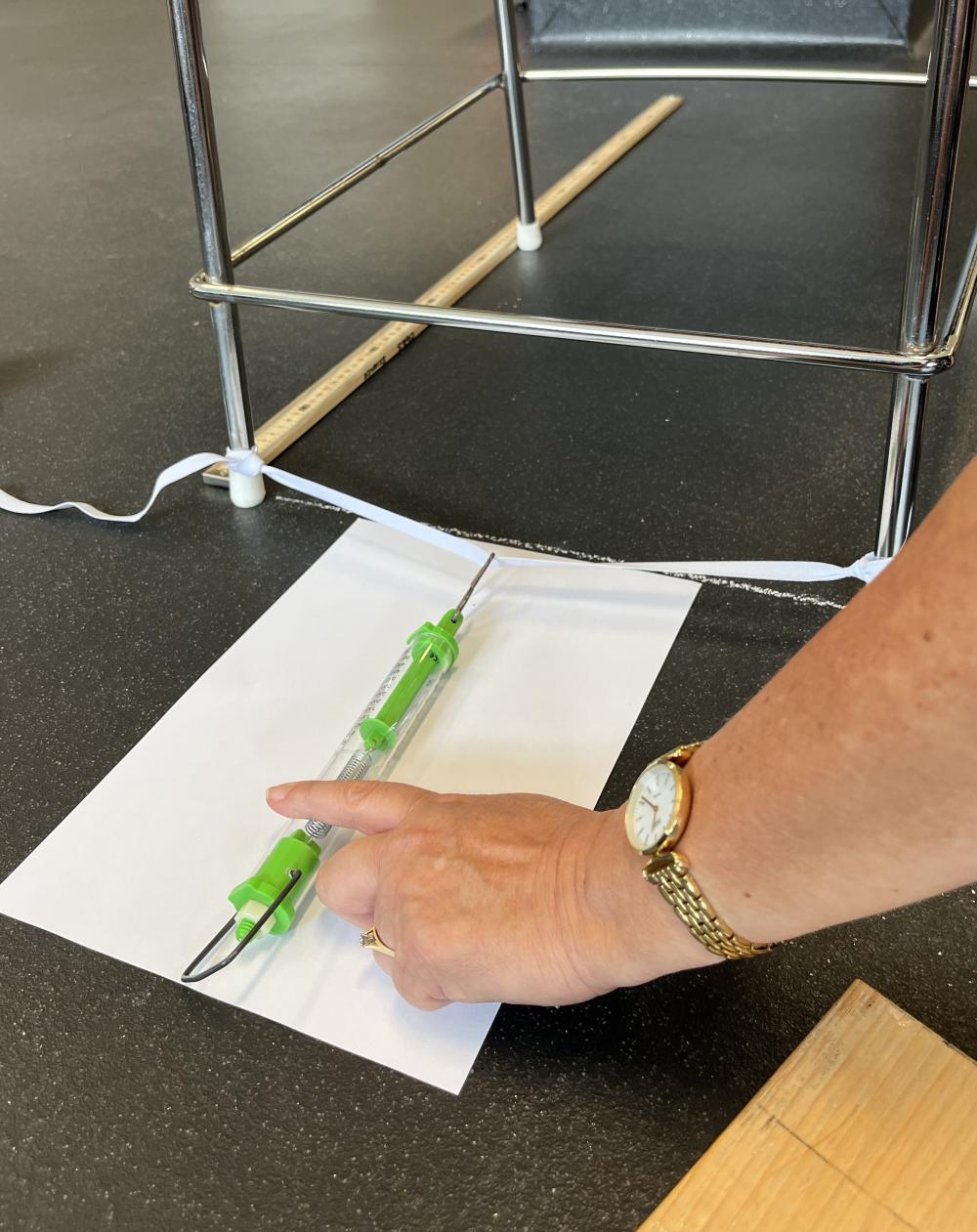
(Slide 41) Set up the force launcher for the investigation by making a Newton scale.
- Tie the sewing elastic between the legs of a lab stool, chair or table and mark a straight starting line from leg to leg with chalk. Place the edge of a sheet of paper against this line.
- Attach the hook of the Newton meter to the elastic and hold the Newton meter level with the surface.
- Pull the Newton meter slowly and evenly until the pointer or marker reaches 1 N. If required, a student could sit on the stool or chair so that it does not move. Make sure to read the force value where the pointer or marker lines up on the scale.
- On the paper, mark where the elastic has been pulled to. Remove the meter from the elastic and check the marker inside the Newton meter returns to zero.
- Repeat the process to mark 2, 3, 4 and 5 N lines.
(Slide 42) Remind students of the question posed at the start of the lesson: How does increased force affect motion? Refine the question so it addresses the investigation: What happens to the distance an object travels if more force is applied?
✎STUDENT NOTES: Write a hypothesis for the investigation.
(Slide 43) Provide students with the Force and motion investigation Resource sheet. Allow time for students to form groups, allocate roles, collect equipment and conduct the investigation.
- Stretch the elastic between the legs of a stool, table or chair.
- Mark a chalk line from leg to leg of table/chair/stool and place the edge of the Newton scale A4 paper (from above) against this line.
- Place the block into the force launcher elastic and pull the block and elastic backwards so the edge of the block is lined up with the 1 N line.
- Release the block and measure the distance the edge of the block (that was in contact with the elastic) travels from the chalk line in centimetres. Record this value in the results table. Repeat this process another two times.
- Repeat steps 3 and 4 for 2 N, 3 N, 4 N and 5 N of force.
.jpeg)
✎STUDENT NOTES: Record the distance the block travels in each trial. Calculate the average distance the block travelled (rounded to the nearest 0.5 cm to make it easier to graph).
The Inquire phase allows students to cycle progressively and with increasing complexity through the key science ideas related to the core concepts. Each Inquire cycle is divided into three teaching and learning routines that allow students to systematically build their knowledge and skills in science and incorporate this into their current understanding of the world.
When designing a teaching sequence, it is important to consider the knowledge and skills that students will need in the final Act phase. Consider what the students already know and identify the steps that need to be taken to reach the level required. How could you facilitate students’ understanding at each step? What investigations could be designed to build the skills at each step?
Read more about using the LIA FrameworkFollowing an investigation, the Integrate routine provides time and space for data to be evaluated and insights to be synthesized. It reveals new insights, consolidates and refines representations, generalises context and broadens students’ perspectives. It allows student thinking to become visible and opens formative feedback opportunities. It may also lead to further questions being asked, allowing the Inquire phase to start again.
When designing a teaching sequence, consider the diagnostic assessment that was undertaken during the Launch phase. Consider if alternative conceptions could be used as a jumping off point to discussions. How could students represent their learning in a way that would support formative feedback opportunities? Could small summative assessment occur at different stages in the teaching sequence?
Read more about using the LIA FrameworkConnecting ideas
Discuss the main features of a graph and how to scale the vertical axis and plot points on the grid.
✎STUDENT NOTES: Graph the data collected in the investigation.
(Slide 44) Use the graph to discuss the patterns and trends shown in the investigation if student data is compromised due to the experimenter inexperience.
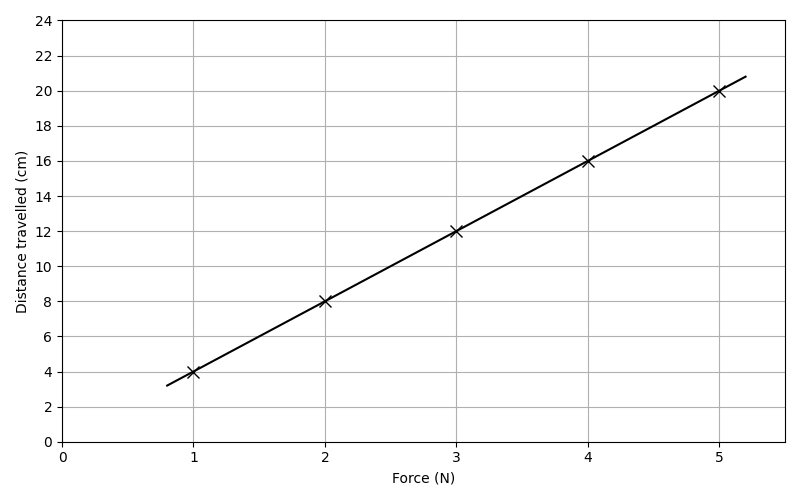
Discuss the pattern shown in the graph (or the graph’s appearance). Guide students to identify that the data increases at a steady rate, as it goes up by the same amount each time and the line is straight, not curved.
Invite students to describe the trend of the data (or what happens to the dependent variable as the independent variable is changed).
Use sentence starters such as: As the force used on the elastic ____, the distance travelled by the wooden block ____.
Discuss how applying extra force to the wooden block increased the distance it travelled. Relate this to the relationship between the variables. Invite students to describe this relationship using phrasing such as: As the amount of force was doubled on the block, the block moved twice the distance.
Students should produce a graph showing a positive linear line-of-best-fit with a direct relationship between the force applied to the block and the distance it travels. A sample graph is shown below.
✎STUDENT NOTES: Complete the conclusion and discussion questions on the Force and motion investigation resource sheet.
If students need support, then the following prompts could be used as temporary scaffolds and could be reduced in future investigations as students become more comfortable with the scientific terminology.
Precision
- Look only at the repeated trials for the same force level. Are the distances close together or spread out?
- What does that tell you about how precise your measurements were?
- You do not need to explain why yet, just describe the consistency.
Patterns in the data
- Read your results from lowest force to highest force. What generally happens to the distance as the force increases?
Model using comparative language such as increased, decreased, or remained similar.
Outliers
- Does one result look very different from the others for that force level?
- Circle the result that doesn’t fit in with the overall trend.
Encourage students not to think that outliers are wrong but that they are data points that need explaining.
Reliability (repeatability of the experiment)
- Imagine doing this investigation tomorrow. Would the results be the same? Similar? Very different? Why?
Error and improvement
- Where might the controlled variables not have been controlled?
- What part of the method could have introduced an error?
- What is one way the experiment could be changed to allow the variable to be better controlled?
- How will the improvement make the data more precise?
(Slide 45) Pose the questions: Which sports rely on increased force for extra distance or extra speed? Which sports rely on increased force to stop motion or to suddenly change direction?
Discuss how the forces applied to objects in the pictures relate to the motion of people and equipment. If required verbally model the thinking process for an image. You could, for example, highlight:
- what happens to the snowboarder’s direction when they apply more force through the board into the snow.
- when the wheelchair athlete pushes the ball harder, the ball’s speed as it leaves their hand is much faster as compared to a softer push.
- kicking the football with more force makes it leave the boot with more speed, and it goes farther than a soft kick.
- increased pulling force by the footballer would stop the kicker from being able to complete the kick.
- the bike image suggests that a large force has been applied, and as a result, the rider has suddenly stopped moving forward.
You could also model inferential thinking by asking questions like:
- If the person pushed or kicked with twice as much force, what do you predict would happen to the distance or speed of the ball or movement?
- Which sports in the images require the greatest force to change motion, and what evidence supports your decision?
- Looking at the wheelchair, what design features can you notice that might help the athlete move quickly or turn sharply so they can apply force in the right direction?
- The wheelchair’s large, outward‑angled wheels increase stability and help the athlete turn quickly without tipping. Their position closer to the body places the hand rims at a more efficient angle, allowing stronger, more effective pushes. The lightweight design also helps the athlete build up speed more quickly.
(Slide 46) Discuss examples of force changing motion in students’ chosen sport or physical activity, and how they might represent this on their infographic in the Act phase.
✎STUDENT NOTES: Write a list of what to include on your infographic about forces, and a list of important movements in your chosen sport or physical activity.
Reflect on the lesson
You might ask students to:
- review the learning goals for the lesson and check for understanding.
- go back to the PhET Forces and motion: basics computer simulation model and change the amount of force applied to a mass.
- What effect does this have on the speed of the skateboard?
- Determine if the data from this simulation shows the same trend as the class investigation.
- review force diagrams and draw three force diagrams for different motion scenarios.
Analysing data: Supported learning and progressive independence
This lesson sequence models how to scaffold learning and gradually release responsibility.

In the Integrate phase, students are guided to consider aspects of validity through questions focusing on precision, consistency of patterns, outliers, repeatability, and sources of error. As students are being introduced to the analysis of investigations for the first time in the sequence, the questions are deliberately scaffolded to support their developing understanding. Earlier learning experiences in Lessons 2 and 3 involved a simple experiment and a computer simulation.
Opportunities for more open‑ended and independent analysis will be provided in later lessons as students build confidence and skill in scientific reasoning. Concepts such as precision, accuracy, reliability, and validity are often challenging for students to distinguish and apply meaningfully, and alternative conceptions about experimental design and what makes an investigation valid are common.
In the Integrate phase, students are guided to consider aspects of validity through questions focusing on precision, consistency of patterns, outliers, repeatability, and sources of error. As students are being introduced to the analysis of investigations for the first time in the sequence, the questions are deliberately scaffolded to support their developing understanding. Earlier learning experiences in Lessons 2 and 3 involved a simple experiment and a computer simulation.
Opportunities for more open‑ended and independent analysis will be provided in later lessons as students build confidence and skill in scientific reasoning. Concepts such as precision, accuracy, reliability, and validity are often challenging for students to distinguish and apply meaningfully, and alternative conceptions about experimental design and what makes an investigation valid are common.