

Water mixture rescue
View Sequence overviewStudents will:
- define filtering, residue and filtrate.
- describe how to control variables in an experiment.
- relate their understanding of filters to preventing the growth of mosquito larvae in a rainwater tank.
Students will represent their understanding as they:
- write a hypothesis for an experiment.
- identify risks to themselves and others in the investigation and record actions that can be taken to avoid or manage those risks.
- identify possible sources of error in the method used and describe how the method could be improved to remove these sources of error.
- construct an argument supported by evidence and reasoning to support or reject a hypothesis.
In this lesson, feedback is formative.
Feedback might focus on students’ ability to:
- write a hypothesis.
- plan a reproducible test that has independent, dependent and controlled variables.
- identify potential experimental errors.
- identify potential risks and take action to minimise those risks.
- draw a conclusion from experimental data.
- provide real-world examples of the need to separate substances based on size.
Potential summative assessment
Students working at standard should:
- investigate and use physical separation techniques such as filtration.
- compare the method with the hypothesis and examine the reasonableness of the method for testing that hypothesis.
- discuss why it is important to identify variables when planning an investigation.
- examine the features of reproducible investigations, constructing methods and reviewing other students’ methods.
- identify assumptions relating to variables that are assumed to be constant, such as ambient temperature, properties of materials used or purity of substances.
- identify risks to themselves and others in investigations and consider actions that can be taken to avoid or manage those risks.
- consider the spread of repeated measurements and observations.
- identify possible sources of error in the method used and describe how the method could be improved to remove these sources of error.
- draw a logical conclusion in consideration of the method of data collection, quality of evidence and limitations or significance of a claim.
Whole class
Water mixture rescue Slides
Filter paper
Rainwater mixture (from previous lesson or recreated)
1 x funnel
1 x 200 mL conical flask or beaker
1 x 100 mL measuring cylinder
Stirring rod or spoon
Access to a video clip of a separation technique used by First Nations Australians, for example:
Each group
Rainwater mixture (from previous lesson or recreated)
Wire mesh e.g. chicken wire, wire netting, gutter guard material
Cloth
2 x funnels
2 x 200 mL conical flasks or beakers
1 x 100 mL measuring cylinder
Stirring rod or spoon
Each student
Individual science notebook
Size matters Resource sheet
Lesson
The Inquire phase allows students to cycle progressively and with increasing complexity through the key science ideas related to the core concepts. Each Inquire cycle is divided into three teaching and learning routines that allow students to systematically build their knowledge and skills in science and incorporate this into their current understanding of the world.
When designing a teaching sequence, it is important to consider the knowledge and skills that students will need in the final Act phase. Consider what the students already know and identify the steps that need to be taken to reach the level required. How could you facilitate students’ understanding at each step? What investigations could be designed to build the skills at each step?
Read more about using the LIA FrameworkRe-orient
Remind students of the discussion of the importance of clean water for the whole community.
Pose the question: What was collected off the roof when it rained? Students will recall that the run-off water contained leaves, dust, dirt, oil/pollution, and bits of metal from the iron roof.
(Slide 19) Discuss the properties of each of the materials in the rainwater mixture. Encourage students to review what was written in their notebooks from the previous lesson.
- Describe the appearance and texture of each material in your rainwater mixture.
- Identify which physical property helped you notice or separate the iron filings from the mixture.
- Explain why the magnet was able to attract the iron filings but not the other substances.
- Suggest another real-life situation where using the magnetic property of a material could help in separating mixtures.
The Inquire phase allows students to cycle progressively and with increasing complexity through the key science ideas related to the core concepts. Each Inquire cycle is divided into three teaching and learning routines that allow students to systematically build their knowledge and skills in science and incorporate this into their current understanding of the world.
When designing a teaching sequence, it is important to consider the knowledge and skills that students will need in the final Act phase. Consider what the students already know and identify the steps that need to be taken to reach the level required. How could you facilitate students’ understanding at each step? What investigations could be designed to build the skills at each step?
Read more about using the LIA FrameworkIdentifying and constructing questions is the creative driver of the inquiry process. It allows students to explore what they know and how they know it. During the Inquire phase of the LIA Framework, the Question routine allows for past activities to be reviewed and to set the scene for the investigation that students will undertake. The use of effective questioning techniques can influence students’ view and interpretation of upcoming content, open them to exploration and link to their current interests and science capital.
When designing a teaching sequence, it is important to spend some time considering the mindset of students at the start of each Inquire phase. What do you want students to be thinking about, what do they already know and what is the best way for them to approach the task? What might tap into their curiosity?
Read more about using the LIA FrameworkIdentifying large particles
(Slide 20) Discuss the larger objects (leaves, bark and sand) that are present in the rainwater mixture. Explore how long it would take to pick out each of the items individually using fingers or tweezers.
Pose the question: Why do we need to remove the leaves and bark from the rainwater?
Discuss how leaves and bark rot/decompose over time. This provides food for mosquitoes, slugs, and snails, which might introduce bacteria and fungi to the water. People drinking the water might become sick as a result.
Pose the question: How can we remove the leaves, bark, and sand from the rainwater?
The Inquire phase allows students to cycle progressively and with increasing complexity through the key science ideas related to the core concepts. Each Inquire cycle is divided into three teaching and learning routines that allow students to systematically build their knowledge and skills in science and incorporate this into their current understanding of the world.
When designing a teaching sequence, it is important to consider the knowledge and skills that students will need in the final Act phase. Consider what the students already know and identify the steps that need to be taken to reach the level required. How could you facilitate students’ understanding at each step? What investigations could be designed to build the skills at each step?
Read more about using the LIA FrameworkThe Investigate routine provides students with an opportunity to explore the key ideas of science, to plan and conduct an investigation, and to gather and record data. The investigations are designed to systematically develop content knowledge and skills through increasingly complex processes of structured inquiry, guided inquiry and open inquiry approaches. Students are encouraged to process data to identify trends and patterns and link them to the real-world context of the teaching sequence.
When designing a teaching sequence, consider the diagnostic assessment (Launch phase) that identified the alternative conceptions that students held. Are there activities that challenge these ideas and provide openings for discussion? What content knowledge and skills do students need to be able to complete the final (Act phase) task? How could you systematically build these through the investigation routines? Are there opportunities to build students’ understanding and skills in the science inquiry processes through the successive investigations?
Read more about using the LIA FrameworkFiltering for size
Discuss the size of the leaves, bark, and sand in the rainwater mixture. Describe large size as a property of leaves, bark, and sand. Encourage students to consider different ways to remove these larger objects. Students may suggest sieves, material, or fine netting.
Pose the question: How can we test if any of these ideas is an effective way to remove the large objects from the rainwater?
Discuss how many of the ideas suggested by students can be grouped together under the term “filtering”. Explain that filtering separates the “residue” from the “filtrate”.
(Slide 21) ✎ STUDENT NOTES: Define filtering as “a method to separate large-sized particles from liquids or gases using a barrier”.
(Slide 22) Discuss how students could test the effectiveness of removing large objects by filtering with different filters.
(Slide 23) Demonstrate how to fold filter paper and place it in a funnel. Place the funnel in the conical flask or beaker. Demonstrate how to pour the rainwater into the filter paper so that it all travels through the filter paper (and not down the outside).
(Slide 23) ✎ STUDENT NOTES: Draw a scientific diagram of the equipment, labelling the filtrate (the substance that passes through the filter) and residue (the large particles that are left behind on the filter).
Discuss how filter paper is expensive and would quickly develop holes if used for large amounts of rainwater going into a rain tank.
- What would happen to filter paper when used with large amounts of water?
- Why might filter paper not be suitable for filtering rainwater for a tank?
- Explain why using filter paper alone for a rain tank is not practical.
- Suggest ways to modify the filtration process to make it more cost-effective and durable.
Show students the alternative materials (wire mesh and cloth) that will be tested. Discuss how students could design a fair test to determine which material would be most effective at removing the leaves or large objects.
(Slide 24) Provide students with a copy of the Size matters Resource sheet. Discuss the independent and dependent variables in the investigation and how to control the remaining variables.
Pose the question: What variables do we need to control?
Discuss how controlling the variables might or might not make a difference, and the importance of not making assumptions about controlled variables. Use the example that the temperature of the water may vary if it were sitting in the sun, and that students should not assume that it will not make a difference.
✎ STUDENT NOTES: Write a hypothesis. Draw a labelled diagram of the equipment and any risks that need to be considered.
(Slide 25) Allow students time to complete the experiment.
- What do you notice about the rainwater mixture before you start filtering?
- How does the mixture look after passing through the wire mesh? How about after the cloth?
- Can you describe the residue left behind in each filtration method?
- Which material is catching more debris, wire mesh or cloth? Why do you think that is?
- How could you modify your filtration setup to make it more effective?
✎ STUDENT NOTES: Complete the results table on the Size matters Resource sheet.
Drawing a scientific diagram
Scientific diagrams of laboratory equipment are used to communicate experimental setups clearly and accurately.
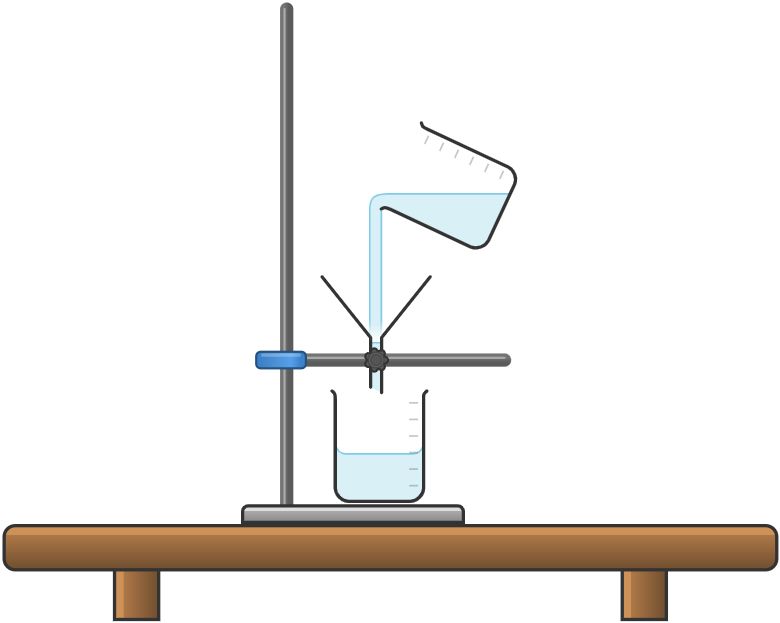
Scientific diagrams of laboratory equipment are used to communicate experimental setups clearly and accurately. These diagrams help students record investigations, explain procedures, and interpret scientific methods. Unlike artistic drawings, laboratory equipment diagrams are simplified representations designed to show essential features and relationships between apparatus components.
When teaching students how to draw laboratory equipment, the emphasis should be placed on clarity, accuracy, and correct scientific conventions rather than artistic skill. Students should use a sharp pencil and ruler, draw equipment with clean, single lines and avoid sketching, shading, or decorative detail.
Key conventions for scientific diagrams of laboratory equipment include:
- diagrams should be large enough to show important details clearly.
- equipment should be drawn in proportion to the surrounding apparatus where possible.
- only essential features should be included.
- straight lines should be ruled neatly with a ruler.
- labels should be printed clearly and horizontally.
- label lines should be ruled, should not cross, and should touch the correct part of the apparatus.
- titles should clearly identify the experimental setup or equipment shown.
Students should also learn standard representations of common laboratory equipment such as beakers, test tubes, measuring cylinders, Bunsen burners, retort stands, thermometers, flasks, and delivery tubes. Consistency in these representations improves scientific communication and helps students interpret textbook and examination diagrams.
Modelling how to break complex setups into simple shapes and draw apparatus step-by-step can support students to avoid unnecessary detail or perspective drawing.
Common student errors include:
- drawing apparatus too small.
- using sketchy or multiple lines.
- including unnecessary shading or colour.
- allowing label lines to cross.
- drawing equipment out of proportion.
- confusing the names of common laboratory apparatus.
Scientific diagrams of laboratory equipment are used to communicate experimental setups clearly and accurately. These diagrams help students record investigations, explain procedures, and interpret scientific methods. Unlike artistic drawings, laboratory equipment diagrams are simplified representations designed to show essential features and relationships between apparatus components.
When teaching students how to draw laboratory equipment, the emphasis should be placed on clarity, accuracy, and correct scientific conventions rather than artistic skill. Students should use a sharp pencil and ruler, draw equipment with clean, single lines and avoid sketching, shading, or decorative detail.
Key conventions for scientific diagrams of laboratory equipment include:
- diagrams should be large enough to show important details clearly.
- equipment should be drawn in proportion to the surrounding apparatus where possible.
- only essential features should be included.
- straight lines should be ruled neatly with a ruler.
- labels should be printed clearly and horizontally.
- label lines should be ruled, should not cross, and should touch the correct part of the apparatus.
- titles should clearly identify the experimental setup or equipment shown.
Students should also learn standard representations of common laboratory equipment such as beakers, test tubes, measuring cylinders, Bunsen burners, retort stands, thermometers, flasks, and delivery tubes. Consistency in these representations improves scientific communication and helps students interpret textbook and examination diagrams.
Modelling how to break complex setups into simple shapes and draw apparatus step-by-step can support students to avoid unnecessary detail or perspective drawing.
Common student errors include:
- drawing apparatus too small.
- using sketchy or multiple lines.
- including unnecessary shading or colour.
- allowing label lines to cross.
- drawing equipment out of proportion.
- confusing the names of common laboratory apparatus.
Filtering
Filtering is a physical separation method that separates particles in a mixture based on size.

Filtering is a physical separation method that separates particles in a mixture based on size. The mixture is passed through a barrier or filter with holes or pores of a specific size, allowing smaller particles to pass through while trapping larger ones. Filtering does not change the chemical composition of the substances; it only separates them physically.
For solids and liquids, filtering is commonly used to separate insoluble solids from liquids. For example, coffee grounds can be removed from water using a coffee filter, or sand can be separated from water using filter paper, cloth, or fine mesh. In these cases, the liquid that passes through the filter is called the filtrate, and the solid that remains on the filter is called the residue. The size of the filter pores must be carefully chosen so that they are smaller than the solid particles but large enough for the liquid to pass through.
Filtering can also be used to separate solid particles from gases. For instance, air purifiers and car cabin filters trap dust, pollen, and soot while allowing air to flow through. This technique is widely used in laboratory and industrial applications to clean air or remove airborne particles.
When using filtering techniques, it is important to select the appropriate filter size, because too large a pore allows solids to pass through, while too small a pore can slow down the filtration process. Often, multiple stages of filtration are used: a coarse filter first removes large debris, followed by a finer filter for smaller particles. Real-world applications of filtering include water purification, brewing, laboratory separations, and air filtration systems.
Filtering is a physical separation method that separates particles in a mixture based on size. The mixture is passed through a barrier or filter with holes or pores of a specific size, allowing smaller particles to pass through while trapping larger ones. Filtering does not change the chemical composition of the substances; it only separates them physically.
For solids and liquids, filtering is commonly used to separate insoluble solids from liquids. For example, coffee grounds can be removed from water using a coffee filter, or sand can be separated from water using filter paper, cloth, or fine mesh. In these cases, the liquid that passes through the filter is called the filtrate, and the solid that remains on the filter is called the residue. The size of the filter pores must be carefully chosen so that they are smaller than the solid particles but large enough for the liquid to pass through.
Filtering can also be used to separate solid particles from gases. For instance, air purifiers and car cabin filters trap dust, pollen, and soot while allowing air to flow through. This technique is widely used in laboratory and industrial applications to clean air or remove airborne particles.
When using filtering techniques, it is important to select the appropriate filter size, because too large a pore allows solids to pass through, while too small a pore can slow down the filtration process. Often, multiple stages of filtration are used: a coarse filter first removes large debris, followed by a finer filter for smaller particles. Real-world applications of filtering include water purification, brewing, laboratory separations, and air filtration systems.
The Inquire phase allows students to cycle progressively and with increasing complexity through the key science ideas related to the core concepts. Each Inquire cycle is divided into three teaching and learning routines that allow students to systematically build their knowledge and skills in science and incorporate this into their current understanding of the world.
When designing a teaching sequence, it is important to consider the knowledge and skills that students will need in the final Act phase. Consider what the students already know and identify the steps that need to be taken to reach the level required. How could you facilitate students’ understanding at each step? What investigations could be designed to build the skills at each step?
Read more about using the LIA FrameworkFollowing an investigation, the Integrate routine provides time and space for data to be evaluated and insights to be synthesized. It reveals new insights, consolidates and refines representations, generalises context and broadens students’ perspectives. It allows student thinking to become visible and opens formative feedback opportunities. It may also lead to further questions being asked, allowing the Inquire phase to start again.
When designing a teaching sequence, consider the diagnostic assessment that was undertaken during the Launch phase. Consider if alternative conceptions could be used as a jumping off point to discussions. How could students represent their learning in a way that would support formative feedback opportunities? Could small summative assessment occur at different stages in the teaching sequence?
Read more about using the LIA FrameworkPreventing infections
(Slide 26) Compare the effectiveness of the different materials in separating the leaves, bark, and sand from the rainwater mixture. Discuss any similarities and differences identified between student groups and the potential errors that may have caused this.
Filtering errors may include:
- mixing up the appearance of residue and filtrate in their notes.
- pouring too quickly, which can overflow the funnel or push solids through the wire mesh.
- improperly securing the wire mesh, causing solids to bypass the filter.
- folding or crumpling the cloth, which can trap water or reduce filtration efficiency.
- pouring too fast, tearing the cloth, or causing overflow.
Discuss how the different-sized holes/pores in each filter separated different substances from the rainwater. Connect the size of particles in a substance to its physical properties.
Note: Photographing the filtrates and residues will allow students to compare the effectiveness of each separation technique in the Act phase.
Discuss which of the materials tested would be most suitable and durable for use in a rainwater tank system.
- How do the sizes and shapes of particles affect how easily they are filtered?
- If you wanted to clean a larger amount of rainwater, which material would you choose and why?
- What other materials or steps might help remove even smaller particles?
- Would you want to use the filter as the rainwater enters the tank, or as it leaves?
✎ STUDENT NOTES: Complete the discussion questions on the Size matters Resource sheet.
Show the video Making clean drinking water using an Indigenous Australian water filtration method (2:51).
Discuss how the video showed small stones acting like a filter to separate many of the larger particles from the drinking water.
(Slide 27) Introduce the idea that mosquitoes like to breed in water, and that often they lay their eggs in water tanks. Discuss how you could prevent the mosquitoes from doing this (e.g. by using a wire mesh filter at all openings to the tank). Link the presence of mosquitoes in tropical countries to the prevalence of diseases like malaria (not found in Australia) and Ross River virus.
- What could happen if a water tank is left uncovered without a filter?
- How could we prevent mosquitoes from entering the tank?
- How could using mesh filters in water tanks reduce mosquito-borne diseases in the community?
- Why is using a wire mesh an effective solution compared to other options?
- Why is the size of the mesh holes important for keeping mosquitoes out while still letting water flow into the tank?
- How does understanding physical properties (like size of openings in a mesh) help in solving real-world problems?
✎ STUDENT NOTES: Write a claim for a way to prevent mosquitoes from laying eggs in a rainwater tank. Support the claim using evidence and reasoning.
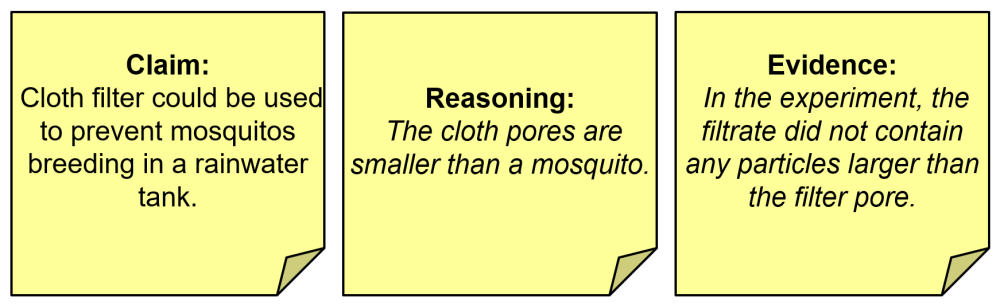
Discuss the claims made by students and link this to the Act phase activity: designing a rainwater tank system that will provide safe drinking water to a household.
Reflect on the lesson
You might ask students to:
- provide evidence and reasoning for the claim “A filter can reduce diseases transmitted by mosquitoes”.
- research other examples of filters being used outside a laboratory.
- describe how sand could be separated from seawater.
- add the words and definitions for “filter”, “filtrate” and “residue” to a glossary.
- investigate separation techniques used by First Nations Australians, such as hand-picking, sieving, winnowing, and filtering.
Mosquito-borne diseases in Australia
Mosquito-borne bacteria and viruses are an identified health issue in Australia.
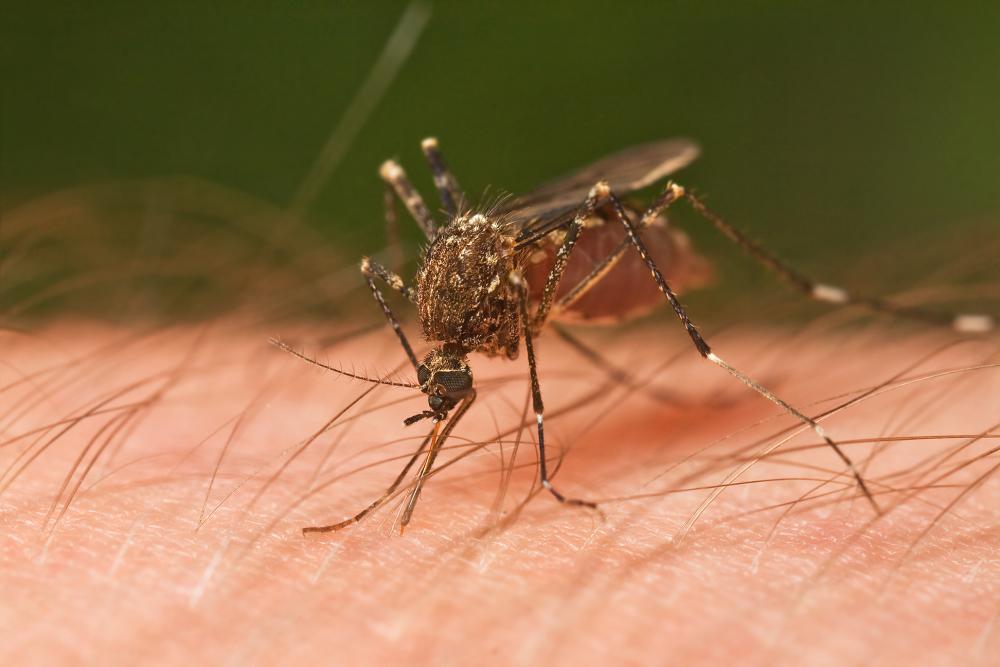
Mosquito-borne bacteria and viruses are an identified health issue in Australia, particularly in warmer months and after periods of rainfall when mosquito populations increase. These viruses are transmitted by female mosquitoes that need blood in order to breed. When biting an infected person or animal, the blood they take also contains viruses. When the mosquito bites the next person, the mosquito may pass on the virus to the person through its saliva.
One of the most common mosquito-borne illnesses in Australia is caused by the Ross River virus. This virus is widespread across the country and is maintained in a natural cycle between mosquitoes and mammals such as possums. Humans become infected when bitten by a mosquito. Symptoms typically include joint pain, fatigue, fever, and rash, and while the disease is rarely life-threatening, it can cause prolonged illness lasting weeks or even months. There is currently no vaccine, so prevention focuses on avoiding mosquito bites and reducing breeding sites.
Another significant emerging disease is Japanese encephalitis, which has recently been detected in parts of Australia after being historically confined to Asia. This virus is transmitted by mosquitoes that breed in water-rich environments, often involving birds and pigs as key hosts. Most infected people experience no symptoms, but in severe cases, it can cause inflammation of the brain (encephalitis), leading to neurological damage or death.
Preventative strategies for these viruses include using insect repellent, wearing protective clothing, and eliminating standing water, such as that found in open water tanks.
Mosquito-borne bacteria and viruses are an identified health issue in Australia, particularly in warmer months and after periods of rainfall when mosquito populations increase. These viruses are transmitted by female mosquitoes that need blood in order to breed. When biting an infected person or animal, the blood they take also contains viruses. When the mosquito bites the next person, the mosquito may pass on the virus to the person through its saliva.
One of the most common mosquito-borne illnesses in Australia is caused by the Ross River virus. This virus is widespread across the country and is maintained in a natural cycle between mosquitoes and mammals such as possums. Humans become infected when bitten by a mosquito. Symptoms typically include joint pain, fatigue, fever, and rash, and while the disease is rarely life-threatening, it can cause prolonged illness lasting weeks or even months. There is currently no vaccine, so prevention focuses on avoiding mosquito bites and reducing breeding sites.
Another significant emerging disease is Japanese encephalitis, which has recently been detected in parts of Australia after being historically confined to Asia. This virus is transmitted by mosquitoes that breed in water-rich environments, often involving birds and pigs as key hosts. Most infected people experience no symptoms, but in severe cases, it can cause inflammation of the brain (encephalitis), leading to neurological damage or death.
Preventative strategies for these viruses include using insect repellent, wearing protective clothing, and eliminating standing water, such as that found in open water tanks.
Argumentation
Argumentation is the process of systematically providing reasoning to support a claim.
Argumentation is the process of systematically providing reasoning to support a claim. Unlike the commonly used negative term ‘argument’, argumentation involves developing a valid argument or persuasive idea.
At the simplest level, students should be able to provide a claim, evidence, and reasoning. At higher levels, students will be able to identify the limitations of a claim, the underlying assumptions that back the claim, and provide a rebuttal for any counterclaims.
In this lesson, students should use the results of their experiment to make a claim about which filter to use. The evidence from the experiment should describe how the filter residue contains particles larger than the filter pore, or that the filtrate only contains particles smaller than a mosquito. The reasoning should link the size of the selected filter pore to being smaller than the mosquito’s size.
Argumentation is the process of systematically providing reasoning to support a claim. Unlike the commonly used negative term ‘argument’, argumentation involves developing a valid argument or persuasive idea.
At the simplest level, students should be able to provide a claim, evidence, and reasoning. At higher levels, students will be able to identify the limitations of a claim, the underlying assumptions that back the claim, and provide a rebuttal for any counterclaims.
In this lesson, students should use the results of their experiment to make a claim about which filter to use. The evidence from the experiment should describe how the filter residue contains particles larger than the filter pore, or that the filtrate only contains particles smaller than a mosquito. The reasoning should link the size of the selected filter pore to being smaller than the mosquito’s size.
First Nations Australians separating mixtures
There are many sources of information about how First Nations Australians traditionally separated mixtures.
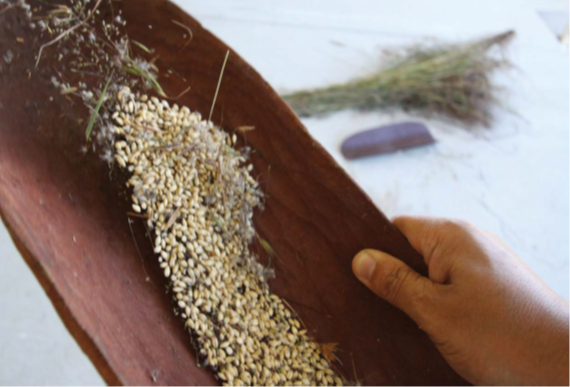
There are many sources of information about how First Nations Australians traditionally separated mixtures through hand-picking, winnowing, yandying, filtering, and cold-pressing. When describing these techniques to students, it is important to consider that these practices are part of sophisticated and diverse knowledge systems developed over thousands of years by Aboriginal and Torres Strait Islander peoples across different regions of Australia. The techniques were carefully adapted to local environments, resources, and cultural practices, and should be recognised as examples of scientific observation, experimentation, and technological innovation rather than simply “traditional practices”. It is also important to acknowledge that knowledge and practices vary between language groups and communities, and that First Nations perspectives should be represented respectfully and accurately.
It is important to consider the language used when discussing these practices. Using the current tense acknowledges that Aboriginal and Torres Strait Islander cultures are living cultures and that many of these practices continue today in communities across Australia. Referring to these methods only in the past tense can unintentionally reinforce the misconception that First Nations cultures exist only in history.
It is also important to incorporate First Nations’ scientific knowledge into the main teaching and learning sequence rather than presenting it as an additional example or “add-on” at the end of a lesson. Embedding these examples alongside Western scientific concepts helps students recognise Aboriginal and Torres Strait Islander knowledge systems as equally valid and evidence-based ways of understanding the world.
Where possible, use examples connected to specific Countries, language groups, and environments to demonstrate the diversity of practices across Australia. Including local perspectives and consulting community-approved resources can further support culturally responsive and accurate teaching. Students should be encouraged to see these techniques not only as cultural practices, but also as practical applications of scientific principles such as particle size, density, filtration, and extraction.
There are many sources of information about how First Nations Australians traditionally separated mixtures through hand-picking, winnowing, yandying, filtering, and cold-pressing. When describing these techniques to students, it is important to consider that these practices are part of sophisticated and diverse knowledge systems developed over thousands of years by Aboriginal and Torres Strait Islander peoples across different regions of Australia. The techniques were carefully adapted to local environments, resources, and cultural practices, and should be recognised as examples of scientific observation, experimentation, and technological innovation rather than simply “traditional practices”. It is also important to acknowledge that knowledge and practices vary between language groups and communities, and that First Nations perspectives should be represented respectfully and accurately.
It is important to consider the language used when discussing these practices. Using the current tense acknowledges that Aboriginal and Torres Strait Islander cultures are living cultures and that many of these practices continue today in communities across Australia. Referring to these methods only in the past tense can unintentionally reinforce the misconception that First Nations cultures exist only in history.
It is also important to incorporate First Nations’ scientific knowledge into the main teaching and learning sequence rather than presenting it as an additional example or “add-on” at the end of a lesson. Embedding these examples alongside Western scientific concepts helps students recognise Aboriginal and Torres Strait Islander knowledge systems as equally valid and evidence-based ways of understanding the world.
Where possible, use examples connected to specific Countries, language groups, and environments to demonstrate the diversity of practices across Australia. Including local perspectives and consulting community-approved resources can further support culturally responsive and accurate teaching. Students should be encouraged to see these techniques not only as cultural practices, but also as practical applications of scientific principles such as particle size, density, filtration, and extraction.