

Water mixture rescue
View Sequence overviewStudents will:
- examine the importance of clean water in everyday life.
- define pure substances and mixtures.
- identify water that runs off a roof as a mixture.
Students will represent their understanding as they:
- identify the consequences of a limited water supply.
- describe why drinking water needs to be clear, odourless, low in dissolved solids, and have no pathogens, toxins or heavy metals.
In the Launch phase, assessment is diagnostic.
Take note of students’ ability to:
- explain the importance of clean water.
- identify a pure substance as containing the same type of particle.
- identify a mixture as containing more than one type of particle.
- identify that collected rainwater will be a mixture.
Whole class
Water mixture rescue Slides
Watering can containing water
5 small containers, each containing one contaminant:
- Iron filings
- Soil (to represent roof dust/dirt)
- Small leaves or grass (to represent roof debris)
- Sand
- Cooking oil (to represent vehicle pollution)
Flat surface to represent a roof (for water runoff)
Container to collect the water running off the “roof”
Access to video clips of people experiencing a lack of water, for example:
Each student
Individual science notebook
Lesson
The Launch phase is designed to increase the science capital in a classroom by asking questions that elicit and explore students’ experiences. It uses local and global contexts and real-world phenomena that inspire students to recognise and explore the science behind objects, events and phenomena that occur in the material world. It encourages students to ask questions, investigate concepts, and engage with the Core Concepts that anchor each unit.
The Launch phase is divided into four routines that:
- ensure students experience the science for themselves and empathise with people who experience the problems science seeks to solve (Experience and empathise)
- anchor the teaching sequence with the key ideas and core science concepts (Anchor)
- elicit students’ prior understanding (Elicit)
- and connect with the students’ lives, languages and interests (Connect).
Students arrive in the classroom with a variety of scientific experiences. This routine provides an opportunity to plan for a common shared experience for all students. The Experience may involve games, role-play, local excursions or yarning with people in the local community. This routine can involve a chance to Empathise with the people who experience the problems science seeks to solve.
When designing a teaching sequence, consider what experiences will be relevant to your students. Is there a location for an excursion, or people to talk to as part of an incursion? Are there local people in the community who might be able to talk about what they are doing? How could you set up your classroom to broaden the students’ thinking about the core science ideas? How could you provide a common experience that will provide a talking point throughout the sequence?
Read more about using the LIA FrameworkWater, water
Discuss how much water students have used that day to drink, wash, or clean their teeth. Invite students to consider what would happen if they did not have enough water to use. Discuss where different families might get their water from.
Watch the video: The city where some residents have run out of fresh water (6:28).
(Slide 3) Brainstorm how individuals would be affected by a lack of water.
- What stops working immediately?
- What becomes dangerous after a few hours?
- Who is affected the most?
Encourage students to consider indirect water use, including hospitals, restaurants, schools, farming, power plants, factories, and AI/data centres.
- What happens to drinking water access in homes and apartments?
- What happens to people who rely on medications that require water?
- What happens to toilets in homes, schools, and hospitals?
- What are the health risks if sewage systems stop functioning?
- How quickly do hygiene-related illnesses spread?
- What happens to firefighting if hydrants run dry?
- How do hospitals operate without the sterilisation of water?
- What happens to dialysis patients?
- Many data centres (operated by tech companies like Google and Microsoft) use water cooling systems—what happens if cooling fails?
- How long would the internet stay functional
(Slide 4) ✎ STUDENT NOTES: Draw a table to identify the effects of no clean water for an entire month as either “inconvenient” or “life-threatening”. For example:
| Inconvenient | Life-threatening |
|---|---|
Data centres Heating and cooling (depending on time of year and location) Hygiene Industry Restaurants | Medical (lack of sterilisation leading to no operations) Sewage systems Drinking water Fire fighting |
Core concepts and key ideas
When planning for teaching in your classroom, it can be useful to see where a sequence fits into the larger picture of science.

When planning for teaching in your classroom, it can be useful to see where a sequence fits into the larger picture of science. This unit is anchored to the Science understanding core concepts for Chemical sciences.
- The chemical and physical properties of substances are determined by their structure at a range of scales.
In Year 7, students have already recognised that objects can be composed of different materials and described the observable properties of those materials (Foundation), investigated the observable properties of solids and liquids and how adding heat energy leads to a change of state (Year 3), examined the properties of natural and man-made materials (Year 4), and modelled the motion and arrangement of particles to explain the properties of solids, liquids and gases (Year 6). It is recommended that students have already used the particle theory to describe the motion and attraction between particles to describe the properties of substances (Year 7) before starting this sequence. This teaching sequence uses the particle model to describe differences between pure substances and mixtures, and applies understanding of the physical properties of substances to separate mixtures.
This core concept is linked to the key science ideas:
- Observed patterns can be related to microscopic and atomic structures (Patterns, order and organisation).
- Microscopic form determines macroscopic properties and functions (Form and function).
- Changes in one part of a system may cause changes in another part of the system (Stability and change).
- Flows and cycles of matter can be tracked within systems (Matter and energy)
- Models can be used to represent systems with defined boundaries, their inputs, processes and outputs (Systems)
- Models can be used to make predictions about how systems behave and the impact of change (Systems).
When your students next examine this core concept in Year 8, they will classify matter as elements, compounds or mixtures, and compare different representations of these.
When planning for teaching in your classroom, it can be useful to see where a sequence fits into the larger picture of science. This unit is anchored to the Science understanding core concepts for Chemical sciences.
- The chemical and physical properties of substances are determined by their structure at a range of scales.
In Year 7, students have already recognised that objects can be composed of different materials and described the observable properties of those materials (Foundation), investigated the observable properties of solids and liquids and how adding heat energy leads to a change of state (Year 3), examined the properties of natural and man-made materials (Year 4), and modelled the motion and arrangement of particles to explain the properties of solids, liquids and gases (Year 6). It is recommended that students have already used the particle theory to describe the motion and attraction between particles to describe the properties of substances (Year 7) before starting this sequence. This teaching sequence uses the particle model to describe differences between pure substances and mixtures, and applies understanding of the physical properties of substances to separate mixtures.
This core concept is linked to the key science ideas:
- Observed patterns can be related to microscopic and atomic structures (Patterns, order and organisation).
- Microscopic form determines macroscopic properties and functions (Form and function).
- Changes in one part of a system may cause changes in another part of the system (Stability and change).
- Flows and cycles of matter can be tracked within systems (Matter and energy)
- Models can be used to represent systems with defined boundaries, their inputs, processes and outputs (Systems)
- Models can be used to make predictions about how systems behave and the impact of change (Systems).
When your students next examine this core concept in Year 8, they will classify matter as elements, compounds or mixtures, and compare different representations of these.
The Launch phase is designed to increase the science capital in a classroom by asking questions that elicit and explore students’ experiences. It uses local and global contexts and real-world phenomena that inspire students to recognise and explore the science behind objects, events and phenomena that occur in the material world. It encourages students to ask questions, investigate concepts, and engage with the Core Concepts that anchor each unit.
The Launch phase is divided into four routines that:
- ensure students experience the science for themselves and empathise with people who experience the problems science seeks to solve (Experience and empathise)
- anchor the teaching sequence with the key ideas and core science concepts (Anchor)
- elicit students’ prior understanding (Elicit)
- and connect with the students’ lives, languages and interests (Connect).
Science education consists of a series of key ideas and core concepts that can explain objects, events and phenomena, and link them to the experiences encountered by students in their lives. The purpose of the Anchor routine is to identify the key ideas and concepts in a way that builds and deepens students’ understanding. During the Launch phase, the Anchor routine provides a lens through which to view the classroom context, and a way to frame the key knowledge and skills students will be learning.
When designing a teaching sequence, consider the core concepts and key ideas that are relevant. Break these into small bite-sized pieces that are relevant to the age and stage of your students. Consider possible alternative concepts that students might hold. How could you provide activities or ask questions that will allow students to consider what they know?
The Elicit routine provides opportunities to identify students’ prior experiences, existing science capital and potential alternative conceptions related to the Core concepts. The diagnostic assessment allows teachers to support their students to build connections between what they already know and the teaching and learning that occurs during the Inquire cycle.
When designing a teaching sequence, consider when and where students may have been exposed to the core concepts and key ideas in the past. Imagine how a situation would have looked without any prior knowledge. What ideas and thoughts might students have used to explain the situation or phenomenon? What alternative conceptions might your students hold? How will you identify these?
The Deep connected learning in the ‘Pedagogical Toolbox: Deep connected learning’ provides a set of tools to identify common alternative conceptions to aid teachers during this routine.
Read more about using the LIA FrameworkThe story of rain
Discuss how many of the homes in the video were not connected to the town water supply and relied on water collected in tanks.
- In our town/community, how many homes do you think are not connected to the town water supply?
- Why might some homes rely on rainwater tanks instead of town water?
- What are the advantages of using rainwater tanks?
- What might be some disadvantages or challenges?
Pose the questions: How many in the class have water tanks? Where does the water come from for the water tank?
(Slide 5) Introduce this lesson’s main activity, examining the collection of rainwater for residential tanks.
One-by-one, sprinkle the individual contaminants onto your “roof” surface. Tell the story of each contaminant as you sprinkle it onto the roof:
- Soil and sand—Dust and sand are caught by the wind and blown into the air and onto the roof.
- Leaves/grass—Small leaves and bark are falling off the tree nearby.
- Iron filings—A branch falling on the iron roof causes small fragments of the metal roof to be scratched off.
- Oil—Cars are driving on the road in front of the house, and the smoke from the exhaust forms droplets of oil in the air that carry onto the roof.
Finally, pour water over the roof: Heavy rain falls on the roof and washes everything off the roof and into the water tank. Allow water to run off the roof and collect in a container at the bottom.
Discuss how this water is a mixture of all the different components that were on the roof.
- Where does dust come from?
- Can you see dust in the air on windy days?
- Why would leaves and bark end up on the roof?
- What happens to leaves when they get wet?
- How could cars affect the water on a roof?
- Can air pollution travel through the air and be trapped in water?
- What do you notice about the water as it runs off?
- Does it look clean or dirty?
- Would you drink it?
This rainwater mixture will be revisited throughout the teaching sequence. You may need to reproduce the rainwater mixture regularly to avoid bacterial and fungal growth.
(Slide 6) Compare the term “mixture” to “pure”: a pure substance has only one type of particle, and a mixture has more than one type of particle.
✎ STUDENT NOTES: Write definitions for “pure substance” and “mixture”. Draw a labelled diagram of the collected rainwater, identifying and listing the different components contained in the mixture.
Rainwater tanks
Rainwater is a valuable natural resource that can reduce dependence on the mains water supply.
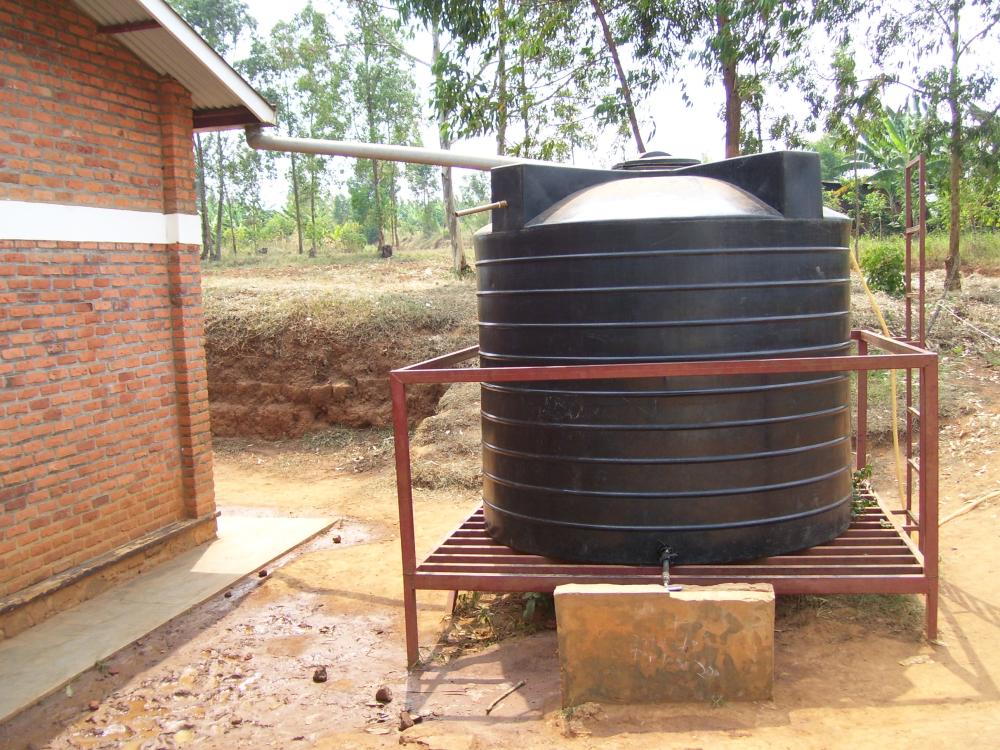
When properly designed and maintained, rainwater systems can supply water suitable for most household uses. However, health authorities generally recommend using treated mains water for drinking and cooking where available, as it is filtered, disinfected, and often fluoridated to prevent tooth decay. It is important for students to understand that different end uses require different water quality standards. For example, garden irrigation has minimal quality requirements, while toilet flushing and clothes washing require water to be clear and odourless. Showering requires additional quality considerations, and drinking water must meet the highest standards, including being free from pathogens, toxins, and heavy metals. This reinforces the concept of risk-based water treatment.
A typical rainwater harvesting system includes a roof and gutter collection surface, downpipes, leaf guards or rain-heads, first-flush diverters to remove initial roof debris, a storage tank, and a supply system that may include pumps and filters. In some cases, a “charged line” system is required when pipes cannot slope directly downward into the tank; in this setup, water pressure pushes collected rainwater through underground piping and up into the tank.
When properly designed and maintained, rainwater systems can supply water suitable for most household uses. However, health authorities generally recommend using treated mains water for drinking and cooking where available, as it is filtered, disinfected, and often fluoridated to prevent tooth decay. It is important for students to understand that different end uses require different water quality standards. For example, garden irrigation has minimal quality requirements, while toilet flushing and clothes washing require water to be clear and odourless. Showering requires additional quality considerations, and drinking water must meet the highest standards, including being free from pathogens, toxins, and heavy metals. This reinforces the concept of risk-based water treatment.
A typical rainwater harvesting system includes a roof and gutter collection surface, downpipes, leaf guards or rain-heads, first-flush diverters to remove initial roof debris, a storage tank, and a supply system that may include pumps and filters. In some cases, a “charged line” system is required when pipes cannot slope directly downward into the tank; in this setup, water pressure pushes collected rainwater through underground piping and up into the tank.
Alternative conceptions
Students enter the classroom with prior experiences that shape how they understand the world.

Students enter the classroom with prior experiences that shape how they understand the world. While some of their ideas align with scientific thinking, many hold alternative conceptions formed through preconceptions, intuition, misinformation, limited exposure, or everyday use of scientific language.
If these alternative conceptions are not identified, they can hinder new learning.
The first stage of addressing these alternative conceptions is identifying students’ existing ideas. This is done in the Elicit routine of the Launch phase through open-ended questions, discussions, predictions, and diagnostic activities that encourage students to explain their reasoning. Creating a safe classroom environment where students feel comfortable sharing their thinking is essential, as it allows alternative conceptions to surface without fear of being wrong.
Once identified, alternative conceptions should be made visible and thoughtfully challenged. The Inquire phase deliberately designs investigations, demonstrations, or learning experiences that test students’ ideas and presents evidence that may contradict their prior beliefs. Rather than simply correcting errors, students should be guided to analyse evidence, compare viewpoints, and reconsider their thinking.
Finally, students’ understanding can be built by connecting new concepts to prior knowledge and encouraging reflection. Through the Integrate routine of the Inquire phase, ongoing formative assessment, discussion, and opportunities are used to revise ideas, encouraging students to learn that questioning and refining their thinking is a normal and important part of scientific learning.
| Alternative conception | Corrected conception |
| If a substance is clear/transparent, then it is pure. | Clarity does not determine purity. A substance is pure if it contains only one type of particle (e.g. a bowl of sugar). Many mixtures (like salt water or air) look clear but contain multiple substances. |
| If a substance has more than one element, it is a mixture. | A compound contains two or more elements chemically bonded in a fixed ratio and is still a pure substance (e.g. sugar). A mixture contains different particles that are not chemically bonded (e.g. sugar water). |
| Pure substances only contain one type of atom. | Pure substances contain one type of particle. That particle may be one type of atom (element), or identical bonded atoms (compound). |
| Mixtures must look different or be layered. | Some mixtures are heterogeneous (visibly different parts, e.g. sand and water), but others are homogeneous and look uniform (e.g. salt water). Even if you cannot see different parts, it can still be a mixture. |
| Mixtures are always dirty or contaminated. | A mixture simply means two or more substances physically combined. It does not mean unsafe or impure. Many everyday substances (like air and soft drinks) are mixtures. |
| If particles are evenly spaced, it’s pure. | Spacing does not determine purity. Purity depends on whether all particles are the same type, not how far apart they are. |
Students enter the classroom with prior experiences that shape how they understand the world. While some of their ideas align with scientific thinking, many hold alternative conceptions formed through preconceptions, intuition, misinformation, limited exposure, or everyday use of scientific language.
If these alternative conceptions are not identified, they can hinder new learning.
The first stage of addressing these alternative conceptions is identifying students’ existing ideas. This is done in the Elicit routine of the Launch phase through open-ended questions, discussions, predictions, and diagnostic activities that encourage students to explain their reasoning. Creating a safe classroom environment where students feel comfortable sharing their thinking is essential, as it allows alternative conceptions to surface without fear of being wrong.
Once identified, alternative conceptions should be made visible and thoughtfully challenged. The Inquire phase deliberately designs investigations, demonstrations, or learning experiences that test students’ ideas and presents evidence that may contradict their prior beliefs. Rather than simply correcting errors, students should be guided to analyse evidence, compare viewpoints, and reconsider their thinking.
Finally, students’ understanding can be built by connecting new concepts to prior knowledge and encouraging reflection. Through the Integrate routine of the Inquire phase, ongoing formative assessment, discussion, and opportunities are used to revise ideas, encouraging students to learn that questioning and refining their thinking is a normal and important part of scientific learning.
| Alternative conception | Corrected conception |
| If a substance is clear/transparent, then it is pure. | Clarity does not determine purity. A substance is pure if it contains only one type of particle (e.g. a bowl of sugar). Many mixtures (like salt water or air) look clear but contain multiple substances. |
| If a substance has more than one element, it is a mixture. | A compound contains two or more elements chemically bonded in a fixed ratio and is still a pure substance (e.g. sugar). A mixture contains different particles that are not chemically bonded (e.g. sugar water). |
| Pure substances only contain one type of atom. | Pure substances contain one type of particle. That particle may be one type of atom (element), or identical bonded atoms (compound). |
| Mixtures must look different or be layered. | Some mixtures are heterogeneous (visibly different parts, e.g. sand and water), but others are homogeneous and look uniform (e.g. salt water). Even if you cannot see different parts, it can still be a mixture. |
| Mixtures are always dirty or contaminated. | A mixture simply means two or more substances physically combined. It does not mean unsafe or impure. Many everyday substances (like air and soft drinks) are mixtures. |
| If particles are evenly spaced, it’s pure. | Spacing does not determine purity. Purity depends on whether all particles are the same type, not how far apart they are. |
The Launch phase is designed to increase the science capital in a classroom by asking questions that elicit and explore students’ experiences. It uses local and global contexts and real-world phenomena that inspire students to recognise and explore the science behind objects, events and phenomena that occur in the material world. It encourages students to ask questions, investigate concepts, and engage with the Core Concepts that anchor each unit.
The Launch phase is divided into four routines that:
- ensure students experience the science for themselves and empathise with people who experience the problems science seeks to solve (Experience and empathise)
- anchor the teaching sequence with the key ideas and core science concepts (Anchor)
- elicit students’ prior understanding (Elicit)
- and connect with the students’ lives, languages and interests (Connect).
Each student comes to the classroom with experiences made up from science-related knowledge, attitudes, experiences and resources in their life. The Connect routine is designed to tap into these experiences and that of their wider community. It is also an opportunity to yarn with community leaders (where appropriate) to gain an understanding of the student’s lives, languages and interests. In the Launch phase, this routine identifies and uses the science capital of students as the foundation of the teaching sequence so students can appreciate the relevance of their learning and its potential impact on future decisions. In short, this routine moves beyond scientific literacy and increases the science capital in the classroom and science identity of the students.
When planning a teaching sequence, take an interest in the lives of your students. What are their hobbies, how do they travel to and from school? What might have happened in the lives of your students (i.e. blackouts) that might be relevant to your next teaching sequence? What context might be of interest to your students?
Read more about using the LIA FrameworkRainwater quality
Pose the question: How is water from rainwater tanks used?
(Slide 7) Introduce the Australian Government’s rainwater quality requirements for using rainwater.
Compare the quality requirements for each of the household uses described.
- Why doesn’t garden water need to be as clean as drinking water?
- Would you care if shower water had a bad smell?
- Why does toilet water need to be clear and odourless?
- Could dirty water damage a washing machine?
- What could happen if shower water had bacteria in it?
- Why must drinking water meet all four requirements?
- If you had limited clean water, which uses would you prioritise?
- How could pollution affect rainwater quality?
- In a drought, which uses could switch to lower-quality rainwater?
- How might using rainwater for toilets and gardens help save drinking water?
✎ STUDENT NOTES: Copy the table into your notebook. Describe why drinking water needs to be clear, odourless, low in dissolved solids, and have no pathogens, toxins, or heavy metals.
(Slide 8) Discuss the usefulness of the rainwater you have collected. Explain to students that at the end of this teaching sequence, they will be designing a rainwater tank system that will provide safe drinking water to a household.
Reflect on the lesson
You might ask students to:
- complete an exit ticket including:
- one fact that surprised them.
- one way they can reduce water waste.
- why water is more important than they thought.
- identify the measurements of any rainwater tanks on their property, including the capacity, where the rainwater is collected, and how the rainwater is used.