

Water mixture rescue
View Sequence overviewStudents will:
- define a physical property of a substance.
- identify the physical properties of each substance in a mixture of rainwater collected from an iron roof.
- use the magnetic property of iron filings to separate them from a rainwater mixture.
Students will represent their understanding as they:
- list the properties of pencil cases that allow them to be identified by the owner.
- identify the properties of individual substances in a rainwater mixture of leaves, sand/dust, oil, iron filings, and water.
- write a hypothesis for using a magnet to separate iron filings from the rainwater mixture.
- describe how a magnet can be used to separate the iron filings from the rainwater mixture.
In this lesson, feedback is formative.
Feedback might focus on students’ ability to:
- identify the properties of the substances in the rainwater mixture.
- write a hypothesis that identifies the independent and dependent variables.
- identify which metals are magnetic.
- identify materials with no magnetic properties.
- connect particle properties to separation methods.
Potential summative assessment
Students working at standard should:
- identify the essential elements of a hypothesis and using a provided scaffold to develop hypotheses.
Whole class
Water mixture rescue Slides
Each group
Rainwater mixture in a petri dish or clear jar
Magnet in a plastic bag (to make it easier to remove the iron filings in the rainwater mixture)
Each student
Individual science notebook
Pencil case
Lesson
The Inquire phase allows students to cycle progressively and with increasing complexity through the key science ideas related to the core concepts. Each Inquire cycle is divided into three teaching and learning routines that allow students to systematically build their knowledge and skills in science and incorporate this into their current understanding of the world.
When designing a teaching sequence, it is important to consider the knowledge and skills that students will need in the final Act phase. Consider what the students already know and identify the steps that need to be taken to reach the level required. How could you facilitate students’ understanding at each step? What investigations could be designed to build the skills at each step?
Read more about using the LIA FrameworkRe-orient
Remind students of the discussion of the importance of clean water for the whole community.
(Slide 10) Pose the question: Last lesson, what was collected from the roof when it rained? Students will recall that the run-off water contained leaves, dust, dirt, oil/pollution, and bits of metal from the iron roof.
Discuss whether this water mixture could safely be used for the garden. Discuss if students would be happy with leaves in the water they use to flush their toilet, wash their clothes, or drink.
- Could this water be safely used on the garden? Why or why not?
- Would it matter if the water was cloudy for watering plants?
- Does toilet water need to be drinking quality? Why?
- What could happen if toilet water was not clear or odourless?
- Would you feel comfortable washing your clothes in this water? Why?
- Would bacteria in the water matter if detergent is used?
- Could this water stain clothes or damage a washing machine?
- Would you drink this water? Why or why not?
The Inquire phase allows students to cycle progressively and with increasing complexity through the key science ideas related to the core concepts. Each Inquire cycle is divided into three teaching and learning routines that allow students to systematically build their knowledge and skills in science and incorporate this into their current understanding of the world.
When designing a teaching sequence, it is important to consider the knowledge and skills that students will need in the final Act phase. Consider what the students already know and identify the steps that need to be taken to reach the level required. How could you facilitate students’ understanding at each step? What investigations could be designed to build the skills at each step?
Read more about using the LIA FrameworkIdentifying and constructing questions is the creative driver of the inquiry process. It allows students to explore what they know and how they know it. During the Inquire phase of the LIA Framework, the Question routine allows for past activities to be reviewed and to set the scene for the investigation that students will undertake. The use of effective questioning techniques can influence students’ view and interpretation of upcoming content, open them to exploration and link to their current interests and science capital.
When designing a teaching sequence, it is important to spend some time considering the mindset of students at the start of each Inquire phase. What do you want students to be thinking about, what do they already know and what is the best way for them to approach the task? What might tap into their curiosity?
Read more about using the LIA FrameworkUseful water
Pose the question: Could this water be made more useful?
Discuss how we would need to know more about each of the contaminants in the water before we can make this decision.
- What does “more useful” mean in this situation?
- What kinds of contaminants could be in the mixture?
- What do we know about these contaminants? What are their properties?
Discuss how the “physical properties” of a substance describe how each thing in the mixture looks or behaves.
(Slide 11) ✎ STUDENT NOTES: Define the physical properties of a substance as how the substance looks and behaves.
(Slide 12) Pose the question: How can we use physical properties of particles to separate a mixture?
The Inquire phase allows students to cycle progressively and with increasing complexity through the key science ideas related to the core concepts. Each Inquire cycle is divided into three teaching and learning routines that allow students to systematically build their knowledge and skills in science and incorporate this into their current understanding of the world.
When designing a teaching sequence, it is important to consider the knowledge and skills that students will need in the final Act phase. Consider what the students already know and identify the steps that need to be taken to reach the level required. How could you facilitate students’ understanding at each step? What investigations could be designed to build the skills at each step?
Read more about using the LIA FrameworkThe Investigate routine provides students with an opportunity to explore the key ideas of science, to plan and conduct an investigation, and to gather and record data. The investigations are designed to systematically develop content knowledge and skills through increasingly complex processes of structured inquiry, guided inquiry and open inquiry approaches. Students are encouraged to process data to identify trends and patterns and link them to the real-world context of the teaching sequence.
When designing a teaching sequence, consider the diagnostic assessment (Launch phase) that identified the alternative conceptions that students held. Are there activities that challenge these ideas and provide openings for discussion? What content knowledge and skills do students need to be able to complete the final (Act phase) task? How could you systematically build these through the investigation routines? Are there opportunities to build students’ understanding and skills in the science inquiry processes through the successive investigations?
Read more about using the LIA FrameworkIdentifying particle properties
Discuss how it can sometimes be difficult to see the individual contaminant particles in a mixture. Explain how scientists sometimes use larger models of particles to show what they know and to plan how to do experiments.
(Slide 13) Introduce the idea that the students will use the physical properties of large objects to separate a mixture. Compare the three pictures of the pencil cases and identify properties that could be used to separate them (colour, patterns, weight, feel of materials used, how they open etc.).
Seek permission from students to use their pencil cases for the model. Collect all the pencil cases in a large pile on a desk in the centre of the room. Discuss how the pile of pencil cases models a mixture.
Discuss the properties of the different pencil cases, including size, colour, weight, materials used etc.
- What do you notice about this pile? Are all the pencil cases the same?
- Has anything new been created by putting all of the pencil cases together?
- Are the pencil cases attached or bonded to each other?
- How is this pile similar to a scientific mixture?
- Do the pencil cases keep their original properties?
- Could we separate them again? How?
- What properties could we use? (Colour? Size? Owner? Brand?)
- Would different groups separate the mixture in different ways? Is there only one correct way to separate it?
✎ STUDENT NOTES: Write a list of the different properties of the pencil cases.
Select one of the properties identified by students and separate the pencil cases into two piles based on the property. Select another property described by students and separate each pile using that property. Repeat this process until individual pencil cases can be reclaimed by students. If multiple students have the same pencil case, weight can be used to distinguish between them.
✎ STUDENT NOTES: Describe the properties used and the order they were applied to separate the mixture of pencil cases into individual cases.
Physical properties of mixtures
A mixture is formed when two or more substances are combined without chemical bonding.

A mixture is formed when two or more substances are combined without chemical bonding. This means each substance retains its own properties. Mixtures can be either homogeneous, where the components are evenly distributed and appear uniform (such as salt dissolved in water), or heterogeneous, where the components are unevenly distributed and visibly different (such as sand in water). Importantly, the physical properties of each substance remain unchanged.
Physical properties are characteristics of a substance that can be observed or measured without changing its chemical identity. These properties describe how a substance looks, feels, or behaves under different conditions, and they remain the same unless a chemical reaction occurs. Common physical properties include colour, shape, size, mass, volume, density, melting point, boiling point, solubility, magnetism, and conductivity. For example, water has a specific boiling point of 100°C at standard pressure, metals such as iron are magnetic, and substances like sugar dissolve readily in water.
Physical properties are particularly important for identifying substances and for separating mixtures. Different substances can be distinguished and isolated based on differences in properties such as particle size, density, or solubility. In the classroom, it is useful to emphasise that a physical change to a substance does not change the individual molecules/particles in the substance. For example, changes such as melting, freezing, or dissolving are physical changes because the molecules/particles themselves remain the same, even if their form or state changes.
Common alternative conceptions about mixtures and physical properties are listed below.
| Alternative conception | Accepted conception |
|---|---|
| Mixtures are a result of chemical reactions. | Mixtures do not form new substances. Each substance retains its original properties. |
| Molecules have the same properties as the solid, liquid, or gas they make up. | Solid, liquid, or gaseous materials have unique properties that are dependent on the intermolecular bonds between the molecules. This is different from the properties of the individual molecules. |
| Boiling and evaporating are the same thing. | Boiling happens at a set temperature for a pure substance. Evaporation can happen at any temperature if a particle can gain enough kinetic energy to escape the surface. |
| Boiling is the maximum temperature a substance can reach. | The boiling point is the maximum temperature that a substance can be classified as a liquid. |
| Objects float in water because they are lighter. | Objects float because they are less dense than water. |
| Only water is a fluid. | A fluid is a substance that can flow and continuously change its shape. That means all liquids and air are classified as fluids. |
A mixture is formed when two or more substances are combined without chemical bonding. This means each substance retains its own properties. Mixtures can be either homogeneous, where the components are evenly distributed and appear uniform (such as salt dissolved in water), or heterogeneous, where the components are unevenly distributed and visibly different (such as sand in water). Importantly, the physical properties of each substance remain unchanged.
Physical properties are characteristics of a substance that can be observed or measured without changing its chemical identity. These properties describe how a substance looks, feels, or behaves under different conditions, and they remain the same unless a chemical reaction occurs. Common physical properties include colour, shape, size, mass, volume, density, melting point, boiling point, solubility, magnetism, and conductivity. For example, water has a specific boiling point of 100°C at standard pressure, metals such as iron are magnetic, and substances like sugar dissolve readily in water.
Physical properties are particularly important for identifying substances and for separating mixtures. Different substances can be distinguished and isolated based on differences in properties such as particle size, density, or solubility. In the classroom, it is useful to emphasise that a physical change to a substance does not change the individual molecules/particles in the substance. For example, changes such as melting, freezing, or dissolving are physical changes because the molecules/particles themselves remain the same, even if their form or state changes.
Common alternative conceptions about mixtures and physical properties are listed below.
| Alternative conception | Accepted conception |
|---|---|
| Mixtures are a result of chemical reactions. | Mixtures do not form new substances. Each substance retains its original properties. |
| Molecules have the same properties as the solid, liquid, or gas they make up. | Solid, liquid, or gaseous materials have unique properties that are dependent on the intermolecular bonds between the molecules. This is different from the properties of the individual molecules. |
| Boiling and evaporating are the same thing. | Boiling happens at a set temperature for a pure substance. Evaporation can happen at any temperature if a particle can gain enough kinetic energy to escape the surface. |
| Boiling is the maximum temperature a substance can reach. | The boiling point is the maximum temperature that a substance can be classified as a liquid. |
| Objects float in water because they are lighter. | Objects float because they are less dense than water. |
| Only water is a fluid. | A fluid is a substance that can flow and continuously change its shape. That means all liquids and air are classified as fluids. |
The Inquire phase allows students to cycle progressively and with increasing complexity through the key science ideas related to the core concepts. Each Inquire cycle is divided into three teaching and learning routines that allow students to systematically build their knowledge and skills in science and incorporate this into their current understanding of the world.
When designing a teaching sequence, it is important to consider the knowledge and skills that students will need in the final Act phase. Consider what the students already know and identify the steps that need to be taken to reach the level required. How could you facilitate students’ understanding at each step? What investigations could be designed to build the skills at each step?
Read more about using the LIA FrameworkFollowing an investigation, the Integrate routine provides time and space for data to be evaluated and insights to be synthesized. It reveals new insights, consolidates and refines representations, generalises context and broadens students’ perspectives. It allows student thinking to become visible and opens formative feedback opportunities. It may also lead to further questions being asked, allowing the Inquire phase to start again.
When designing a teaching sequence, consider the diagnostic assessment that was undertaken during the Launch phase. Consider if alternative conceptions could be used as a jumping off point to discussions. How could students represent their learning in a way that would support formative feedback opportunities? Could small summative assessment occur at different stages in the teaching sequence?
Read more about using the LIA FrameworkRainwater mixture
Discuss how the properties of the pencil cases did not change while they were mixed. Invite students to provide opinions on which properties were the most useful in separating the mixture.
- Were some properties easier to use than others for sorting?
- Colour, size, material, labels.
- Could some properties be more reliable than others? Which ones?
- How does this relate to separating real mixtures in science?
- Can you think of a mixture where colour wouldn’t help you separate the parts?
- What are the limitations of this model?
Display the rainwater mixture and small containers of the individual components from the previous lesson.
Pose the question: What are the physical properties of the substances in the rainwater mixture?
(Slide 14) Invite students to brainstorm the properties of the individual components of the rainwater mixture.
✎ STUDENT NOTES: Draw a table that identifies each individual component of the rainwater mixture and the properties for each component.
Collate the students’ ideas for the class.
| Rainwater components | Properties |
|---|---|
| Dust/dirt/sand |
|
| Bark and leaves |
|
| Iron fragments |
|
| Oily pollution |
|
| Water |
|
Pose the question: Do any of the water components have a unique property?
Guide students to notice that the iron fragments are metallic, and that none of the other components have that property.
Pose the question: How could we remove the iron filings from the rainwater mixture?
The Inquire phase allows students to cycle progressively and with increasing complexity through the key science ideas related to the core concepts. Each Inquire cycle is divided into three teaching and learning routines that allow students to systematically build their knowledge and skills in science and incorporate this into their current understanding of the world.
When designing a teaching sequence, it is important to consider the knowledge and skills that students will need in the final Act phase. Consider what the students already know and identify the steps that need to be taken to reach the level required. How could you facilitate students’ understanding at each step? What investigations could be designed to build the skills at each step?
Read more about using the LIA FrameworkThe Investigate routine provides students with an opportunity to explore the key ideas of science, to plan and conduct an investigation, and to gather and record data. The investigations are designed to systematically develop content knowledge and skills through increasingly complex processes of structured inquiry, guided inquiry and open inquiry approaches. Students are encouraged to process data to identify trends and patterns and link them to the real-world context of the teaching sequence.
When designing a teaching sequence, consider the diagnostic assessment (Launch phase) that identified the alternative conceptions that students held. Are there activities that challenge these ideas and provide openings for discussion? What content knowledge and skills do students need to be able to complete the final (Act phase) task? How could you systematically build these through the investigation routines? Are there opportunities to build students’ understanding and skills in the science inquiry processes through the successive investigations?
Read more about using the LIA FrameworkMagnetic properties
Discuss how some metals (iron, nickel, cobalt and steel—an alloy of iron) have magnetic properties. Compare the metal fragments that come from an iron roof (magnetic) to those from a tin or aluminium roof (non-magnetic).
- What do you think will happen if we place a magnet near the rainwater with iron fragments?
- Will the water affect the fragments’ movement? Why or why not?
- How will the iron fragments behave compared to sand, dirt, or leaves in the water?
- What physical property of iron makes it respond to a magnet?
- Are all metals magnetic? What if the roof was made of tin or aluminium?
- What should we be careful of when using magnets around small particles?
- How could we observe the separation without spilling or losing the filings?
(Slide 15) Introduce how to write a hypothesis that outlines how a magnet could be used to remove iron filings from the rainwater mixture because the iron filings are magnetic.
✎ STUDENT NOTES: Use the sentence starter “If... then... because...” to write a hypothesis for the investigation.
(Slide 16) Provide students with a small sample of the rainwater mixture in a petri dish or jar and a magnet in a plastic bag.
Allow students time to explore how the magnet could be used to remove the iron fragments from the rainwater mixture.
✎ STUDENT NOTES: Draw a labelled diagram of the rainwater mixture before and after the magnet was applied.
Magnetic properties
Magnets only attract materials composed of iron, nickel and cobalt.
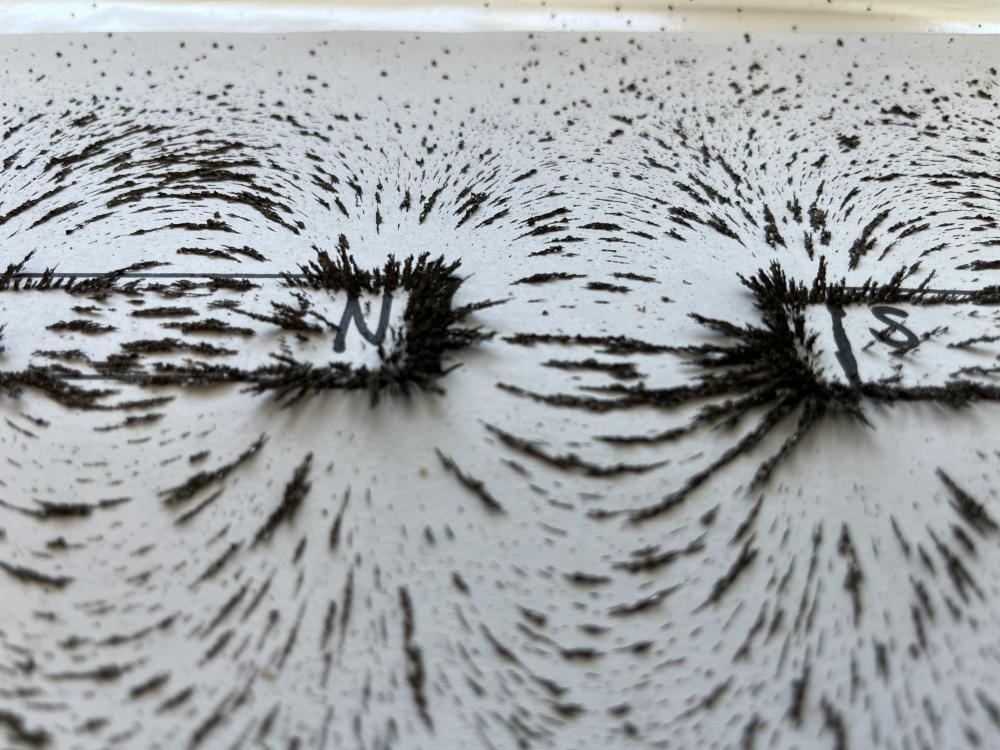
Magnets only attract materials composed of iron, nickel, and cobalt. These materials are described as being “magnetic”. Steel is attracted to magnets as it is mostly made of iron. Most other materials, such as wood, plastic, aluminium, silver, and copper are not attracted to magnets and are called “non-magnetic”.
A magnetic field is the region around a magnet in which the magnet exerts force. Small pieces of iron, called iron filings, are often used in a science classroom to represent the magnetic field around a magnet. When a magnet is brought near iron filings, the magnetic force causes the atoms within the iron to become more aligned, making the filings move towards and stick to the magnet. Water, soil particles, sand, and organic matter in roof runoff do not respond to magnetic force in the same way because their atoms do not have the same magnetic properties as iron. As a result, only the iron filings are attracted to the magnet. This difference in physical properties allows magnetism to be used as an effective method for separating mixtures.
In this investigation, students use the magnetic force to extract the iron filings from the mixture. Encourage students to identify that the magnetic force will be stronger and more effective at removing the iron filings if the magnet is held close.
Magnets only attract materials composed of iron, nickel, and cobalt. These materials are described as being “magnetic”. Steel is attracted to magnets as it is mostly made of iron. Most other materials, such as wood, plastic, aluminium, silver, and copper are not attracted to magnets and are called “non-magnetic”.
A magnetic field is the region around a magnet in which the magnet exerts force. Small pieces of iron, called iron filings, are often used in a science classroom to represent the magnetic field around a magnet. When a magnet is brought near iron filings, the magnetic force causes the atoms within the iron to become more aligned, making the filings move towards and stick to the magnet. Water, soil particles, sand, and organic matter in roof runoff do not respond to magnetic force in the same way because their atoms do not have the same magnetic properties as iron. As a result, only the iron filings are attracted to the magnet. This difference in physical properties allows magnetism to be used as an effective method for separating mixtures.
In this investigation, students use the magnetic force to extract the iron filings from the mixture. Encourage students to identify that the magnetic force will be stronger and more effective at removing the iron filings if the magnet is held close.
The Inquire phase allows students to cycle progressively and with increasing complexity through the key science ideas related to the core concepts. Each Inquire cycle is divided into three teaching and learning routines that allow students to systematically build their knowledge and skills in science and incorporate this into their current understanding of the world.
When designing a teaching sequence, it is important to consider the knowledge and skills that students will need in the final Act phase. Consider what the students already know and identify the steps that need to be taken to reach the level required. How could you facilitate students’ understanding at each step? What investigations could be designed to build the skills at each step?
Read more about using the LIA FrameworkFollowing an investigation, the Integrate routine provides time and space for data to be evaluated and insights to be synthesized. It reveals new insights, consolidates and refines representations, generalises context and broadens students’ perspectives. It allows student thinking to become visible and opens formative feedback opportunities. It may also lead to further questions being asked, allowing the Inquire phase to start again.
When designing a teaching sequence, consider the diagnostic assessment that was undertaken during the Launch phase. Consider if alternative conceptions could be used as a jumping off point to discussions. How could students represent their learning in a way that would support formative feedback opportunities? Could small summative assessment occur at different stages in the teaching sequence?
Read more about using the LIA FrameworkIron roof vs tin roof
(Slide 17) Discuss how the magnetic property of the iron fragments was used to remove them from the rainwater.
- What do you notice about the iron filings in the water?
- Does the water affect whether the filings are magnetic?
- Why are iron filings magnetic but other substances in the water are not?
- If the rainwater also contains sand or dirt, how do they behave with a magnet?
- Why is magnetism a useful property for separating iron filings from water?
- Would this method work for other metals, like aluminium or tin? Why or why not?
- Could magnetism be used to clean real-world polluted water? How?
- How might combining magnetic separation with other methods help clean water more thoroughly?
✎ STUDENT NOTES: Write a sentence describing how the magnetic properties of the iron fragments made them easy to remove from the rainwater. Describe why magnets could not be used to separate fragments from tin or aluminium roofs.
Discuss the consequences of iron filings being left in the water, including for washing clothes, showering, drinking water etc. Discuss how a magnet could be used to separate the iron filings from rainwater to allow the water to have more uses.
Discuss what substances remain in the rainwater sample and how students could use their properties to remove them in the upcoming lessons.
Note: It may be useful to take a photo of the mixture at each separation stage to use for comparison during the Act phase.
Reflect on the lesson
You might ask students to:
- provide evidence and reasoning for the claim: “A magnet can separate iron filings from a rainwater mixture”.
- research a way to separate filings from an aluminium roof found in rainwater.
- describe how tin cans could be separated from aluminium cans at a recycling centre.
- add the words and definitions for “physical properties”, “magnetic” and “separation” to a glossary.