

Tectonic collision course
View Sequence overviewStudents will:
- examine the properties of building materials needed for building in an earthquake zone.
- design an experiment to test the flexibility and yield strength of bamboo, wooden dowel, and metal stakes.
- compare the results of the experiment to make a claim (with evidence and reasoning) of the best material to use for building in an earthquake zone.
Students will represent their understanding as they:
- complete an investigation planner to design an experiment to test the flexibility and yield strength of building material.
- record the results of their experiment in a table.
- compare the investigation of materials to real-world conditions.
- use argumentation to identify the best building material to use in an earthquake zone.
In this lesson, assessment is formative.
Feedback might focus on students’ ability to:
- develop a hypothesis.
- plan and conduct an experiment.
- record data in an appropriate table.
- analyse data to identify trends.
- identify errors and evaluate the precision of the results.
- use scientific language to write a scientific report.
Potential summative assessment
Students working at standard should:
- investigate how scientific responses including new building materials, improved predictions and early warning systems have supported communities living in a country in the Asia-Pacific region located near plate boundaries, for example Japan, Indonesia or New Zealand.
- research how cultural building techniques such as houses built of bamboo led to the development of structures and materials better able to withstand the effects of earthquakes.
- develop investigable questions, reasoned predictions and hypotheses to explore scientific models, identify patterns and test relationships.
- plan and conduct reproducible investigations to answer questions and test hypotheses, including identifying variables and assumptions and, as appropriate, recognising and managing risks.
- select and construct appropriate representations, including tables, graphs, models and mathematical relationships, to organise and process data and information.
- analyse data and information to describe patterns, trends and relationships and identify anomalies.
- analyse methods, conclusions and claims for assumptions, possible sources of error, conflicting evidence and unanswered questions.
- construct evidence-based arguments to support conclusions or evaluate claims.
- write and create texts to communicate ideas, findings and arguments for specific purposes and audiences, including selection of appropriate language and text features, using digital tools as appropriate.
Whole class
Tectonic collision course Resource PowerPoint
Video: Earthquake hits Christchurch, New Zealand (4:03)
Each group
1 x bamboo stake
1 x wooden dowel
1 x metal stake
Bucket
Water or weights to place in the bucket
Scales or Newton meter to measure the mass of the water
Metre ruler (to measure the bend on the testing materials)
Each student
Testing building materials Investigation planner
Individual student notebook
Lesson
The Inquire phase allows students to cycle progressively and with increasing complexity through the key science ideas related to the core concepts. Each Inquire cycle is divided into three teaching and learning routines that allow students to systematically build their knowledge and skills in science and incorporate this into their current understanding of the world.
When designing a teaching sequence, it is important to consider the knowledge and skills that students will need in the final Act phase. Consider what the students already know and identify the steps that need to be taken to reach the level required. How could you facilitate students’ understanding at each step? What investigations could be designed to build the skills at each step?
Read more about using the LIA FrameworkRe-orient
Recall the previous lesson, focusing on the different types of waves that occur during an earthquake.
Discuss how a person might experience the different types of waves during an earthquake.
The Inquire phase allows students to cycle progressively and with increasing complexity through the key science ideas related to the core concepts. Each Inquire cycle is divided into three teaching and learning routines that allow students to systematically build their knowledge and skills in science and incorporate this into their current understanding of the world.
When designing a teaching sequence, it is important to consider the knowledge and skills that students will need in the final Act phase. Consider what the students already know and identify the steps that need to be taken to reach the level required. How could you facilitate students’ understanding at each step? What investigations could be designed to build the skills at each step?
Read more about using the LIA FrameworkIdentifying and constructing questions is the creative driver of the inquiry process. It allows students to explore what they know and how they know it. During the Inquire phase of the LIA Framework, the Question routine allows for past activities to be reviewed and to set the scene for the investigation that students will undertake. The use of effective questioning techniques can influence students’ view and interpretation of upcoming content, open them to exploration and link to their current interests and science capital.
When designing a teaching sequence, it is important to spend some time considering the mindset of students at the start of each Inquire phase. What do you want students to be thinking about, what do they already know and what is the best way for them to approach the task? What might tap into their curiosity?
Read more about using the LIA FrameworkEarthquake buildings
Discuss the challenges of building in an earthquake zone where the Earth can move in different ways.
Show the video Earthquake hits Christchurch, New Zealand (4:03).
(Slide 59) Pose the question: What materials were used in the buildings that collapsed?
The Inquire phase allows students to cycle progressively and with increasing complexity through the key science ideas related to the core concepts. Each Inquire cycle is divided into three teaching and learning routines that allow students to systematically build their knowledge and skills in science and incorporate this into their current understanding of the world.
When designing a teaching sequence, it is important to consider the knowledge and skills that students will need in the final Act phase. Consider what the students already know and identify the steps that need to be taken to reach the level required. How could you facilitate students’ understanding at each step? What investigations could be designed to build the skills at each step?
Read more about using the LIA FrameworkThe Investigate routine provides students with an opportunity to explore the key ideas of science, to plan and conduct an investigation, and to gather and record data. The investigations are designed to systematically develop content knowledge and skills through increasingly complex processes of structured inquiry, guided inquiry and open inquiry approaches. Students are encouraged to process data to identify trends and patterns and link them to the real-world context of the teaching sequence.
When designing a teaching sequence, consider the diagnostic assessment (Launch phase) that identified the alternative conceptions that students held. Are there activities that challenge these ideas and provide openings for discussion? What content knowledge and skills do students need to be able to complete the final (Act phase) task? How could you systematically build these through the investigation routines? Are there opportunities to build students’ understanding and skills in the science inquiry processes through the successive investigations?
Read more about using the LIA FrameworkFlexibility and strength
Discuss how concrete is not very flexible and is likely to crack during an earthquake. This makes it dangerous to be inside a concrete building that might collapse or just outside a building that has lumps of concrete falling off. It is also likely to sink in liquefaction zones.
Discuss what other materials could be used, including steel, wood, and bamboo.
(Slide 60) Explain that the properties of materials can be measured, including:
- rigidity—the ability of a material to resist movement.
- flexibility—the ability of a material to bend without breaking.
- strength. There are three ways to measure strength:
- tensile strength—the ability to resist being stretched.
- compressive strength—the ability to withstand being compressed.
- yield strength—the level where a material is permanently deformed.
✎ STUDENT NOTES: Record the properties of materials, including rigidity, flexibility, and the three types of strength.
Discuss how flexibility and strength are two properties that would be useful materials in earthquake zones.
(Slide 61) Introduce this lesson’s investigation that will test the flexibility and yield strength of wood, bamboo, and metal stakes. Demonstrate how the material can be placed through a bucket handle and placed between two tables.
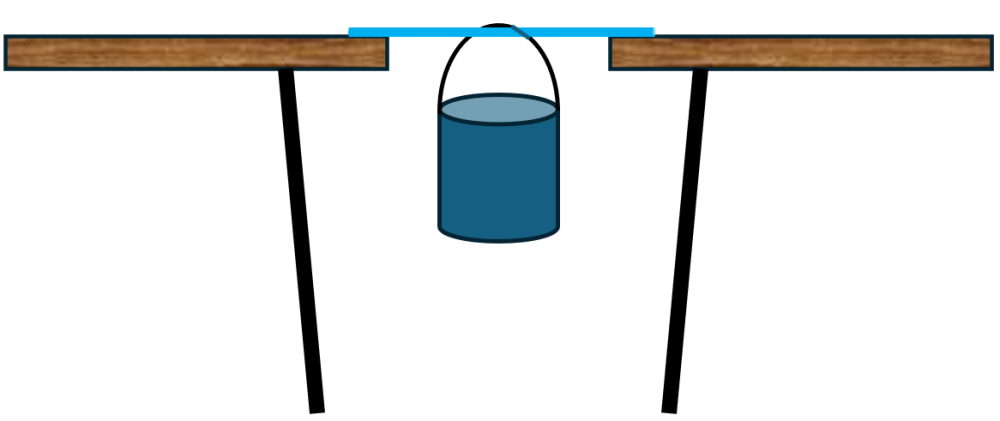
Place the metre ruler vertically, directly behind the bucket, so the students can measure the amount the material flexes when water or weights are placed in the bucket.
✎ STUDENT NOTES: Complete the Testing building materials Investigation planner to plan a reproducible investigation testing the strength and flexibility of the materials.
Allow students time to conduct the investigation.
Properties of materials
Selecting the right building material requires identifying and describing the properties of the material.
Selecting the right building material requires identifying and describing the properties of the material.
Rigidity
Rigidity is a material’s ability to resist movement or bending. A rigid material keeps its shape when a force is applied. Examples of rigid materials include steel, glass, and concrete.
Flexibility
Flexibility is a material’s ability to bend without breaking. Flexible materials can change shape and then return to their original form.
It is important to clarify to students that flexible does not mean weak (many flexible materials can still be very strong). Examples include rubber, fabric, and some plastics.
Strength
Strength describes how well a material can resist forces without breaking or permanently changing shape. Strength is not just one property; it can be measured in three different ways, depending on how the force is applied.
Tensile strength is a material’s ability to resist being stretched or pulled apart. Materials with high tensile strength can withstand strong pulling forces. Examples include steel cables, ropes, and spider silk.
Compressive strength is a material’s ability to withstand being squashed or compressed. Materials with high compressive strength do not collapse easily under load. Examples include concrete, bricks, and stone.
Yield strength is the point at which a material is permanently deformed. Before this point, a material may bend or stretch but return to its original shape. After this point, the material does not return to its original shape. An example is bending a paperclip: once it stays bent, it has passed its yield strength.
Combining different materials can sometimes combine their properties. An example of this is bamboo composite materials that combine bamboo fibres with plastic, ceramic or metals.
References
Hasan, K. F., Al Hasan, K. N., Ahmed, T., György, S. T., Pervez, M. N., Bejó, L., ... & Alpár, T. (2023). Sustainable bamboo fiber reinforced polymeric composites for structural applications: A mini review of recent advances and future prospects. Case Studies in Chemical and Environmental Engineering, 8, 100362.
Selecting the right building material requires identifying and describing the properties of the material.
Rigidity
Rigidity is a material’s ability to resist movement or bending. A rigid material keeps its shape when a force is applied. Examples of rigid materials include steel, glass, and concrete.
Flexibility
Flexibility is a material’s ability to bend without breaking. Flexible materials can change shape and then return to their original form.
It is important to clarify to students that flexible does not mean weak (many flexible materials can still be very strong). Examples include rubber, fabric, and some plastics.
Strength
Strength describes how well a material can resist forces without breaking or permanently changing shape. Strength is not just one property; it can be measured in three different ways, depending on how the force is applied.
Tensile strength is a material’s ability to resist being stretched or pulled apart. Materials with high tensile strength can withstand strong pulling forces. Examples include steel cables, ropes, and spider silk.
Compressive strength is a material’s ability to withstand being squashed or compressed. Materials with high compressive strength do not collapse easily under load. Examples include concrete, bricks, and stone.
Yield strength is the point at which a material is permanently deformed. Before this point, a material may bend or stretch but return to its original shape. After this point, the material does not return to its original shape. An example is bending a paperclip: once it stays bent, it has passed its yield strength.
Combining different materials can sometimes combine their properties. An example of this is bamboo composite materials that combine bamboo fibres with plastic, ceramic or metals.
References
Hasan, K. F., Al Hasan, K. N., Ahmed, T., György, S. T., Pervez, M. N., Bejó, L., ... & Alpár, T. (2023). Sustainable bamboo fiber reinforced polymeric composites for structural applications: A mini review of recent advances and future prospects. Case Studies in Chemical and Environmental Engineering, 8, 100362.
The Inquire phase allows students to cycle progressively and with increasing complexity through the key science ideas related to the core concepts. Each Inquire cycle is divided into three teaching and learning routines that allow students to systematically build their knowledge and skills in science and incorporate this into their current understanding of the world.
When designing a teaching sequence, it is important to consider the knowledge and skills that students will need in the final Act phase. Consider what the students already know and identify the steps that need to be taken to reach the level required. How could you facilitate students’ understanding at each step? What investigations could be designed to build the skills at each step?
Read more about using the LIA FrameworkFollowing an investigation, the Integrate routine provides time and space for data to be evaluated and insights to be synthesized. It reveals new insights, consolidates and refines representations, generalises context and broadens students’ perspectives. It allows student thinking to become visible and opens formative feedback opportunities. It may also lead to further questions being asked, allowing the Inquire phase to start again.
When designing a teaching sequence, consider the diagnostic assessment that was undertaken during the Launch phase. Consider if alternative conceptions could be used as a jumping off point to discussions. How could students represent their learning in a way that would support formative feedback opportunities? Could small summative assessment occur at different stages in the teaching sequence?
Read more about using the LIA FrameworkAnalysing materials
Compare the results from each student team, identifying similar trends in the material with the most flexible and the largest yield strength.
(Slide 62) Identify any discrepancies and errors that could cause differences in the results. Discuss how these errors could be minimised with more precise equipment or by repeating the experiment many times.
- Explain why it was important to test the wood, bamboo, and metal using the same setup.
- Describe how the results for flexibility would change if the material bending was measured from different angles.
- Describe how you knew the material had reached its yield point.
- Describe what might happen to the results if too much weight were added too quickly.
- Compare this testing model to what happens to materials during an earthquake.
- Describe how this experiment could be improved to better represent real-world conditions.
- Explain how engineers balance strength, flexibility, and safety when designing structures.
✎ STUDENT NOTES: Describe how the method could be improved if it were repeated.
(Slide 63) Use argumentation to identify the best material to use in earthquake zones.
(Slide 64) Discuss how it might be difficult to build with the circular structure of the bamboo rods, and how the properties of materials can be changed when combined with others.
- Why might it be harder to build structures using round bamboo rods instead of flat pieces?
- How could the shape of bamboo make walls or straight edges harder to build?
- What building techniques or tools could help make bamboo structures stronger?
- How can combining bamboo with another material (such as string, glue, or wire) make it stronger or more stable?
- Can combining materials change how flexible or stiff a structure is? Why?
- Why might one material be good for strength, while another is better for holding things together?
- Can you think of an example where combining materials makes something better than using just one?
Discuss the limitations of the materials, such as metal buildings sinking in liquefaction zones.
✎ STUDENT NOTES: Revisit previous claims and justify your decision following the discussion on the challenges of building with bamboo.
Reflect on the lesson
You might invite students to:
- add the following words to the glossary: rigidity, flexibility, tensile strength, compressive strength, and yield strength.
- watch the TED-Ed video Why do buildings fall in earthquakes? (4:51).
- research how large buildings in the earthquake zone of San Francisco resist the movement of earthquakes.
- research how cultural building techniques such as houses built of bamboo led to the development of structures and materials better able to withstand the effects of earthquakes.